Security architecture for CLaaS
34 notes filed under Security.
From the folder's own Security/index.md, shown in full.
This subject holds the proposed security architecture for the first CLaaS offering. It is a draft for review by the platform, IAM, security-policy and operations roles. It is not approved architecture, a compliance certificate or evidence that any control works in the development estate. Nothing here was inspected, probed or tested on a live system.
Reading order
- Tenant isolation and provider-control protection is the arc42 HLD. It covers trust boundaries, the tailored tenant-admin role, protection of provider controllers, direct and controller-mediated bypass paths, privileged and emergency access, the testable allow/deny matrix, the owner allocations and the design decisions that are still open.
- SAK applicability and control allocation routes all 15 Security Architectuur Kader (SAK) document sets in the reference collection. It allocates the controls that matter most to CLaaS to owners and design elements, and lists the policy-owner questions. It records support by design or a gap. It does not claim conformity.
- SAK reference collection holds the 15 SAK documents themselves: a Dutch rendering and an English distillation of each issued PDF.
What this subject keeps from the CLaaS service boundary
These positions come from the first-release service boundary and are kept here exactly as stated. The security notes make them precise and testable. They do not reopen them.
- Tenants get a tailored tenant-admin role, not unrestricted Kubernetes
cluster-admin. Security and admission controls stay with the provider. - The controllers that the provider manages inside tenant clusters (ExternalDNS, cert-manager, external-secrets, MetalLB, logging/monitoring collection, the GitOps Operator) are protected. Tenants must not change them directly or through another controller.
- Hosted-cluster APIs and consoles use private management connectivity only. Internet-facing workloads go through the existing external NetScaler publication process.
- MFA is required for platform engineers. Opt-in MFA for tenants is the proposer's intent. It is recorded as a policy-review question and is not assumed to comply with the IAM SAK.
- Phase 1 is one location (AM4) with local redundancy. No disaster-recovery claim is made for the loss of that location.
- Provisioning starts only from a reviewed merge to a protected branch in the external GitLab repository, which then activates AAP.
- DNS-PERSIST-01 is the intended public validation method. Its support is unresolved (see the persistent DNS validation research).
- Workload backups use OADP/Velero towards the organizational Cohesity service. That destination is selected, but the integration is not proven.
The security notes do not change hardware, roadmap or delivery records. Where a security finding affects an estimate or schedule, it is named as a question for the owning note.
Evidence handling
The SAK documents are classified RWS BEDRIJFSVERTROUWELIJK. Since
23 November 2026 the SAK reference collection holds them in
this vault: the issued PDFs as unpublished working sources, and the Dutch
renderings and English distillations as published notes. The Archy owner
decided to publish them on this site, which can be read without signing in.
The notes in this subject cite the SAKs by PDF filename, original section
number and PDF page number. Their links to the PDFs are pinned to commit
d224d15b83a46834560c3a3c7ecd3052ebc2b4f9 of the private rws-arch-wb
repository, from which the collection was imported unchanged. Rows such as
L-IAM-03 or T-12 are local identifiers created for this subject. They are
not official SAK control numbers.
Technical feasibility claims cite primary Kubernetes, OpenShift, Argo CD, cert-manager and External Secrets documentation. Each is labelled with the release it applies to and the date it was observed (21 October 2026). The release baseline is the latest generally available documentation found on that date. It is not a qualified, compatible or deployed release combination.
Tenant security boundary at a glance
 View full-size image (opens in a new tab)
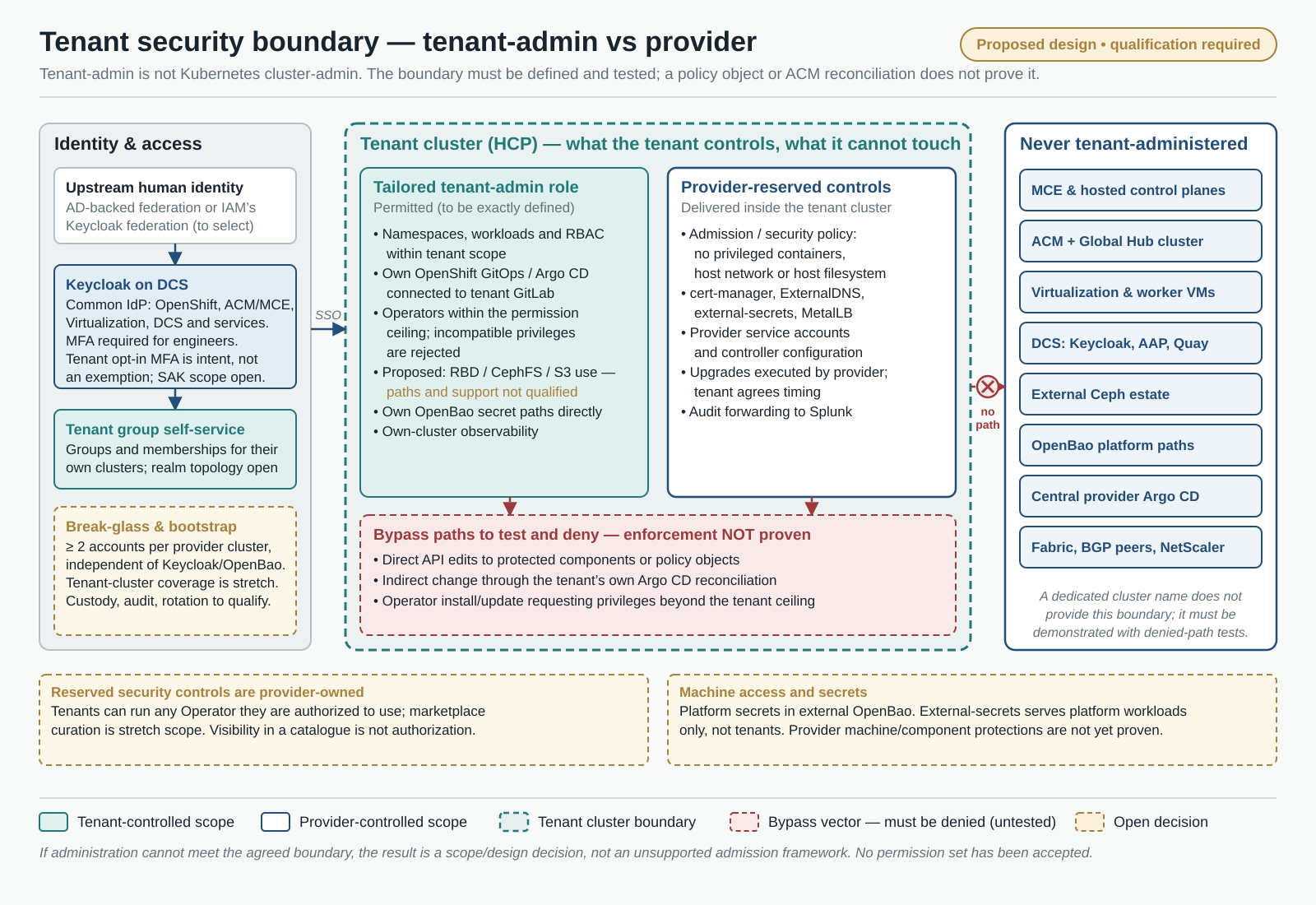
The figure is a proposed design overview. It shows the intent, not a qualified or tested boundary. Read it like this:
- Left: identity and access. Upstream organizational identity is federated through Keycloak on DCS. Engineers must use MFA; tenant MFA is shown as the proposer's opt-in intent, which is still a policy question here. Tenants manage their own groups. Break-glass access does not depend on Keycloak or OpenBao.
- Centre: one tenant cluster. The tailored tenant-admin role and the provider-reserved controls sit side by side in the same hosted cluster. That is why the boundary between them (TB5 in the HLD) is the main subject of tenant isolation. The red box lists the bypass paths: direct API edits, the tenant's own Argo CD and Operator installs. Each must be denied, and none has been tested yet.
- Right: never tenant-administered. MCE and the hosted control planes, ACM, the Virtualization cluster, DCS, external Ceph, OpenBao platform paths, provider Argo CD and the network edge. The "no path" mark is a requirement to prove with denied-path tests, not a result.
- Bottom: open decisions. The left box records the service intent that tenants may run any Operator they are authorized for. The HLD finds that a supported way to hold tenant Operators to the tenant ceiling is not yet established, so the supported Operator ceiling stays open (U4 and U13). The right box keeps external-secrets for platform workloads only and notes that the provider's machine and component protections are not yet proven.
The figure is an overview. It does not number every trust boundary and it is not an exact map of TB1–TB8. For the numbered boundaries, use the HLD trust-boundary table. For the identity, secret and PKI trust domains, use the identity and trust design, which shares this figure.
Notes
In reading order: capabilities (ABB), then solutions (SBB), then designs (HLD), then supporting notes.
Tenant isolation and provider-control protection
HLDDraftReview not recordedThis HLD proposes how CLaaS can give each tenant a usable administrative role in its own hosted cluster while the provider keeps control of security, admission, audit and the platform controllers.…
SAK applicability and control allocation for CLaaS
DraftReview not recordedThis register shows which Security Architectuur Kaders (SAKs) apply to the first CLaaS offering. It also records where the tenant isolation HLD and the neighbouring designs place the obligations, a…
Subjects within Security
- SAK31 notes