Identity and trust design for CLaaS
1. Introduction and Goals
This HLD proposes how human, administrative and machine identities, retained secrets and service certificates are established, delivered, validated, rotated, revoked and recovered across the CLaaS offering. It joins four selected solution directions into one trust architecture: Keycloak as the common authentication/federation service, OpenBao as the secret and internal-PKI service, external-secrets as the platform workload secret-delivery pattern, and cert-manager as per-cluster certificate automation. It realizes the Federated Authentication, Secrets Management and Certificate Lifecycle capability contracts.
This is a proposal for review, not approved architecture, a selected release combination or evidence of a deployed or tested integration. It introduces no accounts, credentials, key material, issuers or realms, and performs no infrastructure query or mutation. Named roles are allocations of responsibility to be assigned, not records of appointed owners. Where a required decision has not been made by the proposer, this design keeps the choice open and states the evidence needed to close it rather than inventing a policy, interval or authority.
Scope. The identity trust and credential lifecycle, the federation and certificate integration boundaries, and the isolation obligations that must be enforced between tenants, between tenant and provider, and between the identity/secret/PKI services and the platforms they help build and restore. The design links the tenant isolation assessment and SAK assurance, which are separate security notes; it does not perform a broad SAK applicability assessment here.
Out of scope. Application-level authorization inside relying services (an authenticated identity is not an entitlement); the full CLaaS network, storage, automation, registry and recovery designs, owned by their sibling notes; the institutional selection of the organizational identity source; and any numeric service objective, retention value or policy interval, which belong to their policy owners.
Quality goals
| # | Goal | Why it matters here |
|---|---|---|
| G1 | Authentication is separable from authorization at every relying service | A valid login or signed token must never, by itself, grant cluster, tenant or secret-path access |
| G2 | Every machine consumer has a named identity, bounded scope and revocation path | No shared or ambient credential stands in for a scoped service identity |
| G3 | Trust is tiered so the identity, secret and PKI services can be bootstrapped and recovered without depending on each other in a cycle | Avoids an identity↔secrets↔DCS deadlock during cold start or outage |
| G4 | Tenant delegated administration cannot change another tenant or any provider-reserved resource | Multi-tenant isolation must be enforced, not labelled |
| G5 | Issuance, renewal, rotation and revocation are observable and testable with explicit allow/deny acceptance | A controller's success is not proof a consumer trusts or serves the new material |
2. Constraints
The constraints that actually govern this design, with their sources. Product evidence is a documentation baseline for reasoning; it is not a selected release, a support statement or a tested result. The release baseline and its limits are those recorded in the CLaaS technical-feasibility register; the versions below were re-confirmed on the dates in §Evidence.
| # | Constraint | Source |
|---|---|---|
| C1 | Keycloak server and realm administrators are not limited by fine-grained admin permissions; delegated administration applies only through the admin console/API | Keycloak 26.8.1 Server Admin guide, "Understanding the different types of realm administrators" and "Delegating realm administration using permissions" (P1) |
| C2 | Delegated admin and fine-grained-permission features are an area of active security correction (privilege escalation via group/role mapping, reset-password bypass, cross-realm cache read/write) | Keycloak 26.8.1 release notes, security fixes incl. CVE-2026-94000/94001/94215 (P2) |
| C3 | OpenShift direct external OIDC permits only one OIDC provider, removes the OAuth user/group/oauthclient APIs, and requires a pre-existing long-lived cluster-admin login (certificate or long-lived service-account kubeconfig) for emergency access; several claim/validation fields are Technology Preview | OCP 4.22 "Enabling direct authentication with an external OIDC identity provider", §8.1–8.2 (P3) |
| C4 | A hosted cluster's identity providers are configured in the HostedCluster custom resource on the management (MCE) cluster, not inside the tenant cluster; adding any IdP removes the default kubeadmin user |
OCP 4.22 HCP "Authentication and authorization for hosted control planes", §10.1 (P4) |
| C5 | Kubernetes RBAC is purely additive with no deny rules; a boundary is built only by not granting rights, and holding escalate/bind or controller privileges can widen access |
Kubernetes RBAC reference, reused from feasibility claim 4 (P5) |
| C6 | OpenBao policies are deny-by-default; root tokens can do anything and are deliberately hard to mint. With a Shamir seal, a threshold of unseal-key shares unseals OpenBao and authorizes quorum operations such as root-token generation. With auto-unseal (HSM/KMS), initialization returns recovery keys instead: they authorize quorum operations (e.g. generate-root, unseal-key rotation) but cannot decrypt the root key and cannot unseal if the seal mechanism is unavailable; permanent loss of the seal mechanism or its keys makes the cluster unrecoverable even from backups |
OpenBao 2.7.x policies, tokens and Seal/Unseal concepts, "Auto unseal" and "Recovery key" (P6) |
| C7 | OpenBao PKI roles should constrain issuance (allow_any_name=false, allow_wildcard_certificates=false, enforce_hostnames=true, one role per purpose); a CA hierarchy with a protected root issuing scoped intermediates is recommended |
OpenBao 2.7.x PKI "considerations" (P7) |
| C8 | cert-manager's Vault issuer is documented against HashiCorp Vault, not OpenBao; reuse with OpenBao is a candidate compatible-API integration that requires validation of the exact OpenBao and cert-manager/Operator releases. In that guide, a service-account token requested per Issuer/ClusterIssuer carries a generated audience (vault://<namespace>/<issuer-name> for an Issuer, vault://<cluster-issuer-name> for a ClusterIssuer) that the auth role binds (Kubernetes auth audience, JWT auth bound_audiences) to restrict the role to one issuer; extra audiences can be added via serviceAccountRef.audiences. The audience binding authorizes the login identity only; issuance permission comes from the attached OpenBao policy and PKI role |
cert-manager Vault configuration guide, "C. Authenticating with Kubernetes Service Accounts" (P8) |
| C9 | The OpenShift cert-manager Operator's documented supported ACME challenge types are only HTTP-01 and DNS-01; no DNS-PERSIST-01 support was found in upstream cert-manager; current production availability of DNS-PERSIST-01 at the CA is not verified (which is not proof that it is unavailable) | feasibility claim 6; cert-manager Operator 4.22 docs (P9) |
| C10 | external-secrets confines SecretStore/ExternalSecret to their namespace; ClusterSecretStore/ClusterExternalSecret reach Secrets across all namespaces and should be restricted by match conditions or disabled when not required |
external-secrets security best practices (P10) |
| C11 | ID Token issuer/audience validation (OIDC Core §3.1.3.7) and audience-restricted access tokens (RFC 9700 §4.10.2) are required at the relying service; a signed token alone does not prove the intended recipient and operation are protected | reused from the ABB P1/P2 |
| C12 | Public-cert validation uses DNS-PERSIST-01 as confirmed proposer intent, with no silent DNS-01 fallback; any interim method is an explicit decision after qualification |
CLaaS index decision row; DNS research |
Additional governing inputs: MFA is required for platform engineers and intended opt-in for tenants; tenant MFA opt-in is proposer intent, not a policy exemption or a claim of compliance by default — the SAK assurance owner evaluates applicable requirements. Service-native identities are used where a consumer does not support Keycloak, rather than forcing every token through Keycloak. The Red Hat build of Keycloak (RHBK) edition, its release and feature parity with upstream 26.8.1 are unverified (an edition gap).
3. Context and Scope
3.1 Trust domains
The design separates five trust domains. A boundary between them must be an enforced control, not a naming or console-filtering convention.
| Domain | Contains | Boundary obligation |
|---|---|---|
| Organizational identity | An existing AD-backed organizational federation service or the IAM team's Keycloak-based federation — selection open | Platform Keycloak is a relying/broker party toward this upstream; it is not authoritative for organizational account creation and does not replace AD |
| Provider platform | MCE/Global Hub, Virtualization, DCS, provider controllers (ExternalDNS, cert-manager, external-secrets), AAP, provider GitOps | Provider-reserved; no tenant identity may read or change provider configuration, issuers, stores or controllers |
| Secret/PKI service | External OpenBao (secret engines + internal PKI), later DCS-hosted | Must remain usable without the clusters it helps build or restore; its own bootstrap/unseal/recovery must not depend on Keycloak or DCS |
| Tenant | A tenant's hosted cluster, its Argo CD, its Operators, its DNS subzone, its OpenBao scope | A tenant administers only its own groups, workloads and subzone; cross-tenant and provider access must be refused |
| Recovery/root (T0) | Offline custody of break-glass credentials and OpenBao key shares (Shamir unseal shares or auto-unseal recovery shares, depending on the seal type); the external PKI root authority. With auto-unseal, access to the external seal provider and its key material is a separate recovery dependency that T0 shares cannot replace (C6) | Independent of the running identity, secret and DCS services so a cold start or total-IdP loss is recoverable |
The canonical tenant/provider security boundary figure is shared with the
security assessment:
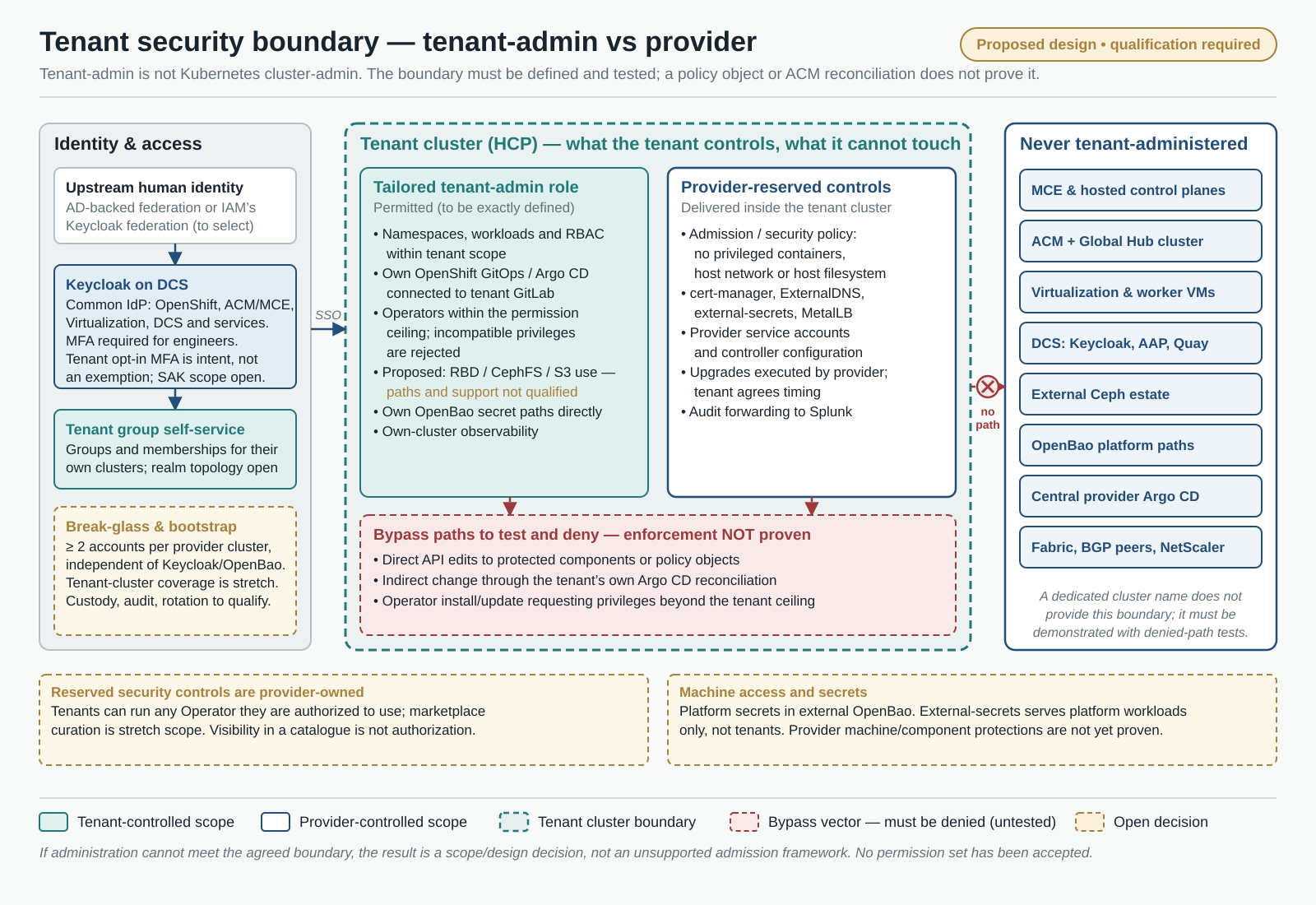 The figure is illustrative context for the domains above. The proposed controls
are specified, not yet proven, in this note's interface contracts and in the
tenant isolation assessment.
Sibling designs own the adjacent subjects and are referenced rather than duplicated: CLaaS platform design, tenant lifecycle (onboarding and deprovisioning sequence that invokes the identity flows below), CLaaS network design (private management access and DNS paths) and storage recovery.
3.2 External interfaces (system boundary)
| Neighbour | Interaction | This design's boundary |
|---|---|---|
| Organizational IdP | Keycloak federates/brokers organizational human identities (protocol and service selection open) | Consume an identified issuer; do not assume account-lifecycle authority |
| OpenShift/HCP clusters | Keycloak is the OIDC identity provider (issuer); each provider cluster, and each tenant cluster through its HostedCluster CR, is an OIDC relying party represented by a client registered in Keycloak |
Authentication only; cluster RBAC is enforced locally (G1, C5) |
| OpenBao (external) | Keycloak admin (where integrated), external-secrets, cert-manager PKI, AAP/GitOps and tenants authenticate to scoped auth mounts | Scoped identities and policies per consumer; no shared credential (G2, C6) |
| Infoblox DNS | cert-manager DNS validation and ExternalDNS record management within scoped (sub)zones | Scope domain-validation and record authority; see DNS/DDI and ExternalDNS |
| Public ACME CA (Let's Encrypt) | cert-manager requests public certificates via the confirmed DNS-PERSIST-01 method | Unqualified dependency: CA production availability not verified and no supported client method found (C9/C12); an internal release gate stays closed until that evidence exists. Account-key custody is a design obligation regardless |
| SIEM / audit (external Splunk handoff) | Authentication, administration and issuance events are forwarded without secret values | Coverage and retention owned by observability and policy owners |
4. Solution Strategy
- Separate authentication from authorization everywhere (G1, C11). Keycloak (or a native issuer) establishes who; each relying service — OpenShift, Argo CD, OpenBao, Quay, object storage — enforces what locally. Acceptance must include refusal of a valid token at a service where the identity has no entitlement, not only a successful login.
- Keycloak when possible, service-native identities when needed (G2). Interactive OIDC is not forced onto Kubernetes service accounts, Ceph client identities, TLS client authentication or bootstrap/recovery paths. Each consumer is qualified for a supported integration, audience/claim scope, permissions and a revocation contract.
- Tier trust to break the cycle (G3). A recovery/root tier (T0) and an external secret/PKI service that does not depend on the clusters it serves let DCS, Keycloak and the platforms be bootstrapped and recovered without an identity↔secrets↔DCS deadlock. OpenBao retains a non-Keycloak administrative and recovery path even after operational Keycloak integration.
- Provider-only controllers; tenant consumes directly (G4, C10). external-secrets, cert-manager and ExternalDNS run under provider control with provider-scoped backend identities tenants cannot read or use. Tenants consume external OpenBao directly under their own scoped identities and paths.
- Scope issuance narrowly and decide fallbacks explicitly (G4, G5, C7, C12). PKI roles and ACME accounts are constrained per purpose and domain scope; no wildcard/any-name issuance by default; no silent DNS-01 fallback. A gate decision is required before public-certificate lifecycle is offered.
- Make every lifecycle transition observable and testable (G5). Each flow below has an allow case and a measurable deny case; controller success is distinguished from the consumer actually trusting/serving the new material.
5. Building Block View
This HLD describes the four SBBs. Their internal product configuration remains
with the SBBs; this view allocates responsibilities and the trust tier each block
sits in.
| Block | Trust tier | Responsibility in this design |
|---|---|---|
| Keycloak | Provider platform (DCS) | Common authentication/federation; realm(s), delegated tenant group admin, MFA enforcement for engineers; OIDC identity provider (issuer) with a registered client per provider and tenant cluster relying party |
| OpenBao | Secret/PKI service (external first) | Secret engines, scoped auth mounts/policies, internal PKI mounts/roles/intermediates; independent bootstrap/unseal/recovery |
| external-secrets | Provider platform | Reusable platform-only secret delivery from OpenBao into provider-managed workloads; no tenant-application bridge |
| cert-manager | Provider platform (per cluster) | Internal-PKI and public-ACME certificate automation under provider-controlled issuers |
| Recovery/root custody (T0) | Recovery/root | Offline custody of break-glass cluster logins and OpenBao Shamir unseal or auto-unseal recovery shares (per selected seal type); relationship to the external PKI root. Does not by itself cover an external auto-unseal seal provider (C6) |
5.1 Consumer, privilege and credential inventory
Each consumer of identity, secrets or certificates, its proposed credential type, scope and revocation path. Privileges are proposed; the effective permission set and its non-bypassable enforcement remain to prove (C1, C5).
| Consumer | Credential / identity | Proposed scope | Revocation / expiry path |
|---|---|---|---|
| Platform engineer (human) | Keycloak federated login + mandatory MFA | Provider-cluster and DCS-team roles; no tenant data | Upstream account removal; Keycloak session/refresh-session revocation; group change. Already-issued access tokens stay valid at offline-validating consumers until expiry unless that consumer is shown to honour revocation (§8) |
| Tenant administrator (human) | Keycloak federated login; tenant MFA opt-in | Own tenant cluster roles; own Keycloak group subtree only | Group removal; session revocation; upstream removal; same residual access-token window (§8) |
| OpenShift/MCE/Virtualization/DCS cluster (OIDC relying party) | A confidential client registered in Keycloak (the IdP) for that cluster; client secret held in OpenBao | Audience = that cluster; claims→role mapping | Client disable; client-secret rotation; bounded token lifetime. Not-before push reaches a client only if it has an Admin URL and supports the push; OCP support is not established (§8) |
| Hosted tenant cluster (OIDC relying party) | A client registered in Keycloak per tenant cluster, referenced from the HostedCluster CR |
Audience = that tenant cluster only | Provider edits/removes the client; secret rotation; bounded token lifetime (§8) |
| external-secrets controller | OpenBao auth (Kubernetes/JWT or AppRole) bound to a provider SA; login returns an OpenBao token | Provider secret paths only; namespaced stores | Revoke issued OpenBao tokens/leases (service tokens by accessor); disable/remove the auth role or its login credentials to prevent new logins; separately remove ACL grants and rotate SA tokens (§8) |
| cert-manager (internal PKI) | OpenBao auth role per Issuer/ClusterIssuer, bound to the issuer-generated audience (C8); login returns an OpenBao token | One PKI role per issuer purpose; constrained names | Revoke issued OpenBao token(s); auth-role disable; issuer removal; cert revoke/CRL |
| cert-manager (public ACME) | ACME account key(s) | Domains permitted by issuer policy, DNS authority and standing-record scope (the account key itself is not domain-constrained) | Account deactivation; standing/validation record removal; cert revoke |
| ExternalDNS | Infoblox credential per cluster/subzone | That cluster's records in its subzone | Credential rotation; zone-permission change |
| Tenant workload → OpenBao (direct) | Tenant-scoped OpenBao auth mount/role (per tenant); login returns an OpenBao token | Tenant secret paths only; no provider mounts | Revoke issued OpenBao tokens/leases; tenant role/policy change; token TTL |
| AAP / provider GitOps | Machine identity + OpenBao credentials + cluster kubeconfig | Provisioning scope; protected branches/targets | Credential rotation; identity disable |
| MCE → Virtualization worker-hosting | Infrastructure kubeconfig (--infra-kubeconfig-file) |
A namespace per hosted cluster (to qualify) | Credential rotation; namespace-scoped RBAC |
| Storage client (RBD/CephFS/RGW) | Native Ceph client key or KubeVirt CSI (undecided) | Tenant pool/namespace | Cephx key rotation; CSI class change — see storage note |
| Break-glass (per provider/platform cluster) | ≥2 certificate-based or long-lived SA kubeconfigs | Full cluster admin, emergency use | Scheduled rotation + post-use review; offline custody |
6. Runtime View
Significant interactions and failure scenarios, in prose and compact tables to avoid unsupported rendering. Each flow names an allow case and a measurable deny case for acceptance (§10).
6.1 Human authentication to a provider cluster
Keycloak brokers the organizational identity, enforces engineer MFA, and issues tokens to the cluster acting as an OIDC relying party. OCP direct external OIDC permits one provider and disables the built-in OAuth user/group APIs (C3); whether to use direct external OIDC or the internal OAuth server with an OIDC identity provider is an open decision (IC-2). Group claims map to cluster roles; missing or ambiguous claims must not become administrative access.
- Allow: a federated engineer with the required group and MFA receives only the intended cluster role.
- Deny: the same token presented to a different cluster (wrong audience) is refused (C11); the test also confirms the token does not carry the other cluster's audience (a multi-audience token would defeat the check); a user without MFA is refused the engineer role.
6.2 Human authentication to a hosted tenant cluster
A tenant cluster's identity provider is set in its HostedCluster CR on the MCE
management cluster (C4), under provider control — the tenant cannot edit it.
Each tenant cluster is a distinct relying party, represented by its own client
registered in Keycloak with its own audience and redirect URI. Adding an IdP removes kubeadmin; before that change, qualify the provider-held
hosted-cluster admin kubeconfig described in the
tenant-isolation design §6.5 as the emergency
access path. Additional tenant-cluster break-glass accounts remain stretch scope;
IC-14 covers the provider/platform-cluster account requirement.
- Allow: tenant user with the tenant's group obtains only that tenant cluster's mapped role.
- Deny: a tenant user's token is refused at another tenant's cluster and at any provider cluster.
6.3 Delegated tenant group administration
Tenant self-service is scoped to groups and group memberships for the tenant's
own clusters (IC-4). Keycloak delegated administration must be used with care:
server/realm admins bypass it entirely (C1), and the feature has had privilege-
escalation fixes (C2). A tenant delegated admin must not create users, map roles
that grant provider or cross-tenant privilege, impersonate, or manage another
tenant's groups. Note that certain group scopes (manage-members with
manage-membership and view) can allow creating users as group members —
this must be denied for tenant delegates. LDAP/federated members may be invisible
under fine-grained permissions unless import or view-users is granted, which
has its own exposure trade-off.
- Allow: tenant delegate adds/removes a member within its own group subtree.
- Deny: tenant delegate reads or changes another realm/tenant group, assigns an admin or provider role, impersonates, or creates a user outside policy.
6.4 Workload authentication to OpenBao
A provider workload (e.g. external-secrets) authenticates to a scoped OpenBao
auth mount bound to its service account; policies are deny-by-default (C6).
Two credentials are involved and must not be conflated: the input JWT (the
Kubernetes service-account token presented at login) and the resulting
OpenBao token returned by the login (auth.client_token, P6). Per-cluster
mounts with path-scoped policies and short OpenBao token TTLs are proposed
(IC-5). Tenants authenticate to separate tenant-scoped mounts (IC-12) and
never inherit the provider controller's identity.
- Allow: provider SA reads only its provider paths; tenant SA reads only its tenant paths.
- Deny: tenant SA (or a tenant-crafted secret reference) cannot read a provider or another tenant's path; an expired OpenBao token is refused; a revoked OpenBao service token is refused immediately after revocation.
6.5 Certificate issuance, renewal and activation
cert-manager's Vault issuer is a candidate integration with OpenBao PKI that assumes API compatibility with Vault, pending validation of the exact releases (C8). Each Issuer/ClusterIssuer uses its own OpenBao auth role bound to that issuer's generated audience; the audience restricts which issuer can log in, while the attached policy and the constrained PKI role (C7) determine what it may issue. Renewal produces a new certificate; the endpoint owner must activate it (some services need a restart, per the Certificate Lifecycle ABB P4), and representative clients must observe the served identity and trust the chain after renewal.
- Allow: a certificate for an authorized name is issued, renewed and actually served and trusted by a representative client.
- Deny: a request for a name outside the role's
allowed_domains/wildcard policy is refused; a request from a different issuer/account is refused.
6.6 Public-certificate validation (gated)
DNS-PERSIST-01 is confirmed intent but an unqualified dependency: current production availability at the CA is not verified, the Operator's documented supported challenges are only HTTP-01 and DNS-01, and no upstream cert-manager support was found (C9/C12). That is missing evidence, not proven CA unavailability. This design therefore keeps an explicit internal go/no-go release gate closed until the CA availability and a supported client method are qualified; there is no silent DNS-01 fallback and no invented challenge interval.
6.7 Failure scenarios
| Scenario | Required behaviour | Must not happen |
|---|---|---|
| Keycloak/IdP outage | Break-glass cluster login and OpenBao non-Keycloak admin/recovery path remain usable; existing sessions bounded by timeouts | Loss of all administrative access; fallback to an unmanaged static credential |
| OpenBao unavailable/sealed | Shamir seal: unseal with a threshold of T0-custodied unseal shares. Auto-unseal: unsealing requires the external seal provider and its key to be reachable; T0 recovery shares only authorize privileged operations and cannot unseal or decrypt without it (C6). Cached certs remain valid until expiry | Issuing new trust for a recovery that depends on the sealed store itself; treating recovery shares as a substitute for a lost seal key |
| Upstream account/group revoked | Access removed within the stated (policy-owned) interval: Keycloak sessions and refresh sessions revoked; each consumer either honours revocation or accepts already-issued tokens only until their bounded lifetime ends (§8) | A removed consumer regaining access through restored historical config; assuming a not-before push reached a consumer that has not been shown to receive it |
| cert-manager issuer unavailable | Renewal retries; early-renew margin absorbs the outage; alert on impending expiry | Disabling TLS validation or issuing from an unapproved path |
| Compromised controller/account | Scoped revocation of the issued credentials themselves (OpenBao tokens/leases, client secrets, certificates via CRL/OCSP), plus auth-role, issuer or client disable to stop new logins, and rotation | A single compromise yielding cross-tenant or provider-wide issuance; treating a role/policy disable as revocation of already-issued credentials |
| Cold bootstrap (no Keycloak/AAP/Quay yet) | External engineer-run bootstrap with independently authorized access and a controlled initial trust/registry path | Unfederated clusters exposed to tenants; permanent unmanaged admin creds |
7. Deployment View
Keycloak is placed on DCS after the external engineer-run
provider bootstrap and before production IAM
integration of the provider roles. OpenBao is consumed external-first, with a
possible later DCS transition owned separately (no cutover authorized here).
external-secrets and cert-manager run as provider-managed controllers in each
provider cluster and in each tenant cluster, with issuer/store/identity
configuration reserved to the provider. Each tenant cluster is a relying party
with its own client registered in Keycloak, referenced from the MCE-side
HostedCluster CR, and receives direct, tenant-scoped
OpenBao access.
Restricted, location-specific details (addresses, host identities, exact mounts, custody mechanisms) stay out of this website-scoped design. The deployment assumes the first-release single-location (AM4) posture of the CLaaS index; multi-site and DCS-hosted OpenBao are later scope.
7.1 Trust tiers and the circularity-avoidance rule (G3)
| Pair | Apparent dependency | Independent path that breaks the cycle |
|---|---|---|
| Keycloak → OpenBao | Keycloak reads its DB/admin secrets from OpenBao | OpenBao is external and does not require Keycloak; Keycloak secrets delivered at bootstrap |
| OpenBao admin → Keycloak | OpenBao admin may later federate via Keycloak | OpenBao retains a non-Keycloak admin + recovery auth path (root/break-glass) |
| Keycloak TLS → cert-manager → OpenBao PKI | Keycloak's serving cert comes from the PKI | A controlled initial trust/cert path at bootstrap precedes the in-cluster controller; existing certs stay valid through a PKI outage until expiry |
| DCS services → external OpenBao | DCS-hosted services consume external OpenBao | External OpenBao does not require DCS; a future DCS-hosted OpenBao must not make DCS a prerequisite for the store that bootstraps it |
| Any service → identity for recovery | Recovery seems to need the IdP | T0 offline break-glass + OpenBao Shamir unseal or auto-unseal recovery shares, independent of Keycloak/DCS; with auto-unseal, access to the external seal provider and its key must also be independent of Keycloak/DCS (C6) |
8. Crosscutting Concepts
Identity state and deprovisioning. A human identity moves through federated → enrolled/mapped → entitled → session-active → deprovisioned. Deprovisioning must (a) remove upstream access, (b) remove group/role mappings, (c) revoke Keycloak user sessions and refresh sessions so no new tokens are issued, (d) bound the residual validity of already-issued tokens at every consumer, and (e) be verifiable by refusal within the policy-owned interval. Keycloak's not-before revocation policy (P1) only reaches a client through a push: REST and confidential clients must have an Admin URL set and support the push request. Whether OpenShift (direct external OIDC or the OAuth server), Argo CD or OpenBao's JWT/OIDC auth receive and honour such a push is not established; a consumer that validates tokens offline keeps accepting an already-issued access token until it expires. For each consumer the design must therefore record which mechanism applies — honoured push, token revalidation (e.g. introspection or a session-bound check), or a bounded access-token lifetime — and test it. A directory change does not instantly end every existing session; session and token timeouts bound the window and must be stated by the policy owner, not invented here.
Machine credential custody and rotation. Secret values never enter Git, images, notes or evidence bundles. Rotation coordinates replacement and consumer adoption (overlap during replacement; refusal of the old credential afterwards). Short TTLs are preferred for OpenBao-issued tokens and PKI leaves (C7); long-lived break-glass material is the deliberate exception and is rotated and reviewed.
Revocation. Three mechanisms, by consumer type:
- Human/OIDC. Keycloak session and refresh-session revocation stops new tokens; the not-before policy reaches only clients that are configured and able to receive the push (see above). Existing access tokens at other consumers are bounded by their lifetime or by explicit revalidation.
- Workloads → OpenBao. Distinguish the input JWT from the OpenBao token the login returns. When Kubernetes service-account JWTs are validated offline by JWT auth (no TokenReview), a revoked or deleted Kubernetes token remains acceptable as login input until its own expiry (P6), so its lifetime must be short. Every JWT/Kubernetes login returns a separate OpenBao token: a service token can be revoked immediately (including by accessor) together with its leases; a batch token cannot be manually revoked and stops only at TTL expiry or when its parent is revoked (P6). The token type per role is therefore a qualification obligation (IC-5). Disabling an auth role prevents new logins through that role. Editing a named ACL policy changes the permissions evaluated for attached tokens; it is not equivalent to revoking those tokens or their issued leases, nor does every policy edit prevent authentication. Revocation must explicitly handle issued tokens and leases (P6).
- Certificates. Revocation via CRL/OCSP plus issuer and auth-role disable (C7, P7).
Trust-store rotation and overlap windows remain assumptions to qualify, not invented intervals.
MFA. Mandatory for platform engineers; the enforcement point (upstream federation assurance claim versus a Keycloak conditional/step-up flow) is an open decision — Keycloak must still verify the assertion it relies on. Tenant MFA is opt-in intent, not a policy exemption or compliance-by-default; the SAK assurance owner evaluates applicable requirements and any conflict needs an explicit decision.
Isolation. Tenant/provider and tenant/tenant isolation is to be enforced by scoped OIDC audiences and clients, scoped OpenBao mounts/policies, provider-only controller identities, constrained PKI roles and per-subzone DNS scope — not by realm names, labels or console filtering. The adversarial verification of the tailored tenant-admin boundary (including indirect escalation via Operators or Argo CD, C5) is owned by the hosted control planes control-qualification feature and the tenant isolation assessment; this design supplies the identity/secret/PKI allow-deny obligations it must test.
Recovery and custody independence. Break-glass logins and OpenBao key shares are held in T0 custody that does not live solely inside Keycloak, OpenBao or DCS. Which shares these are depends on the seal type, which this design does not select: with a Shamir seal they are unseal shares that both unseal and authorize quorum operations; with auto-unseal they are recovery shares that only authorize quorum operations such as root-token generation, and the external seal provider (KMS/HSM) and its key material are a separate, independent recovery dependency — if that seal key is lost, the cluster cannot be recovered even from backups (C6). Either way, the recovery strategy must keep the needed seal material reachable without Keycloak, OpenBao-online or DCS. The custody mechanism (split knowledge, sealed store, HSM) is the security/PKI owner's decision; this design states only the independence requirement and that at least two break-glass accounts exist per provider/platform cluster (tenant-cluster coverage is a stretch goal). No real accounts, keys or secret material are created here.
Shares and seal-provider access are not a backup of the secret service's data. The external OpenBao service owner must also supply the backend-appropriate, off-backend backup and qualified restore of engines, PKI and auth state defined in the storage data-unit contract. Restore that state before treating OpenBao as the recovery escrow. If it cannot be restored, only individually verified, independently held consumer-key copies can support a limited recovery; missing keys block the affected consumer.
8.1 Interface contracts
Implementable contracts. Each identifies provider, consumer, protocol/mechanism, scope and the open decision. Field names cite the fetched product APIs; they are a documented baseline, not a tested configuration.
- IC-1 — Organizational upstream → Keycloak (federation/brokering).
Protocol LDAP/AD user federation or OIDC/SAML brokering (Keycloak 26.8.1, P1).
Scope: a stable subject identifier that survives differing local account names;
group feed; an MFA/assurance signal if enforcement is upstream; deprovisioning
propagation. Open: actual service, protocol and trust; LDAP storage mode and
edit mode. Keycloak never imports LDAP passwords and validates them at LDAP in
either storage mode; Import Users copies user data and metadata into the
Keycloak database (making members visible under FGAP, see §6.3), while
non-import keeps the LDAP-backed user model without a local copy. Separately,
the
UNSYNCEDedit mode stores local changes — including passwords — in Keycloak, so a local password copy is governed by the edit mode, not by the import switch;READ_ONLYorWRITABLEavoids it (P1). - IC-2 — Keycloak (OIDC IdP) → provider OpenShift cluster (OIDC relying
party, registered as a Keycloak client).
Either internal OAuth server with an OIDC identity provider, or direct external
OIDC (
Authenticationconfig,oidcProviders[].issuer.audiences,claimMappings.groups.claim,username.claim, P3). Scope: audience = that cluster; claims→role mapping. Open: direct-vs-OAuth choice (direct allows one provider only and removes user/group APIs, C3); several fields are Tech Preview; whether the chosen path receives Keycloak not-before pushes or otherwise revalidates tokens, or relies on bounded token lifetime (§8). - IC-3 — Keycloak (OIDC IdP) → hosted tenant cluster (relying party via
HostedCluster).spec.configuration.oauth.identityProviders[].openIDon the MCE-sideHostedClusterCR (P4):clientID,clientSecret.name,issuer,claims,mappingMethod— the cluster-side reference to that tenant cluster's client registered in Keycloak. Scope: one client/audience per tenant cluster, provider-set; revocation semantics as in IC-2. Open: whether HCP exposes direct external OIDC (spec.configuration.authentication) in the selected release, or only the internal OAuth+OIDC path;kubeadminremoval requires break-glass readiness (IC-14). - IC-4 — Keycloak delegated tenant group administration.
Fine-grained admin permissions (
manage-membership,manage-group-membership, P1), scoped to a tenant's own group subtree. Deny: user creation, role mapping, impersonation, cross-tenant/realm access, becoming realm-admin (C1, C2). Open: realm topology (shared realm vs realm-per-tenant vs Keycloak Organizations multi-tenancy within a realm) — not selected; each must prove no cross-tenant/provider change. LDAP member visibility caveat applies. - IC-5 — Provider workload → OpenBao (machine auth).
Kubernetes auth (
bound_service_account_names,bound_service_account_namespaces,audience, P6) or JWT/OIDC auth (bound_audiences,bound_subject,user_claim) per provider cluster; deny-by-default policies; shortttl. The input is a Kubernetes service-account JWT; the login returns a separate OpenBao token (auth.client_token, P6). Open: per-cluster mount vs shared mount; Kubernetes auth with TokenReview vs JWT auth (JWT auth avoids a reviewer JWT, but the input Kubernetes JWT is validated offline and cannot be revoked before its own expiry, so keep it short-lived, P6); OpenBao token type per role — a service token is revocable (including by accessor) with its leases, a batch token only expires or stops with its parent — is a qualification obligation (§8). - IC-6 — external-secrets → OpenBao (platform-only delivery).
Namespaced
SecretStorebound to a provider SA;ClusterSecretStoreonly withnamespaceSelector/explicit namespaces, or disabled (P10). Scope: provider secret paths only; a tenant-createdExternalSecretmust not make the controller fetch a provider/other-tenant value. Open: controller deployment locations; store match conditions. - IC-7 — cert-manager → OpenBao PKI (internal issuer).
Candidate integration: cert-manager's Vault issuer, documented for HashiCorp
Vault, used against OpenBao on an assumption of API compatibility that must be
validated for the exact OpenBao and cert-manager/Operator releases (C8).
Issuer/ClusterIssuerspec.vault.auth.kuberneteswithrole,mountPathandserviceAccountRef.name(optionallyserviceAccountRef.audiencesfor extra audiences, P8). One OpenBao auth role per issuer, bound to the generated audience —vault://<namespace>/<issuer-name>for an Issuer,vault://<cluster-issuer-name>for a ClusterIssuer — viaaudience(Kubernetes auth) orbound_audiencesplusbound_subject(JWT auth). The audience restricts the login to one issuer; the attached policy and a PKI role that setsallow_any_name=false,allow_wildcard_certificates=false,enforce_hostnames=true, one role per purpose (P7), restrict what is issued. Scope: per-cluster/per-purpose intermediate; the root issues intermediates only and is protected. Open: release compatibility; mount path, role-to-endpoint map, intermediate hierarchy, trust-store distribution and rotation overlap (assumption, not a fixed interval). - IC-8 — cert-manager → public ACME (gated). ACME issuer using DNS-PERSIST-01, the confirmed method. Both the CA's production availability and the client method are pending qualification: no supported cert-manager or Operator solver for it was found (C9/C12), so the ACME client method is itself open, not assumed to be a DNS-01 solver variant. DNS-PERSIST-01 relies on a standing validation record bound to the CA and the ACME account, rather than per-order DNS-01 TXT writes; the Infoblox interface is scoped separately for whichever method is qualified (who may create, change and remove the standing record or any per-order records, in which zones). The ACME account key is not cryptographically domain-constrained by default: domain restriction comes from issuer policy, DNS authority and the scope of the standing record, and must be tested negatively (a request for a name outside that scope is refused). Scope: account-key custody; standing-authorization domain scope; revocation. Open: the explicit internal go/no-go decision before offering public-cert lifecycle; no silent DNS-01 fallback; renewal must not assume a fixed 90-day lifetime (a 64-day default is announced for 2027-02, per the DNS research P5).
- IC-9 — MCE → Virtualization (worker-hosting credential).
External-infrastructure kubeconfig (
--infra-kubeconfig-file,--infra-namespace, feasibility claim 1). Scope: one namespace per hosted cluster; the hosted cluster has no API access to the infrastructure cluster. Open: whether a namespace-restricted credential is supported and its blast radius if the MCE cluster is compromised — a trust concern to qualify. - IC-10 — Tenant storage client identity. Either KubeVirt CSI onto the infrastructure cluster (tenant holds no Ceph credentials) or in-tenant ceph-csi (tenant holds a Ceph client key and network reach), feasibility claim 3. Not selected; the custody/revocation of a direct tenant Ceph key is owned by storage recovery design.
- IC-11 — ExternalDNS/Infoblox credential. Per cluster/subzone credential with record authority confined to that subzone; conflict/retirement behaviour defined. Open: whether tenants write records directly in Infoblox or only via the provider controller — see DNS/DDI.
- IC-12 — Tenant workload → OpenBao (direct tenant consumption). A tenant-scoped auth mount/role bound to that tenant cluster's issuer/SA, with a tenant-id path prefix; deny access to provider mounts and other tenant paths (C6, C10). Open: tenant onboarding, client tooling and support contract; no platform-owned secret bridge.
- IC-13 — AAP / provider GitOps machine identities. Named machine principals with OpenBao-delivered credentials and scoped cluster kubeconfigs; redacted execution evidence. Open: exact execution identities, handoffs and protected targets — owned by automation.
- IC-14 — Break-glass and recovery custody (T0). At least two certificate-
based or long-lived service-account kubeconfigs per provider/platform cluster
(C3 requires such a path before direct OIDC/
kubeadminremoval), plus OpenBao Shamir unseal shares or auto-unseal recovery shares according to the seal type; held in offline custody independent of Keycloak, OpenBao-online and DCS. With auto-unseal, access to the external seal provider and its key material is an additional independent dependency that recovery shares cannot replace (C6). Open: seal type (not selected here), custody mechanism, activation/audit/ rotation and tenant-cluster coverage (stretch).
9. Architectural Decisions
Consequential choices. Technical checks and repository merges are not approval.
| ID | Decision | Status | Rationale / consequence |
|---|---|---|---|
| D1 | Separate authentication from authorization at every relying service | Proposed | A token is never an entitlement (G1, C11); each service enforces local RBAC |
| D2 | Keycloak when possible, service-native identities when needed | Proposed | Avoids forcing OIDC onto SA tokens, Ceph keys, TLS and bootstrap paths (G2) |
| D3 | Tier trust with a recovery/root (T0) layer and external-first OpenBao | Proposed | Breaks identity↔secrets↔DCS cycle; independent cold-start/recovery (G3) |
| D4 | Provider-only controllers; tenant consumes OpenBao directly | Proposed | Tenants never hold provider controller identities (G4, C10) |
| D5 | Constrain PKI roles and ACME accounts per purpose/domain | Proposed | No wildcard/any-name by default; scoped issuance (C7) |
| D6 | No silent DNS-01 fallback; explicit internal release gate before public-cert lifecycle | Proposed | DNS-PERSIST-01 is unqualified: CA production availability not verified and no supported client method found (C9/C12). The gate stays closed for missing evidence, not because unavailability is proven; any fallback is a proposer decision |
| D7 | Realm topology for tenant delegation deliberately unselected | Open | Shared realm / realm-per-tenant / Organizations each need isolation proof (IC-4) |
| D8 | Direct external OIDC vs internal OAuth+OIDC per cluster unselected | Open | Direct allows one provider and removes user/group APIs (C3) |
| D9 | Pin an approved, jointly supported release matrix incl. RHBK edition | Open | Upstream 26.8.1 and the Operator baselines are references, not selections |
10. Quality Requirements
Measurable allow/deny acceptance scenarios. Thresholds that depend on policy (intervals, RPO/RTO) are owned by policy owners and are marked (policy-owned); they are not invented here.
| # | Scenario | Pass criterion |
|---|---|---|
| Q1 | Wrong-audience token | A token minted for cluster A is refused by cluster B and by OpenBao (C11); the test token is confirmed not to also carry cluster B's or OpenBao's audience, since a multi-audience token would not exercise the check |
| Q2 | Cross-tenant group admin | A tenant delegate's attempt to read/change another tenant's or the master realm's groups, map an admin role, impersonate, or create a user is refused (IC-4, C1/C2) |
| Q3 | Provider-path secret read | A tenant SA, and a tenant-crafted ExternalSecret, cannot read any provider or other-tenant OpenBao path (IC-6/IC-12, C10) |
| Q4 | Out-of-scope certificate | A cert request for a name outside the role's allowed_domains/wildcard policy, or from a different issuer/account, is refused (IC-7, C7/C8) |
| Q5 | Renewal activation | After renewal a representative client observes the new served identity and trusts the chain; a restart-dependent service is activated per plan (Certificate Lifecycle ABB P4) |
| Q6 | IdP-outage access | With Keycloak unavailable, a provider break-glass login and a non-Keycloak OpenBao admin/recovery path still work (IC-14, C3) |
| Q7 | Revocation effectiveness | After upstream removal and Keycloak session/refresh-session revocation, no new tokens are issued, and each consumer (OpenShift, Argo CD, OpenBao) refuses the identity within the interval (policy-owned) by its demonstrated mechanism — honoured not-before push, revalidation, or expiry of a bounded access-token lifetime. A revoked OpenBao service token is refused immediately. A restored historical config does not re-grant access |
| Q8 | Engineer MFA | A platform engineer without satisfied MFA is refused the engineer role; the enforcement point is demonstrated (not assumed) |
| Q9 | Cold bootstrap trust | DCS/Keycloak are brought up with a controlled initial trust/registry path and independently authorized access, without exposing an unfederated cluster to tenants |
| Q10 | Public-cert gate | No public-certificate lifecycle is offered until the DNS-PERSIST-01 go/no-go gate records verified CA production availability and a supported client method, exercised against staging, including a refused request for a name outside the issuer policy/standing-record scope (C9/C12, IC-8) |
11. Risks and Technical Debt
- R1 — Delegated-admin escalation. Keycloak server/realm admins bypass fine-grained permissions (C1) and the feature has recent escalation CVEs (C2); the tenant-delegation boundary is unproven and must be adversarially tested and pinned to a corrected release.
- R2 — Edition and release matrix. RHBK edition/release parity with upstream 26.8.1, and a jointly supported OCP/MCE/Operator matrix, are unverified (D9).
- R3 — Public-certificate dependency unqualified. DNS-PERSIST-01's current CA production availability is not verified and no supported client method was found (C9/C12); this is an evidence gap that keeps the internal gate closed, not proof the CA cannot serve it. Scheduling on it is a risk. Account-key custody and standing-authorization scope remain obligations regardless.
- R4 — MCE→Virtualization credential blast radius. The infrastructure kubeconfig's scope (IC-9) could expose the Virtualization namespace if the MCE cluster is compromised; namespace restriction must be qualified.
- R5 — Direct external OIDC single-provider limit. One provider and removed user/group APIs (C3) constrain multi-IdP and tooling; the per-cluster choice (D8) is open and affects emergency access design.
- R6 — Tenant storage key custody undecided. A direct tenant Ceph key (IC-10) widens tenant reach versus KubeVirt CSI; unresolved, owned by storage recovery.
- R7 — Trust-store rotation overlap. Rotation windows and intervals are assumptions (C7); treating them as fixed policy is debt until qualified.
- R8 — Token-revocation limits. An input Kubernetes JWT validated offline by OpenBao JWT auth cannot be revoked before its own expiry (P6); OpenBao batch tokens cannot be manually revoked, whereas service tokens can (P6), so the token type per role must be qualified. Keycloak's not-before push reaches only clients configured and able to receive it; consumers that validate access tokens offline accept them until expiry (P1, §8). OIDC refresh-vs-revoke races exist (C2). Bounded TTLs, explicit revalidation and revocation of issued OpenBao tokens/leases mitigate but do not eliminate the window.
- R9 — Auto-unseal seal dependency. If auto-unseal is selected, loss of the external seal provider or its key makes OpenBao unrecoverable even from backups, and recovery shares cannot compensate (C6). Seal selection must weigh this independently of convenience.
- Unresolved decisions for owners: realm topology (D7); direct-vs-OAuth per cluster (D8); release matrix and RHBK edition (D9); public-cert fallback (D6); tenant storage identity (IC-10); tenant direct-Infoblox vs controller (IC-11); MFA enforcement point and tenant-MFA policy reconciliation (§8); per-consumer revocation mechanism and OpenBao token type (§8, IC-5); OpenBao seal type and break-glass custody mechanism and tenant-cluster coverage (IC-14); cert-manager Vault-issuer compatibility with OpenBao (IC-7).
12. Glossary
| Term | Meaning here |
|---|---|
| Break-glass | A pre-established, independently custodied emergency cluster login used when normal identity services fail |
| Delegated administration | Keycloak fine-grained permissions letting a non-admin manage a bounded subset of realm resources |
| FGAP | Fine-grained admin permissions (Keycloak) |
| HCP / HostedCluster | Hosted control plane; its CR on the management cluster holds a tenant cluster's IdP config |
| Issuer / ClusterIssuer | cert-manager resources that reference a certificate authority |
| Input JWT vs OpenBao token | The JWT presented to an OpenBao JWT/Kubernetes auth login, versus the separate OpenBao service or batch token that the login returns |
| Not-before / revocation policy | Keycloak time-based invalidation of tokens/sessions issued before a point in time; reaches a client only through a push the client is configured and able to receive |
| OIDC IdP / relying party | Keycloak is the identity provider (token issuer); each cluster or service consuming its tokens is a relying party, represented in Keycloak by a registered client |
| T0 / trust tier | The recovery/root tier holding offline break-glass and OpenBao key-share custody |
| Unseal keys (Shamir) | Threshold key shares that reconstruct the key to unseal OpenBao and authorize quorum operations such as root-token generation |
| Recovery keys (auto-unseal) | Threshold key shares returned when an HSM/KMS seal is used; they authorize quorum operations but cannot decrypt the root key or unseal without the external seal |
Evidence and primary sources
Documentation-evidence baseline; not a tested integration, support statement or approval. Existing ABB/ Secrets/ Certificate review dates are not extended by this note. Where a claim is only documented (not tested) it is labelled in context. This design reuses the CLaaS technical-feasibility register baseline and its stated limits.
- P1 — Keycloak 26.8.1 Server Administration guide (upstream, fetched
2026-10-21): realm-administrator types and delegation bypass; fine-grained
permissions; group
manage-members/manage-membershipscopes; Kubernetes identity providers (per-issuer, subject from namespace+SA); Organizations multi-tenancy; session/token timeouts and revocation policy (the not-before policy is pushed to clients; REST and confidential clients must set an Admin URL to receive it); LDAP storage mode (Keycloak never imports passwords and validates them at LDAP; Import Users switch) and edit modes (UNSYNCEDstores local changes, including passwords, in Keycloak). https://www.keycloak.org/docs/26.8.1/server_admin/ - P2 — Keycloak 26.8.1 release notes (fetched 2026-10-21): security fixes in delegated administration and token handling, e.g. CVE-2026-94000 (manage-users → realm-admin via group), CVE-2026-94001/97177 (reset-password bypass), CVE-2026-94215 (cross-realm cache read/write). 26.8.1 is the latest GA line and is not an approved/pinned version; RHBK edition unverified. https://github.com/keycloak/keycloak/releases/tag/26.8.1
- P3 — OCP 4.22 "Enabling direct authentication with an external OIDC identity provider", §8.1–8.2 (fetched 2026-10-21): one provider only; OAuth user/group/oauthclient APIs removed; long-lived admin login required for emergencies; tested providers listed include Keycloak and Red Hat Single Sign-On (RHBK not named); several fields Tech Preview. https://docs.redhat.com/en/documentation/openshift_container_platform/4.22/html/authentication_and_authorization/external-auth
- P4 — OCP 4.22 HCP "Authentication and authorization for hosted control
planes", §10.1 (fetched 2026-10-21): IdP configured in the
HostedClusterCR on the management cluster; adding an IdP removeskubeadmin. https://docs.redhat.com/en/documentation/openshift_container_platform/4.22/html/hosted_control_planes/hcp-authentication-authorization - P5 — Kubernetes RBAC reference: additive permissions, no deny, escalate/bind — reused from feasibility claim 4. https://kubernetes.io/docs/reference/access-authn-authz/rbac/
- P6 — OpenBao 2.7.x docs (fetched 2026-10-21): deny-by-default policies;
tokens — external auth methods dynamically create normal OpenBao tokens;
service tokens are manually revocable and have accessors, batch tokens are not
and expire at a fixed TTL or with their parent; root tokens and generation.
Seal/Unseal — Shamir unseal keys; auto-unseal recovery keys authorize quorum
operations but cannot decrypt the root key, and loss of the seal mechanism
prevents recovery even from backups. Kubernetes auth (
bound_service_account_*,audience, reviewer JWT; section "Use JWT auth": Kubernetes JWTs validated without TokenReview cannot be revoked before expiry) and JWT/OIDC auth (bound_audiences; the login response returns an OpenBao token inauth.client_token). Latest release v2.7.1 (2026-10-01); existing service version unverified. https://openbao.org/docs/concepts/policies/, https://openbao.org/docs/concepts/tokens/, https://openbao.org/docs/concepts/seal/, https://openbao.org/docs/auth/kubernetes/, https://openbao.org/docs/auth/jwt/ - P7 — OpenBao PKI "considerations" (v2.7.1) (fetched 2026-10-21): safe role
construction (
allow_any_name/allow_wildcard_certificatesfalse,enforce_hostnamestrue, one role per purpose), CA hierarchy with protected root, CRL/OCSP revocation spectrum, short lifetimes. https://github.com/openbao/openbao/blob/v2.7.1/website/content/docs/secrets/pki/considerations.mdx - P8 — cert-manager Vault configuration guide (latest docs, cert-manager
1.21 line, fetched 2026-10-21), section "C. Authenticating with Kubernetes
Service Accounts": written for HashiCorp Vault (OpenBao is not named); one
Vault role per Issuer/ClusterIssuer bound to the generated audience
vault://<namespace>/<issuer-name>(Issuer) orvault://<cluster-issuer-name>(ClusterIssuer) viaaudience(Kubernetes auth) orbound_audiences(JWT auth);spec.vault.auth.kuberneteswithrole,mountPath,serviceAccountRef.nameand optionalserviceAccountRef.audiences. https://cert-manager.io/docs/configuration/vault/ - P9 — cert-manager Operator / DNS-PERSIST-01: Operator documented supported ACME challenge types HTTP-01/DNS-01 only; no upstream cert-manager support found; current CA production availability not verified (not proven unavailable) — reused from feasibility claim 6 and DNS research.
- P10 — external-secrets security best practices (fetched 2026-10-21):
namespace isolation; restrict/disable
ClusterSecretStore; match conditions. Latest chart/app v2.13.0 (2026-10-16); version not selected. https://external-secrets.io/latest/guides/security-best-practices/ - P11 — OIDC Core §3.1.3.7 and RFC 9700 §4.10.2: issuer/audience validation — reused from the Federated Authentication ABB.
Explore this note’s relationships 23 connected notes
Connections are authored references and declared relationships, not verified runtime dependencies or approval.
No notes match these filters. Reset filters to show the whole graph.
Drag to pan. Use arrow keys to pan, + / − to zoom, and 0 to fit. Select notes or relationships in the list below for a keyboard alternative.
Every note and relationship is available in the list below. The interactive map requires JavaScript.
Notes and relationships Accessible list
Notes (24)
- Intent, delivery and runtime evidenceNote · draft · Automation. Icon: Automation
- CLaaS tenant lifecycle design — request, provisioning, change and retirementHLD · draft · Automation. Icon: Automation
- cert-manager — internal and public certificate automationSBB · draft · Certificates. Icon: Certificates
- Certificate Lifecycle and TrustABB · draft · Certificates. Icon: Certificates
- Persistent DNS validation for public certificatesResearch · draft · Certificates. Icon: Certificates
- CLaaS — Clusters-as-a-Service: first production offeringNote · draft · CLaaS. Icon: General note
- CLaaS platform design — service planes, hosting and failure boundariesHLD · draft · CLaaS. Icon: General note
- CLaaS technical feasibility evidence registerResearch · draft · CLaaS. Icon: General note
- Federated AuthenticationABB · draft · Identity. Icon: Identity
- Identity and trust design for CLaaSHLD · draft · Identity. Icon: Identity
- Keycloak — shared identity providerSBB · draft · Identity. Icon: Identity
- CLaaS tenant network designHLD · draft · Network. Icon: Network
- DNS, DHCP and IP address managementABB · draft · Network. Icon: Network
- ExternalDNS — provider-managed DNS integrationSBB · draft · Network. Icon: Network
- CLaaS observability — local stacks and central visibilityNote · draft · Observability. Icon: General note
- Hosted control planes — CLaaS cluster realizationSBB · draft · Platform. Icon: Platform
- Provider bootstrap — external engineer-run foundationNote · draft · Platform. Icon: Platform
- External-secrets — platform workload secret deliverySBB · draft · Secrets. Icon: Secrets
- OpenBao — external first, DCS laterSBB · draft · Secrets. Icon: Secrets
- Secrets ManagementABB · draft · Secrets. Icon: Secrets
- Security architecture for CLaaSNote · draft · Security. Icon: General note
- SAK applicability and control allocation for CLaaSNote · draft · Security. Icon: General note
- Tenant isolation and provider-control protectionHLD · draft · Security. Icon: General note
- CLaaS storage and data-recovery designHLD · draft · Storage. Icon: Storage
Relationships (38)
- CLaaS tenant lifecycle design — request, provisioning, change and retirementReferences →Identity and trust design for CLaaSAutomation/tenant-lifecycle-design.md · Markdown link
- CLaaS — Clusters-as-a-Service: first production offeringReferences →Identity and trust design for CLaaSCLaaS/index.md · Markdown link
- CLaaS platform design — service planes, hosting and failure boundariesReferences →Identity and trust design for CLaaSCLaaS/platform-design.md · Markdown link
- CLaaS technical feasibility evidence registerReferences →Identity and trust design for CLaaSCLaaS/technical-feasibility.md · Markdown link
- Identity and trust design for CLaaSDepends on →Certificate Lifecycle and TrustIdentity/identity-trust-design.md · depends_on
- Identity and trust design for CLaaSDepends on →Federated AuthenticationIdentity/identity-trust-design.md · depends_on
- Identity and trust design for CLaaSDepends on →Secrets ManagementIdentity/identity-trust-design.md · depends_on
- Identity and trust design for CLaaSDescribes →cert-manager — internal and public certificate automationIdentity/identity-trust-design.md · describes
- Identity and trust design for CLaaSDescribes →Keycloak — shared identity providerIdentity/identity-trust-design.md · describes
- Identity and trust design for CLaaSDescribes →External-secrets — platform workload secret deliveryIdentity/identity-trust-design.md · describes
- Identity and trust design for CLaaSDescribes →OpenBao — external first, DCS laterIdentity/identity-trust-design.md · describes
- Identity and trust design for CLaaSReferences →Intent, delivery and runtime evidenceIdentity/identity-trust-design.md · Markdown link
- Identity and trust design for CLaaSReferences →CLaaS tenant lifecycle design — request, provisioning, change and retirementIdentity/identity-trust-design.md · Markdown link
- Identity and trust design for CLaaSReferences →cert-manager — internal and public certificate automationIdentity/identity-trust-design.md · Markdown link
- Identity and trust design for CLaaSReferences →Certificate Lifecycle and TrustIdentity/identity-trust-design.md · Markdown link
- Identity and trust design for CLaaSReferences →Persistent DNS validation for public certificatesIdentity/identity-trust-design.md · Markdown link
- Identity and trust design for CLaaSReferences →CLaaS — Clusters-as-a-Service: first production offeringIdentity/identity-trust-design.md · Markdown link
- Identity and trust design for CLaaSReferences →CLaaS platform design — service planes, hosting and failure boundariesIdentity/identity-trust-design.md · Markdown link
- Identity and trust design for CLaaSReferences →CLaaS technical feasibility evidence registerIdentity/identity-trust-design.md · Markdown link
- Identity and trust design for CLaaSReferences →Federated AuthenticationIdentity/identity-trust-design.md · Markdown link
- Identity and trust design for CLaaSReferences →Keycloak — shared identity providerIdentity/identity-trust-design.md · Markdown link
- Identity and trust design for CLaaSReferences →CLaaS tenant network designIdentity/identity-trust-design.md · Markdown link
- Identity and trust design for CLaaSReferences →DNS, DHCP and IP address managementIdentity/identity-trust-design.md · Markdown link
- Identity and trust design for CLaaSReferences →ExternalDNS — provider-managed DNS integrationIdentity/identity-trust-design.md · Markdown link
- Identity and trust design for CLaaSReferences →CLaaS observability — local stacks and central visibilityIdentity/identity-trust-design.md · Markdown link
- Identity and trust design for CLaaSReferences →Hosted control planes — CLaaS cluster realizationIdentity/identity-trust-design.md · Markdown link
- Identity and trust design for CLaaSReferences →Provider bootstrap — external engineer-run foundationIdentity/identity-trust-design.md · Markdown link
- Identity and trust design for CLaaSReferences →External-secrets — platform workload secret deliveryIdentity/identity-trust-design.md · Markdown link
- Identity and trust design for CLaaSReferences →OpenBao — external first, DCS laterIdentity/identity-trust-design.md · Markdown link
- Identity and trust design for CLaaSReferences →Secrets ManagementIdentity/identity-trust-design.md · Markdown link
- Identity and trust design for CLaaSReferences →SAK applicability and control allocation for CLaaSIdentity/identity-trust-design.md · Markdown link
- Identity and trust design for CLaaSReferences →Tenant isolation and provider-control protectionIdentity/identity-trust-design.md · Markdown link
- Identity and trust design for CLaaSReferences →CLaaS storage and data-recovery designIdentity/identity-trust-design.md · Markdown link
- CLaaS tenant network designReferences →Identity and trust design for CLaaSNetwork/claas-network-design.md · Markdown link
- Security architecture for CLaaSReferences →Identity and trust design for CLaaSSecurity/index.md · Markdown link
- SAK applicability and control allocation for CLaaSReferences →Identity and trust design for CLaaSSecurity/sak-assurance.md · Markdown link
- Tenant isolation and provider-control protectionReferences →Identity and trust design for CLaaSSecurity/tenant-isolation.md · Markdown link
- CLaaS storage and data-recovery designReferences →Identity and trust design for CLaaSStorage/storage-recovery-design.md · Markdown link