CLaaS tenant network design
1. Introduction and Goals
This HLD describes how the first CLaaS offering connects tenant clusters, their management endpoints and their applications to the organization's networks. It is written for the AM4 Phase 1 scope. It brings four building blocks into one design: MetalLB in BGP mode, ExternalDNS against Infoblox, the existing external NetScaler perimeter and the Cisco Nexus Dashboard service. They run on the EVPN/VXLAN fabric and use the organization's DNS/IPAM and egress services.
This is a draft design proposal. Nothing in it has been configured, inspected or tested. Every scenario in this note is NOT TESTED. Where the selected intent depends on a capability that the vendor documentation does not establish, the design states the condition, the alternatives and the test that decides it. It does not quietly replace the selected intent with a fallback.
The problem has two parts. A tenant must be able to reach its own cluster API and console, and to publish internal and internet-facing applications. The same shared fabric must stop that tenant, its users and the public internet from reaching anything else: other tenants, provider management planes, storage back-ends and the out-of-band management network. The design must also keep these paths operable and recoverable by teams who do not all sit in the CLaaS platform team.
Stakeholders. Networking (Quanza owns the Phase 1 fabric features), the CLaaS platform team, the DDI/Infoblox service owner, the perimeter/NetScaler service owner, the egress-service owner, security architecture, storage operations (for path E) and tenants. Individual accountable people and approval authority have not been recorded.
Quality goals, in priority order:
- Management stays private. Tenant APIs, OAuth and consoles are reachable only over private organizational connectivity. No application publication path may lead to a management endpoint. Where an endpoint shares an ingress router or VIP with applications, this goal is met only by the separation chosen in gating decision D-N10 and proven by NQ-6. Separate DNS names or non-public addresses alone do not meet it.
- Exposure is explicit and refusable. An address, prefix, DNS name or public publication exists only because an authorized party approved it. Each control point refuses anything outside that approval, and the refusal can be tested.
- Reachability is not permission. Being on the fabric, receiving a route or resolving a name grants no access. Access control is placed at named points and verified with denied-path tests.
- One writer per configuration value. The fabric, DNS, addresses and perimeter each have a single authoritative writer and an auditable change path.
- Recoverable and diagnosable. Each path has an owner for diagnosis, a documented failure behaviour and a way to rebuild it from authoritative records.
2. Constraints
Recorded first-release choices
These choices come from the first-release service boundary. They are the proposer's intent, not institutional approval:
- Tenant hosted-cluster APIs and consoles are private-connectivity only.
- MetalLB on the MCE cluster publishes hosted tenant APIs. MCE's own API stays on the Agent-based Installer API VIP/keepalived arrangement.
- Provider-managed MetalLB inside each tenant cluster, in BGP mode, peers with the EVPN fabric leaf switches to publish tenant application ingress.
- Internal and internet-facing applications are offered. The existing external NetScaler fronts internet-facing applications through the existing organizational request/approval process, with no initial appliance automation.
- Provider-managed ExternalDNS in provider and tenant clusters integrates with organizational Infoblox. Each tenant gets its own subzone with delegated control, created during onboarding.
- Tenant runtime egress uses the existing organizational egress service and its policy.
- Any network automation goes through Cisco Nexus Dashboard first.
- Phase 1 is AM4: one location with local redundancy, and no promise of continued service if the location is lost.
Fabric state that constrains the design
The reduced Phase 1 fabric scope reports AM4 firmware as installed and the DCM network as complete. VRF separation details, the 100 pre-provisioned VLANs and orchestrator integration are still proposed. This HLD therefore does not invent VLAN IDs, VRF names, route targets, address pools, AS numbers, BGP peer addresses or firewall rules. Wherever one of those values is needed, the design names the owner and the decision. Node attachment and the reported adapter throughput issue belong to the hardware note. This HLD neither repeats nor changes those facts.
Technical constraints from vendor documentation
The CLaaS technical feasibility register, observed 2026-10-21, sets the release baseline: OpenShift 4.22, MCE 2.17. Claims 1 and 2 there apply directly. On the same date this HLD read the following sections of OpenShift 4.22 Hosted control planes, chapter 4, Deploying hosted control planes:
| Ref | Section | What it establishes for this design |
|---|---|---|
| N-H1 | §4.4.1 prerequisites | A configured load balancer is a prerequisite. The cluster that hosts the KubeVirt VMs should use MTU 9000 or more for good performance, and the MTU cannot be changed after installation. |
| N-H2 | §4.4.1.1 firewall/ports | kube-apiserver uses 6443 by default. If MetalLB is used, ingress to the LoadBalancer IP range must be allowed. The konnectivity agent on workers needs egress to the API address on 6443. The section recommends restricting access to required sources only. |
| N-H3 | §4.4.3 Configuring MetalLB | The documented procedure uses an IPAddressPool plus an L2Advertisement, with addresses taken from the node network. No BGP variant is shown. |
| N-H4 | §4.4.4.2 external infrastructure | Worker VMs can run on a separate infrastructure cluster. This needs an infrastructure namespace and a kubeconfig for that cluster. |
| N-H5 | §4.4.6–4.4.7 ingress and DNS | By default, hosted-cluster ingress is a subdomain of the VM-hosting cluster's apps domain and serves only port 443. Alternatively, a custom base domain uses a LoadBalancer service that targets the ingress NodePorts, plus a wildcard DNS record that must resolve "inside and outside of the cluster". |
| N-H6 | §4.4.7.2 | A LoadBalancer service created in a KubeVirt hosted cluster is mirrored onto the hosting cluster and exposed with that cluster's LoadBalancer technology. |
| N-H7 | §4.4.8.1 | Node-pool VMs attach to the pod network by default. Extra networks can be attached through NetworkAttachmentDefinitions. A Linux bridge or a localnet UDN is supported. Multiple layer 2/layer 3 overlay UDNs are not supported. The pod network can be disabled and an additional network used as the default (--attach-default-network false). |
| N-H8 | 4.22 Networking Operators, External DNS Operator §4.1.1, §4.2.1, §4.4.1, §4.8.1 | The Operator supports the Infoblox provider, using WAPI credentials held in a Secret, domains include filters and Service/Route sources. It uses a TXT registry for record ownership. Release 1.3.0 fixed deployment of operands on HCP clusters. The Operator is supported on x86_64 only. |
From the feasibility register (claim 2) this HLD reuses three points without fetching them again. MetalLB's supported platforms are bare metal, vSphere, IBM Z and IBM Power. MetalLB allows one ASN and one router ID across its peers. Speaker or node failure can reset connections. Claim 2 also records that no fetched source shows in-tenant MetalLB BGP on KubeVirt-hosted workers is supported. That is a compatibility gap, not a documented prohibition. A KubeVirt-platform hosted cluster is not in the supported-platform list.
Constraints this design imposes
- Do not put credentials, keys, peer secrets or real addresses in this vault.
- Do not credit BGP, EVPN, VRFs, VLANs or DNS with authorization.
- Do not let a tenant-admin role edit provider-owned networking resources. The enforcement of that boundary is owned by tenant isolation and has not been demonstrated.
- Check applicable security requirements through SAK assurance. This HLD neither claims nor denies conformity.
3. Context and Scope
System boundary
The design covers the logical network paths that a tenant cluster creates or uses, and the controls on each path. It does not cover underlay design, switch configuration, Infoblox or NetScaler internals, the egress service itself or the cluster CNI's internal design. Those stay with their owners. The CLaaS platform design owns cluster placement. The tenant lifecycle design owns onboarding and retirement orchestration. The identity and trust design owns authentication on the endpoints that these paths reach.
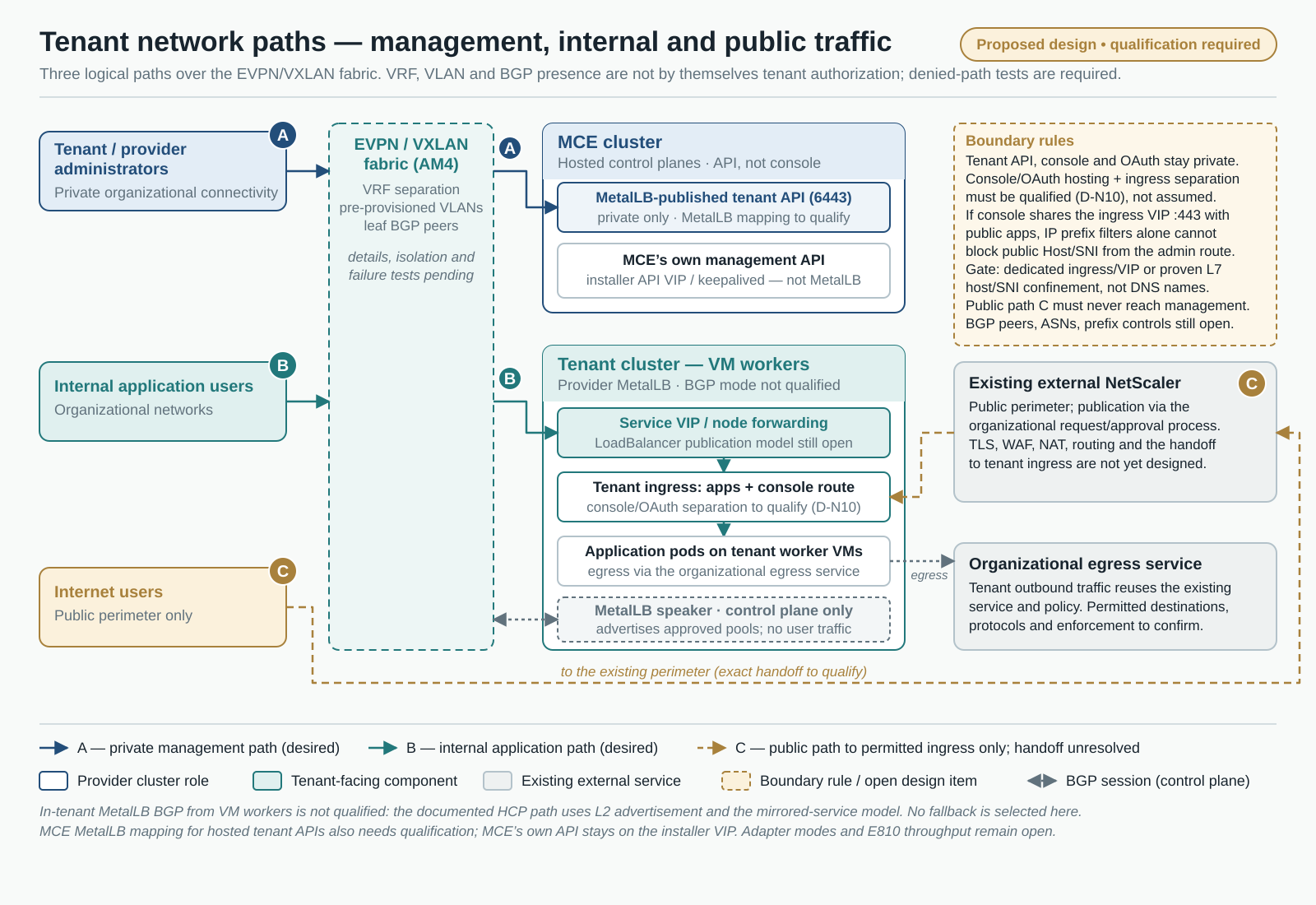 View full-size image (opens in a new tab)
The figure is the shared canonical source ../CLaaS/assets/tenant-network-paths.svg,
also used by the platform design. This HLD does
not own it. It shows paths A–C and the egress path. The design treats the
figure's paths as desired, and its open items (BGP peers, AS numbers, prefix
controls, handoff to NetScaler) as unresolved. It locates the API on MCE but
leaves console/OAuth placement and private ingress separation to the
management endpoint map in §5 is
authoritative for where each management endpoint is served. The table below adds
paths E (storage) and F (out-of-band), which the figure does not draw.
Shared path vocabulary
| Path | From → to | Carrier | Where permission is enforced | Owner of the enforcement | Status |
|---|---|---|---|---|---|
| A — private management | Tenant/provider administrators on approved organizational networks → hosted tenant API (6443), OAuth and console | Per endpoint, as in the management endpoint map. The API is a MetalLB VIP on MCE. OAuth and console placement depend on the release's service-publishing configuration and on D-N10. | Source-network filters at the fabric or a firewall in front of the published prefixes, where an endpoint has its own address. For an endpoint that shares a router or VIP, the separation chosen in D-N10. Authentication and RBAC at each endpoint. | Networking (filters). Platform (ingress separation). Identity design (authentication). | Desired; filters undesigned; D-N10 open |
| B — internal applications | Organizational users → tenant application hostnames | Tenant ingress VIP, published by the selected ingress-publication option (§5) | Route policy and filters that limit which source networks may reach tenant ingress prefixes. Application authentication. | Networking; tenant for the application | Desired; option depends on D-N2 |
| C — public applications | Internet → external NetScaler → permitted tenant ingress only | NetScaler virtual server → approved backend address | NetScaler publication approval, perimeter firewall, TLS policy. No route from the perimeter to any path-A prefix. | Perimeter owner; Networking | Desired; handoff unresolved |
| D — runtime egress | Tenant pods → organizational egress service → permitted destinations | Worker VM egress, carried on the selected worker network | Egress-service policy and source attribution | Egress-service owner | Desired; service unnamed |
| E — storage | Provider nodes (and, depending on the storage decision, tenant workers) → external Ceph and RGW | Storage VRF/VLANs | Ceph client capabilities, RGW credentials, network filters on the storage segments | Storage operations; Networking | See storage and recovery design |
| F — out-of-band | Platform engineers, OneView, authorized provisioning identities → BMC/IPMI on the DCM network | Existing DCM network | DCM access controls. Tenant workloads, public networks and office networks are refused. | Networking | DCM reported complete; denied paths not inspected |
Paths A–F are separate trust relationships. If two of them share physical links, leaves or a VRF, the separation is weaker than it looks. That sharing must be recorded and tested, not assumed harmless.
Neighbours and interfaces
| Neighbour | Interface to this design | Not supplied by the neighbour |
|---|---|---|
| EVPN/VXLAN fabric (Quanza) | VRFs, VLANs, leaf BGP sessions, prefix filters, route import/export | Tenant authorization, perimeter security |
| Cisco Nexus Dashboard | Authoritative fabric intent and deployment (Manage API with scoped roles) | Tenant self-service, per-VLAN authorization (not promised in Phase 1) |
| Infoblox DNS; organizational IPAM (product unconfirmed) | Parent zones, tenant subzones, WAPI for records; address allocations through the IPAM service | Reachability, certificates, publication approval |
| External NetScaler service | Public virtual servers created through the request process | Automated changes, tenant administration, private-path protection |
| Organizational egress service | Policy-controlled outbound path | Bootstrap, image-pull or provider-update egress (separate contracts) |
| MCE cluster | Hosted API publication (MetalLB). OAuth, konnectivity and any other hosted control-plane endpoints, as the endpoint map records. | Tenant ingress |
| Virtualization cluster | Worker VM network attachment (pod network and/or NADs) | Tenant-side load balancing unless option I2 is chosen |
| Tenant cluster | Ingress Controller (applications and, unless D-N10 places it elsewhere, the tenant console; to confirm for the release), provider-managed MetalLB (if I1/I3), ExternalDNS | Fabric or DNS authority beyond its own delegation |
4. Solution Strategy
Separate reachability from permission. The fabric gives addressable, segmented transport. Permission sits at explicitly named control points: leaf prefix filters and route policy, firewalls in front of management prefixes, NetScaler publication approval, Infoblox permissions, egress policy, and authentication on each endpoint. Each control point gets a denied-path test. A design review that cannot name the refusing control for a path has not designed that path.
Give each path an owner and a single writer. Fabric intent is written only through Nexus Dashboard once the Manage feature is qualified. Until then, Networking's manual change process is the writer. Git and AAP must not also write fabric configuration. Infoblox remains authoritative for zones; the organizational IPAM service (product unconfirmed) remains authoritative for allocations. ExternalDNS writes only records inside a tenant's delegated subzone. NetScaler changes are made only by the perimeter owner, through the request process. MetalLB pools are a consumer of ranges allocated by that IPAM service, not a second IPAM.
Keep the selected ingress intent, and make it conditional. The selected intent is provider-managed MetalLB inside each tenant cluster, in BGP mode, peering with leaves. Option I1 in §5 is that intent. It needs tenant worker VMs whose BGP source addresses the leaves can accept as peers. This design proposes a VLAN-backed attachment (W2 or W3) as the conservative candidate for that. Peering from the default pod network (W1) is not ruled out technically, but it is unqualified and not part of the selected design. The supportability of running MetalLB on KubeVirt-hosted workers must also be resolved with Red Hat. I1 stays the desired design until NQ-1 to NQ-3 decide it (D-N2). Option I2, the documented mirrored-LoadBalancer model, is the named alternative. Option I3, in-tenant L2, is a secondary alternative. Choosing an alternative is a recorded decision for the proposer (D-N2). This HLD does not make that choice.
Publish hosted APIs from MCE, privately. MCE runs on bare metal, which is a supported MetalLB platform. The vendor procedure for this setup uses L2 advertisement (N-H3). The recorded first-release choice selects MetalLB on MCE for hosted APIs, but records no advertisement mode for it. Peering the MCE MetalLB with the leaves in BGP mode is this design's recommendation, not a recorded proposer choice. It combines a supported platform with an advertisement mode the HCP procedure does not show. The design therefore puts BGP on MCE (recommended) and L2 on a dedicated MCE VLAN (documented) to the deciders as D-N3. In both cases, the published API prefixes are reachable only from approved management source networks. The MCE cluster's own API keeps its installer VIP. Which hosted management endpoints share that publication is set out per endpoint in §5, not assumed.
Reuse organizational services through scoped, testable handoffs. ExternalDNS uses a scoped Infoblox identity per cluster. Delegation is enforced in Infoblox itself, not only by the controller's domain filter. NetScaler publication is a request with defined evidence and a defined return handoff. Egress reuses the existing service. Each of these handoffs has refusal tests, not only success tests.
Design for the single site that exists. Phase 1 is AM4 with local redundancy. Network resilience targets are leaf, link, node and speaker failures inside AM4. No second site, stretched L2 or DNS-based site failover is designed or implied.
5. Building Block View
Responsibilities
| Building block | Responsibility in this design | Explicitly not responsible for |
|---|---|---|
| EVPN/VXLAN fabric | VRF separation of tenant, platform, storage and management traffic. VLAN handoff to node bonds. Leaf BGP sessions and route policy for approved prefixes only. | Deciding who may reach a prefix from the user side (that is filter policy), application security |
| Nexus Dashboard | Single authoritative writer for fabric intent. Preview/deploy separation. Scoped API roles. | Tenant-initiated changes, per-tenant VLAN self-service in Phase 1 |
| MetalLB on MCE | Advertising per-tenant hosted API VIPs from an MCE pool allocated for this purpose | Tenant ingress, MCE's own API, access control |
| Provider MetalLB in tenant cluster (I1/I3) | Advertising the tenant ingress VIP(s) from a provider-owned, per-tenant pool | Exposing arbitrary tenant LoadBalancer services outside the approved pool |
| Tenant Ingress Controller | Terminating or passing application traffic to tenant pods | Being the public perimeter |
| ExternalDNS (provider and tenant clusters) | Creating and removing records for approved Routes/Services inside the cluster's delegated subzone, with TXT ownership | Allocating addresses, creating zones, approving publication |
| Infoblox DNS and the organizational IPAM service (DNS/IPAM; IPAM product unconfirmed) | Parent zones, tenant subzone creation and delegation, and permission enforcement per subzone (Infoblox); address allocation for pools and VIPs (IPAM service) | Routing, TLS |
| External NetScaler | Public entry, TLS policy at the perimeter, and the backend mapping to the approved tenant ingress VIP | Private-path access, any tenant management endpoint |
| Organizational egress | Policy-controlled outbound traffic for tenant workloads, with source attribution | Unrestricted internet, provider bootstrap traffic |
| DCM network | Out-of-band management (path F) | Any tenant traffic |
Tenant worker network attachment (decision D-N1)
The ingress options depend on how the tenant worker VMs attach to the network. HCP on OpenShift Virtualization documents these attachments (N-H7):
| Option | What it means | Effect on BGP from tenant workers | Other consequences |
|---|---|---|---|
| W1 — pod network only (default) | Worker VMs sit on the Virtualization cluster's pod network | The VMs are not directly on a fabric segment. A BGP session from in-tenant MetalLB to a leaf would cross the infrastructure cluster's pod network and its egress/NAT path. Routed peering of that kind is not technically excluded, but it would need stable, attributable source addresses, a route back, and a support position. None of these has been established. Not part of the selected design unless qualified. | Simplest attachment. Konnectivity and egress use the infrastructure cluster's paths. |
| W2 — pod network plus an additional VLAN-backed network (Linux bridge or localnet UDN through a NAD) | Each worker VM also gets an interface on a per-tenant (or per-tenant-group) fabric VLAN in a tenant VRF | Leaves are directly reachable as BGP peers on that VLAN. This is the proposed, conservative candidate attachment for I1 and the shape to qualify. It is a design choice, not a technical prerequisite. | Uses pre-provisioned VLANs. Needs an address plan from Infoblox. Live migration and NAD behaviour need qualification. |
W3 — additional network as the only default (--attach-default-network false) |
Workers use only the VLAN-backed network | Same as W2 for BGP | All worker traffic (konnectivity to MCE, egress, storage if direct) must be routed from that VLAN. Higher design and failure-analysis effort. |
Design position. W2 is the proposed attachment for the selected intent. In this design, W1 is paired with I2 only. I1 over W1 would be a separate option. It could be considered only after a routed-peering qualification and a support position, and it would need its own D-N1 decision. W3 is held back until a requirement justifies it. The VLAN-to-tenant mapping, the VRF that carries it and the address source are Networking/DDI decisions within the 100-VLAN feature. They are not invented here. One VLAN per tenant is not assumed.
Tenant ingress publication (decision D-N2)
| Option | Mechanism | Vendor position (4.22) | Security shape | Recovery shape |
|---|---|---|---|---|
| I1 — selected intent | Provider MetalLB in the tenant cluster, BGP from W2/W3 interfaces to leaves, advertising a per-tenant pool | Not established. The HCP procedure shows L2 (N-H3). The MetalLB platform list does not name KubeVirt-hosted clusters. One ASN/router ID per MetalLB instance. | Tenant cluster holds BGP session configuration. Leaf-side prefix filters are mandatory, because a compromised tenant control could announce anything. Provider ownership of MetalLB resources relies on tenant-admin enforcement that has not been demonstrated. | Each tenant cluster's MetalLB config is reconciled by provider GitOps. Leaf sessions per worker scale with tenants × workers. |
| I2 — documented alternative | The tenant creates an ingress LoadBalancer. HCP mirrors it onto the hosting cluster, where that cluster's MetalLB (bare metal, a supported platform; BGP or L2) advertises it (N-H6). |
Documented for KubeVirt hosted clusters. With external infrastructure, whether the mirror lands on the Virtualization cluster or the MCE cluster, and which cluster's MetalLB answers, is not stated in the fetched pages. | No BGP configuration or speaker in the tenant cluster. Pools and peers stay on a provider cluster. The tenant still chooses to create LoadBalancer services, which needs an admission ceiling. | BGP sessions only from provider nodes. Tenant VIPs depend on the provider cluster's MetalLB health. |
| I3 — secondary alternative | Provider MetalLB in the tenant cluster with L2 advertisement on a W2 VLAN | Same supportability gap as I1, minus BGP | No routing control in the tenant cluster. Its failure domain is the VLAN. | L2 failover through gratuitous ARP. Leaf/VLAN design must carry the VIP range. |
What decides D-N2. NQ-1 has two distinct outcomes, and they are not equivalent:
- Supported. A written vendor support statement covers the configuration at the pinned versions.
- Gap accepted. No such statement exists, and a party authorized to accept supportability risk records an explicit risk exception. That exception names its scope, the residual risk and the compensating controls. It does not make the configuration vendor-supported. Who holds that authority has not been recorded. Neither this HLD nor the proposer's intent grants it.
I1 remains the design only if NQ-1 ends in either outcome and NQ-2 (session) and NQ-3 (refusal) pass. The decision record states which NQ-1 outcome applies. If NQ-1 ends in neither, or NQ-2 or NQ-3 fails, the proposer chooses between I2 and I3. I2 is preferred on security grounds because it keeps routing configuration out of the tenant's data plane. The proposer may weigh other factors.
Hosted API publication (decision D-N3)
The hosted kube-apiserver is published from the MCE cluster through MetalLB
(recorded choice). The recommended form is MetalLB in BGP mode advertising a
dedicated management pool to the leaves. The prefix sits in a management VRF, or
is filtered to approved source networks. The documented form is L2 advertisement
on an MCE node network (N-H3). Both need the same control: only approved
management source networks may reach the API prefix. The konnectivity agent on
each worker needs the API-address access described on port 6443 (N-H2), but that
does not establish that 6443 is its complete management-side dependency set.
The same deployment chapter describes route/443 or NodePort publication for
Konnectivity, OAuth and Ignition servers (§4.3.2.1, the Agent-platform procedure),
and §4.4.1.1 discusses NodePort firewall rules for Ignition and OAuth. Those
examples do not select the KubeVirt configuration. Before writing the worker
rules, map every endpoint required by the pinned KubeVirt release and its
servicePublishingStrategy below, including boot-time Ignition access. Permit
only the recorded destination, protocol and port for each required service;
this must not become general tenant-to-management reachability.
Management endpoint map (decision D-N10)
The hosted control plane does not necessarily publish every management endpoint the same way. The HostedCluster specification sets a publishing strategy for each hosted service. OAuth, for example, can be served from the MCE cluster while the tenant console is a route on the tenant cluster's own ingress. This design did not read the pinned release's documented defaults and supported values for KubeVirt hosted clusters. The rows below are therefore placeholders to fill from the release documentation and the actual HostedCluster configuration. They are not assumptions that the endpoints share one location.
| Endpoint | Where it is served | Exposure strategy | Address, listener and L7 mapping | Private enforcement | Status |
|---|---|---|---|---|---|
| Hosted kube-apiserver | MCE cluster (recorded choice) | MetalLB LoadBalancer; supported strategy value to confirm |
Dedicated VIP from the MCE management pool, 6443 | Source filters in front of the management prefix (D-N9 for konnectivity) | Recorded; D-N3 open |
| Hosted OAuth server | To confirm from the release documentation and configuration. The MCE side is possible. | Supported strategy to select, pending qualification | Own address, or a hostname on an MCE ingress router. The router, VIP and SNI/Host mapping are to be recorded. | If it has its own address, source filters. If it shares an MCE router, that router must be unreachable from path C, and D-N10 rules apply. | Open |
| Konnectivity | To confirm from the release documentation and configuration | Supported strategy to select, pending qualification | To be recorded. Workers must reach it (N-H2). | D-N9 scoped worker permission. No path-B/C reach. | Open |
| Ignition server | To confirm for the pinned KubeVirt boot and replacement flow | Supported publishing strategy to record | Exact destination, hostname and route/443 or NodePort, if required by that configuration | D-N9 worker-bootstrap scope only; no general management access | Open; required before worker-join testing |
| Tenant web console | Tenant cluster ingress (console route), to confirm | Default: a route on the tenant's default ingress controller. That controller may be the same router and VIP as the tenant applications. | Hostname under the tenant's internal names, on the router/VIP and SNI/Host mapping chosen in D-N10 | D-N10 | Open, gating |
Other hosted control-plane endpoints that workers or clients need are recorded in the same table once the release configuration is known. The same rules apply to them.
Why D-N10 is gating. When the console shares a router and a VIP on 443 with applications that NetScaler publishes, a NetScaler backend that can reach an application can reach the same IP and port as the console. IP routing and port filters cannot then refuse the console. The prohibition "path C never reaches console or OAuth" holds only if D-N10 selects and NQ-6 proves one of these separations:
- S1 — separate ingress. Management routes (console and, if applicable, OAuth) are served by a separate ingress shard, or another router with its own VIP or listener. That address is published only to path-A sources. NetScaler backends are restricted to the application VIP, so IP-level refusal becomes possible again.
- S2 — shared ingress with proven L7 allowlisting. NetScaler forwards only approved hostnames, with SNI and Host pinned to those names. It has no rewrite, redirect or wildcard backend that could reach a management hostname. The router or route also denies management hostnames to NetScaler source addresses. If the platform cannot enforce that per host or per route, S2 rests on the NetScaler allowlist alone, and D-N10 must record that as a residual risk. Indirect paths are refused too. That includes NetScaler rewriting or redirection, and a published application acting as a proxy to a management hostname. A tenant application that proxies its own tenant's console stays a tenant-side exposure. D-N10 must state whether it is refused or accepted as a residual risk.
This HLD does not select S1 or S2 and does not add a new ingress topology. A console that has its own DNS name or a non-public address is not private for that reason alone. Until D-N10 is decided and NQ-6 passes, path C must not be offered for a tenant whose console shares the router that NetScaler reaches.
DNS structure
- Parent zones (owned by DDI) contain one delegated tenant subzone per tenant. Creating the subzone is the zone-delegation feature. Running it per tenant is the tenant lifecycle design's job.
- Provider-side records (hosted API name, possibly the ingress wildcard) are written by the provider ExternalDNS on MCE, or by the provisioning flow. They are never written by the tenant cluster.
- Tenant-side records are written by the provider-managed ExternalDNS in the
tenant cluster, using a credential scoped to that tenant's subzone. Its
domainsinclude filter (N-H8) narrows the controller's behaviour. Infoblox permissions are what must refuse writes outside the subzone. - Views. If internal and public names differ (split horizon), the internal view carries path-A and path-B names. Only names that have passed NetScaler publication appear in the public view. Which views exist is a DDI decision.
6. Runtime View
All scenarios are NOT TESTED. They describe intended behaviour to qualify.
R-N1 Tenant network onboarding
- An approved tenant request reaches provisioning, as described in the tenant lifecycle design.
- DDI allocates the API VIP from the MCE management pool and the ingress VIP or pool for the tenant. Under W2 it also allocates the worker VLAN addresses. The allocations are recorded against the tenant by the organizational allocation authority; its product and interface remain unconfirmed.
- Networking maps a pre-provisioned VLAN and its VRF to the tenant, if W2 is used, through the authoritative fabric writer. It also adds leaf prefix filters that accept exactly the tenant's allocated prefixes from the expected peers.
- The tenant subzone is created and delegated. A scoped DNS credential is issued through approved secret delivery.
- The hosted cluster is created. MCE MetalLB advertises the API VIP. The provider DNS record for the API is created.
- Provider GitOps installs MetalLB (I1/I3) and ExternalDNS in the tenant cluster. The configuration contains only the tenant's pool, peers and subzone.
- Acceptance: the representative checks in §10 pass for this tenant. That includes the refusal checks.
Ordering rule. Leaf prefix filters (step 3) and the source filters for the management prefix exist before anything is advertised (steps 5–6). The scoped DNS credential is issued only after Infoblox permissions confine it to the subzone. The management endpoint separation chosen in D-N10 is in place before path C is offered.
Partial failure. A failure at any step leaves a recorded partial state. The provisioning owner either completes it or rolls it back. Two kinds of partial state must be kept apart:
- Safe, recorded quarantine (acceptable). Allocations, VLAN mappings and an undelegated or unpublished subzone are reserved and recorded against the tenant. Nothing is advertised or reachable that its filters do not already cover. No tenant-held credential has wider scope than its enforced permission. The state can wait for completion or rollback.
- Exposed partial state (defect). Examples are a prefix announced or a VIP answering without its filter, a delegation or credential that reaches further than the Infoblox permission enforces, and a console reachable through path C. Each of these is a security defect. It must be withdrawn at once, not left for later completion.
R-N2 Private management access (path A)
An administrator on an approved network resolves the API name and connects to the MCE-published VIP. Source filtering admits the connection, and the API authenticates the user through the identity design. From an unapproved network, from another tenant's workers, or from the NetScaler backend segment, the same address must not be reachable. A refusal at the network layer is required in addition to authentication. OAuth and console access follow the endpoint map. Where an endpoint shares an address with applications, the refusal is the D-N10 separation, not a route or port filter.
R-N3 Internal application (path B)
A tenant creates a Route under its subzone. ExternalDNS writes the record, pointing it at the tenant ingress VIP. Organizational clients reach the VIP over the tenant VRF's permitted routes.
R-N4 Public publication (path C)
- The tenant requests public exposure of a named application through the organizational NetScaler process. The request includes the hostname, backend VIP and TLS arrangement.
- The perimeter owner approves it and creates the virtual server, with the backend restricted to that tenant's ingress VIP and ports.
- The public name is published in the public view through the DDI process. ExternalDNS does not write public records unless that is explicitly agreed.
- The perimeter owner hands back completion evidence to the provider and the tenant.
- Withdrawal follows the reverse order: remove the public name, then the virtual server, then confirm that the backend is unreachable from the perimeter.
The NetScaler backend segment must never have a route to MCE API prefixes or to provider management networks. For management endpoints that share the tenant's application router or VIP, route absence cannot provide this separation. It depends on D-N10 (S1 or S2). Both are checked in NQ-6.
R-N5 Runtime egress (path D)
A tenant pod opens an outbound connection. The traffic leaves through the worker's network to the organizational egress service, which applies its policy and records the source. A pod's attempt to bypass the egress service, for example by routing directly from the worker VLAN to the internet, must fail.
Failure scenarios
| ID | Failure | Expected behaviour (design) | Evidence needed |
|---|---|---|---|
| F-N1 | MetalLB speaker restart or node loss | Depends on the advertisement mode. L2: one speaker answers ARP for the VIP, and another speaker takes over after failure detection. BGP: several speakers may advertise the same VIP at once (ECMP). The leaf withdraws the lost next hop when the session drops or its timers expire, and the remaining paths carry the traffic. Nothing "moves". Flows hashed to the lost node, and possibly some rehashed flows, may reset (feasibility claim 2). Convergence time depends on BGP timers or BFD, if Networking adopts BFD, and on the service's traffic policy. | Measured reconnect behaviour per mode against the service promise (NQ-8) |
| F-N2 | Leaf or link loss in a redundant pair | BGP session on the other leaf keeps the route. Traffic re-converges. | Convergence and connection-impact measurement |
| F-N3 | MCE cluster loss (control plane and workers) | Hosted APIs and any MCE-served management endpoints (for example OAuth, per the endpoint map) become unavailable. HCP 4.22 High availability, §9.1.1, states that the hosted data plane stays available. That covers already running workloads. It does not establish that paths B, C and D all keep working. Workloads that need the API (controllers, operators, new scheduling, pod restarts, certificate or token renewal), nodes that need replacing, and anything depending on MCE-hosted shared services or I2 mirrored services on a provider cluster may degrade or fail. | Fault test: record observed behaviour of each path, of running and restarting pods and of API-dependent applications over a defined outage window. API unavailability is a management outage that may grow into workload impact. Recovery is covered in the storage and recovery design. |
| F-N4 | Nexus Dashboard unavailable | The fabric keeps forwarding its last deployed state. Changes, including new tenants, stop. An emergency manual change needs the documented exception and must be reconciled afterwards. | Emergency procedure and reconciliation evidence |
| F-N5a | Infoblox WAPI (management API) unavailable, DNS serving healthy | Authoritative DNS can keep serving existing records. ExternalDNS writes fail and are retried. New onboarding and record changes stop. | Behaviour of ExternalDNS on WAPI errors. Confirmation that no deletions happen during a partial outage or on recovery. |
| F-N5b | Authoritative DNS serving for the tenant zones unavailable | Cached answers may remain available subject to TTL, resolver serve-stale policy and client caching. Resolution during the outage is not guaranteed; TTL expiry is not a universal failure or cutover deadline. | DDI's documented serving redundancy and TTL settings. Observed client behaviour in a fault test. |
| F-N6 | Wrong or missing leaf prefix filter | An unauthorized prefix is accepted. This is a security defect. | NQ-3 detects it before service and in regression |
| F-N7 | ExternalDNS ownership conflict (two clusters claim a name) | TXT ownership stops the second owner from overwriting. A conflict is reported. | NQ-5 |
| F-N8 | Egress service unavailable | Tenant outbound traffic fails closed. No fallback to unrestricted routing. | Denied-path evidence |
Retirement
Retirement reverses onboarding under the tenant retirement procedure. Stop tenant reconciliation first, so that nothing recreates records or advertisements. Then withdraw public publication. Then remove MetalLB advertisements and their leaf filters, ExternalDNS records and the tenant subzone. Return the VLAN mapping and release allocations under DDI's reuse rule. Record cached-answer and connection drain behaviour. A deleted record does not prove that clients have stopped using it.
7. Deployment View
This is a logical view for AM4. Exact racks, leaves, VLANs and addresses are deliberately absent.
| Cluster or service | Network components deployed | Network attachment (logical) |
|---|---|---|
| MCE cluster | MetalLB (hosted API pool), provider ExternalDNS | Bonded node uplinks. Platform/management VRF. Storage VRF for path E. |
| Virtualization cluster | Node networking for VM hosting. NADs for W2/W3. MetalLB only if I2 is chosen. | Bonded node uplinks carrying the pre-provisioned tenant VLANs (W2), the platform VRF and the storage VRF |
| Each tenant cluster | Ingress Controller. Provider MetalLB (I1/I3). Provider ExternalDNS. | Worker VMs on the pod network (W1) and/or a tenant VLAN (W2/W3) |
| ACM/Global Hub, DCS | Their own ingress/API publication, outside this HLD's tenant scope | Platform VRF |
| Nexus Dashboard | Fabric management | Placement and its bootstrap network not yet decided (service note) |
| Infoblox, NetScaler, egress | External organizational services | Reached through their existing interfaces |
MTU for the VM-hosting cluster must be decided before it is installed, because it cannot be changed afterwards (N-H1). The vendor recommends 9000 or more. The end-to-end MTU budget must include the fabric's VXLAN overhead and any cluster overlay. That budget is a fabric-design decision (D-N6).
8. Crosscutting Concepts
Security: where enforcement actually happens
| Concern | Enforcement point | Not an enforcement point |
|---|---|---|
| Who may reach tenant APIs | Source filters/firewall in front of the MCE API prefix. API authentication. | The VRF that carries the prefix, or the fact that the prefix is a "private" address |
| Whether path C can reach console/OAuth | The D-N10 separation: a separate ingress shard/VIP/listener (S1), or proven SNI/Host allowlisting plus backend policy (S2) | Separate DNS names, absence of public DNS records, or IP route filters when the endpoint shares the application VIP |
| Which prefixes a cluster may announce | Leaf inbound prefix filters per peer, with maximum-prefix limits if Networking adopts them. Provider-owned MetalLB pools. | The MetalLB configuration alone (a tenant-side compromise can change it) |
| Which names a cluster may write | Infoblox permission on the subzone | The ExternalDNS domains filter alone |
| What is public | NetScaler publication approval and perimeter firewall | DNS presence |
| Where tenant egress goes | Egress-service policy, plus routing that forces traffic through it | Kubernetes NetworkPolicy alone (tenant-reachable) |
| Out-of-band isolation | DCM access controls | Separate VLAN numbering |
BGP session protection. Leaf peer authentication (for example, a session password or TTL security) and its credential custody are Networking decisions (D-N5). Under I1 such secrets would sit in tenant clusters. That is a reason to prefer filtering at the leaf and to treat any tenant-side secret as exposed to the tenant administrator. That remains true until tenant isolation demonstrates otherwise.
Credentials
- Infoblox. The 4.22 Operator uses WAPI username/password in a Secret (N-H8). Use one scoped Infoblox identity per tenant cluster, permitted only on that tenant's subzone, and a separate provider identity for parent/provider records. Deliver them through the approved secrets path. Rotate them, and revoke them at retirement. A shared identity across tenants is rejected, because a single cluster compromise would then reach all subzones.
- Nexus Dashboard. Separate the right to edit intent from the right to deploy, as the Manage feature requires.
- MCE infrastructure kubeconfig. This affects networking because it lets MCE create resources, including NAD use, in the Virtualization cluster namespace (N-H4). Scope it per the platform design.
Change ownership and drift
Fabric intent is authoritative in Nexus Dashboard once it is qualified. DNS zones are authoritative in Infoblox. Address allocations remain authoritative in the organizational IPAM service, whose product and configuration are unconfirmed. Cluster-side MetalLB/ExternalDNS configuration is authoritative in provider Git and reconciled by provider GitOps. Each layer reports drift against its own authority. No layer silently corrects another layer's authority.
Observability
The design needs: BGP session state and received/accepted prefixes per peer at the leaf, MetalLB speaker and advertisement status per cluster, ExternalDNS sync errors and ownership conflicts, NetScaler backend health for published applications, and egress-service denies attributed to the tenant. Delivery is in the observability note. The tenant sees only its own cluster's signals.
Recovery of network state
The network design depends on these authoritative stores. Each must be recoverable without the CLaaS platform being available:
| State | Authority | Recovery expectation (to agree) |
|---|---|---|
| Fabric intent and deployed config | Nexus Dashboard (and Networking's backups) | Restore or redeploy from the orchestrator's backup. A manual procedure if the orchestrator is unavailable. |
| Zones, delegations, allocations | Infoblox (zones); organizational IPAM service, product unconfirmed (allocations) | DDI's own backup and restore. Reconcile allocations before new ones are made. |
| ExternalDNS ownership records | TXT records in Infoblox | Restored with the zone. Clusters re-sync after restore. Mass deletion after a partial restore must be prevented (NQ-5). |
| MetalLB/ExternalDNS cluster config | Provider Git | Reapplied by GitOps |
| NetScaler publications | Perimeter owner | Their own recovery. CLaaS keeps the list of approved publications per tenant. |
9. Architectural Decisions
The decisions below are open unless marked "recorded". A recorded decision is the proposer's intent. It is not approval.
| ID | Decision | Status | Options and consequence | Decider (proposed) |
|---|---|---|---|---|
| D-N0 | Private-only tenant management. MetalLB on MCE for hosted APIs. MCE's own API on installer VIP. | Recorded | — | Proposer |
| D-N1 | Tenant worker attachment | Open | W1 / W2 / W3 (§5). W2 is the proposed candidate for I1. I1 over W1 only after a routed-peering qualification. | Networking + platform |
| D-N2 | Tenant ingress publication | Recorded intent I1, conditional | I1 stays only if NQ-1 ends supported or gap accepted, and NQ-2 and NQ-3 pass. The record states which NQ-1 outcome applies. Gap accepted is a risk exception by an authority not yet recorded. It is not vendor support. Otherwise choose I2 (preferred on security grounds) or I3. | Proposer, with Networking and security. The risk-acceptance authority is to be named. |
| D-N3 | Hosted API advertisement mode on MCE | Open | BGP (this design's recommendation; no mode recorded by the proposer) or L2 on a dedicated VLAN (documented) | Networking + platform |
| D-N4 | Tenant-to-VLAN/VRF mapping and address source | Open | One per tenant, shared pools or tenant groups. Not assumed. | Networking + DDI |
| D-N5 | Leaf peer authentication, max-prefix and filter style | Open | Networking design | Networking |
| D-N6 | End-to-end MTU budget | Open; must precede Virtualization cluster install | Vendor recommends ≥9000 on the VM-hosting cluster | Networking + platform |
| D-N7 | DNS views and which names are public | Open | Split-horizon or not. Public records written by DDI or by ExternalDNS. | DDI + perimeter + security |
| D-N8 | Infoblox identity model | Proposed: one scoped identity per tenant cluster | Shared identity rejected | DDI + security |
| D-N9 | Worker-to-management cross-path permission | Proposed: API access on 6443 plus only the Konnectivity, Ignition and any OAuth endpoints actually required by the pinned publishing strategies, each recorded in D-N10 before firewall acceptance | No unspecified destinations or ports. Any later widening needs security review. | Networking + security |
| D-N10 | Management endpoint exposure and console/OAuth separation from path C | Open, gating for path C | Fill the endpoint map from release documentation and configuration. For any management endpoint that shares a router or VIP with applications, choose S1 (separate ingress shard/VIP/listener) or S2 (proven per-host SNI/Host allowlisting plus backend policy and refusal of indirect proxies). Not selected here. | Platform + Networking + perimeter owner + security |
10. Quality Requirements
These scenarios are acceptance tests to run. Every one is NOT TESTED. A pass needs retained evidence: environment, versions, configuration revision and result.
| ID | Quality | Scenario and pass criterion |
|---|---|---|
| NQ-1 | Supportability | Red Hat's written position on MetalLB inside a KubeVirt-platform hosted cluster with external infrastructure, at the pinned OCP/MCE/Virtualization versions. It also covers the mirrored-LoadBalancer target cluster with external infrastructure (I2). Two outcomes are recorded separately. Supported: an explicit vendor support statement for that scope. Gap accepted: no statement, plus a risk exception recorded by a party with authority to accept supportability risk. Gap accepted is not a pass on support and does not make the configuration supported. This test grants no authority to accept exceptions. |
| NQ-2 | Feasibility | On W2, establish BGP sessions from tenant MetalLB to both leaves of a pair and advertise the tenant pool. Pass: the routes are received and traffic from an approved source reaches ingress. Failure records a compatibility gap and triggers D-N2. |
| NQ-3 | Prefix refusal | Positive case: the tenant's allocated, approved prefix is announced from its expected peers, accepted by both leaves and reachable from approved sources. Negative cases, as tenant-admin: attempt to (a) edit provider MetalLB resources, (b) create a pool or advertisement outside the allocation, (c) announce another tenant's prefix or any other unallocated prefix. Pass: the positive case works. (a) and (b) are refused by admission or RBAC. Independently of that RBAC result, the leaf rejects every unauthorized prefix from (b) and (c), also when the announcement is injected directly at the tenant's speaker. That injection simulates an RBAC bypass. |
| NQ-4 | Management privacy | First complete D-N10 for the exact release and publishing strategies. Reach the API VIP on 6443 from the approved admin network and that tenant's required workers (allowed), another tenant's workers, the NetScaler backend and the internet (refused). Prove worker boot/join, replacement and tunnel operation against every additional required Konnectivity, Ignition or OAuth destination/port in the map; refuse all unlisted access. Repeat source-scope tests per endpoint. A failure does not authorize widening the rules without review. |
| NQ-5 | DNS scope and ownership | With the tenant credential: (a) create, update and delete a record in its own subzone (allowed); (b) write to the parent zone, another tenant's subzone, or the wrong view (refused by Infoblox, not only by the filter); (c) a second cluster claiming an existing name is refused by TXT ownership; (d) deleting a Route removes only that cluster's record; (e) after a simulated Infoblox restore to an earlier point, ExternalDNS does not delete records it does not own. |
| NQ-6 | Perimeter separation | A published path-C application is reachable from the internet. From the NetScaler backend segment, the tenant's API and any provider prefix are unreachable at the IP level. For console, OAuth and every other management hostname, testing reachability is not enough. Through the public URL and from the backend segment, attempt: direct requests to the management hostnames; requests to the shared VIP with an alternate Host header, an alternate SNI, or SNI and Host that differ; NetScaler rewrite or redirect paths; and indirect access through a published application acting as a proxy. Pass: every attempt is refused at the control D-N10 names (S1 or S2), and the refusing point is recorded. After withdrawal, the backend is unreachable from the perimeter. |
| NQ-7 | Egress control | A permitted destination works and is attributed to the tenant. A denied destination is refused. A direct route that bypasses the egress service fails. |
| NQ-8 | Resilience | Speaker restart, worker drain/live migration, and leaf/link loss inside AM4: measure convergence and connection impact against the agreed service promise. No numeric target is set here. |
| NQ-9 | Out-of-band isolation | From a tenant worker and a tenant pod, BMC/IPMI addresses on DCM are unreachable. |
| NQ-10 | Single writer | A fabric change made outside Nexus Dashboard (once qualified) is detected as drift. An unauthorized Manage API role cannot deploy. |
11. Risks and Technical Debt
| Risk | Effect | Treatment |
|---|---|---|
| I1 is unsupported or does not work | Selected ingress design is not viable as stated | NQ-1/NQ-2 early. Alternatives I2/I3 are defined. Decision D-N2. |
| Tenant-reachable network configuration (I1) | A tenant-admin bypass could announce prefixes or change advertisements | Leaf filters are mandatory regardless. Enforcement ownership sits with tenant isolation. |
| VRF details unknown | Path separation cannot be assessed | Blocked on VRF feature delivery |
| Tenant console (and possibly OAuth) shares the application router/VIP that NetScaler reaches | Path C could reach a management endpoint despite route filters | D-N10 gating before path C. NQ-6 L7 tests. |
| Konnectivity requires a worker→management permission | The permission could be widened over time | Port-scoped rule. NQ-4 regression. |
| Infoblox permission model not yet verified for per-subzone enforcement | DNS scope relies on the controller filter | NQ-5(b). Feature zone-delegation. |
| NetScaler handoff is manual and its lead times are unknown | Slow public onboarding. Risk of a mistaken backend. | Request template with backend restricted to tenant VIP. NQ-6. |
| MTU fixed at install | A wrong value forces a reinstall | D-N6 before installation |
| BGP session count grows with tenants × workers (I1) | Leaf scale and operational load | Count at the expected tenant scale before accepting I1 |
| Single location | No network continuity on AM4 loss | Explicitly out of scope for Phase 1 |
| Networking skill concentrated in one engineer on the core team | Delivery and incident risk | Already recorded in the fabric note |
Unresolved and deliberately not invented: VLAN IDs, VRF names, route targets, AS numbers, peer addresses, pools, NetScaler capabilities (WAF, TLS mode), egress protocols and destinations, and numeric availability targets.
12. Glossary
| Term | Meaning here |
|---|---|
| Path A–F | The shared vocabulary in §3: management, internal apps, public apps, egress, storage, out-of-band |
| Reachability | A packet can be routed to an address. It grants no permission. |
| Enforcement point | A control that refuses traffic or changes outside an approval and can be tested |
| W1/W2/W3 | Tenant worker VM network attachment options (§5) |
| I1/I2/I3 | Tenant ingress publication options (§5) |
| Mirrored LoadBalancer | HCP behaviour where a tenant LoadBalancer service is recreated on the hosting cluster and exposed there (N-H6) |
| Konnectivity | The HCP agent tunnel from workers to the hosted API |
| Subzone delegation | A DNS zone under a parent zone whose records a tenant may change, enforced in Infoblox |
| TXT registry | ExternalDNS's ownership records stored next to the records it manages |
| DCM | The existing datacenter management (out-of-band) network |
Decision and qualification matrix
| Item | Selected intent | Evidence status (2026-10-21) | Required decision | Qualification test | Blocking for |
|---|---|---|---|---|---|
| Hosted API publication | MetalLB on MCE (mode not recorded; BGP recommended here) | Documented with L2 (N-H3). BGP not shown. | D-N3 | NQ-4, NQ-8 | Any tenant onboarding |
| Management endpoint map and console/OAuth separation | Private-only | Per-service publishing strategies for the pinned release not read | D-N10 | NQ-4, NQ-6 | Path C for any tenant |
| Tenant ingress | In-tenant MetalLB BGP (I1) | Not established (feasibility claim 2) | D-N1, D-N2 | NQ-1, NQ-2, NQ-3 | Path B/C acceptance |
| Ingress alternative | — | I2 documented (N-H6). Target cluster with external infrastructure not stated. | D-N2 fallback | NQ-1 (I2 part) | Only if I1 fails |
| Worker attachment | Not recorded (W2 proposed for I1) | W2/W3 documented (N-H7). BGP from W1 not qualified. | D-N1 | NQ-2, NQ-8 | I1 |
| Prefix control | Leaf peering | Leaf filters not designed | D-N5 | NQ-3 | I1/I3 and D-N3 BGP |
| Management privacy | Private-only | Not designed | D-N9 | NQ-4 | Service acceptance |
| DNS | ExternalDNS + Infoblox subzones | Operator Infoblox support documented (N-H8). Subzone permission unverified. | D-N7, D-N8 | NQ-5 | Onboarding automation |
| Public perimeter | Existing NetScaler, request process | Service capabilities not confirmed | Request/evidence contract | NQ-6 | Path C |
| Egress | Organizational service | Service unnamed | Service identification | NQ-7 | Path D |
| Fabric writer | Nexus Dashboard | Proposed features, readiness unknown | Release/placement | NQ-10 | Network automation |
| MTU | Not recorded | Vendor ≥9000 recommendation, immutable after install (N-H1) | D-N6 | Packet-size test end to end | Virtualization cluster install |
| Out-of-band | DCM | Reported complete, not inspected | — | NQ-9 | Service acceptance |
Explore this note’s relationships 20 connected notes
Connections are authored references and declared relationships, not verified runtime dependencies or approval.
No notes match these filters. Reset filters to show the whole graph.
Drag to pan. Use arrow keys to pan, + / − to zoom, and 0 to fit. Select notes or relationships in the list below for a keyboard alternative.
Every note and relationship is available in the list below. The interactive map requires JavaScript.
Notes and relationships Accessible list
Notes (21)
- CLaaS tenant lifecycle design — request, provisioning, change and retirementHLD · draft · Automation. Icon: Automation
- CLaaS — Clusters-as-a-Service: first production offeringNote · draft · CLaaS. Icon: General note
- CLaaS platform design — service planes, hosting and failure boundariesHLD · draft · CLaaS. Icon: General note
- CLaaS technical feasibility evidence registerResearch · draft · CLaaS. Icon: General note
- Approved complete tenant retirementNote · draft · CLaaS. Icon: General note
- Inventory and hardware-management control designHLD · draft · DCIM. Icon: Inventory
- Datacenter hardwareNote · draft · Hardware. Icon: General note
- Identity and trust design for CLaaSHLD · draft · Identity. Icon: Identity
- CLaaS tenant network designHLD · draft · Network. Icon: Network
- DNS, DHCP and IP address managementABB · draft · Network. Icon: Network
- EVPN/VXLAN network fabricABB · draft · Network. Icon: Network
- ExternalDNS — provider-managed DNS integrationSBB · draft · Network. Icon: Network
- NetScaler — existing external application perimeterSBB · draft · Network. Icon: Network
- MetalLB — BGP application entry pointsSBB · draft · Network. Icon: Network
- Cisco Nexus DashboardSBB · draft · Network. Icon: Network
- Tenant workload egress — organizational serviceNote · draft · Network. Icon: Network
- CLaaS observability — local stacks and central visibilityNote · draft · Observability. Icon: General note
- Secrets ManagementABB · draft · Secrets. Icon: Secrets
- SAK applicability and control allocation for CLaaSNote · draft · Security. Icon: General note
- Tenant isolation and provider-control protectionHLD · draft · Security. Icon: General note
- CLaaS storage and data-recovery designHLD · draft · Storage. Icon: Storage
Relationships (34)
- CLaaS tenant lifecycle design — request, provisioning, change and retirementReferences →CLaaS tenant network designAutomation/tenant-lifecycle-design.md · Markdown link
- CLaaS — Clusters-as-a-Service: first production offeringReferences →CLaaS tenant network designCLaaS/index.md · Markdown link
- CLaaS platform design — service planes, hosting and failure boundariesReferences →CLaaS tenant network designCLaaS/platform-design.md · Markdown link
- CLaaS technical feasibility evidence registerReferences →CLaaS tenant network designCLaaS/technical-feasibility.md · Markdown link
- Inventory and hardware-management control designReferences →CLaaS tenant network designDCIM/inventory-control-design.md · Markdown link
- Identity and trust design for CLaaSReferences →CLaaS tenant network designIdentity/identity-trust-design.md · Markdown link
- CLaaS tenant network designDepends on →DNS, DHCP and IP address managementNetwork/claas-network-design.md · depends_on
- CLaaS tenant network designDepends on →EVPN/VXLAN network fabricNetwork/claas-network-design.md · depends_on
- CLaaS tenant network designDepends on →Tenant workload egress — organizational serviceNetwork/claas-network-design.md · depends_on
- CLaaS tenant network designDescribes →ExternalDNS — provider-managed DNS integrationNetwork/claas-network-design.md · describes
- CLaaS tenant network designDescribes →NetScaler — existing external application perimeterNetwork/claas-network-design.md · describes
- CLaaS tenant network designDescribes →MetalLB — BGP application entry pointsNetwork/claas-network-design.md · describes
- CLaaS tenant network designDescribes →Cisco Nexus DashboardNetwork/claas-network-design.md · describes
- CLaaS tenant network designReferences →CLaaS tenant lifecycle design — request, provisioning, change and retirementNetwork/claas-network-design.md · Markdown link
- CLaaS tenant network designReferences →CLaaS — Clusters-as-a-Service: first production offeringNetwork/claas-network-design.md · Markdown link
- CLaaS tenant network designReferences →CLaaS platform design — service planes, hosting and failure boundariesNetwork/claas-network-design.md · Markdown link
- CLaaS tenant network designReferences →CLaaS technical feasibility evidence registerNetwork/claas-network-design.md · Markdown link
- CLaaS tenant network designReferences →Approved complete tenant retirementNetwork/claas-network-design.md · Markdown link
- CLaaS tenant network designReferences →Datacenter hardwareNetwork/claas-network-design.md · Markdown link
- CLaaS tenant network designReferences →Identity and trust design for CLaaSNetwork/claas-network-design.md · Markdown link
- CLaaS tenant network designReferences →DNS, DHCP and IP address managementNetwork/claas-network-design.md · Markdown link
- CLaaS tenant network designReferences →EVPN/VXLAN network fabricNetwork/claas-network-design.md · Markdown link
- CLaaS tenant network designReferences →ExternalDNS — provider-managed DNS integrationNetwork/claas-network-design.md · Markdown link
- CLaaS tenant network designReferences →NetScaler — existing external application perimeterNetwork/claas-network-design.md · Markdown link
- CLaaS tenant network designReferences →MetalLB — BGP application entry pointsNetwork/claas-network-design.md · Markdown link
- CLaaS tenant network designReferences →Cisco Nexus DashboardNetwork/claas-network-design.md · Markdown link
- CLaaS tenant network designReferences →Tenant workload egress — organizational serviceNetwork/claas-network-design.md · Markdown link
- CLaaS tenant network designReferences →CLaaS observability — local stacks and central visibilityNetwork/claas-network-design.md · Markdown link
- CLaaS tenant network designReferences →Secrets ManagementNetwork/claas-network-design.md · Markdown link
- CLaaS tenant network designReferences →SAK applicability and control allocation for CLaaSNetwork/claas-network-design.md · Markdown link
- CLaaS tenant network designReferences →Tenant isolation and provider-control protectionNetwork/claas-network-design.md · Markdown link
- CLaaS tenant network designReferences →CLaaS storage and data-recovery designNetwork/claas-network-design.md · Markdown link
- SAK applicability and control allocation for CLaaSReferences →CLaaS tenant network designSecurity/sak-assurance.md · Markdown link
- CLaaS storage and data-recovery designReferences →CLaaS tenant network designStorage/storage-recovery-design.md · Markdown link