CLaaS platform design — service planes, hosting and failure boundaries
1. Introduction and Goals
This HLD describes how the proposed provider estate turns the CLaaS offering into tenant OpenShift clusters. Each tenant cluster has a hosted control plane on the MCE cluster and worker VMs on the separate OpenShift Virtualization cluster. The HCP SBB joins those two placements. ACM and Global Hub govern the estate. DCS runs the provider's own critical services, and the shared OpenShift baseline gives every role its fabric, storage and bootstrap contracts.
The SBBs already record which product does what. This HLD adds what they deliberately leave out:
- how the roles depend on each other at runtime;
- which component may change which state, and who holds which credentials;
- what keeps working when a plane fails;
- the order for bootstrap, upgrade and recovery;
- which decisions are still open.
The companion tenant lifecycle design covers requests, provisioning, upgrades and retirement. This HLD covers the platform those flows act on.
This is a draft proposal. It does not record a deployed estate, an approved architecture, a supported version matrix or a test result. Development progress the proposer reported on 2026-10-12 is treated as reported, not inspected. No failure scenario in this document has been tested.
Stakeholders (roles, not named people): platform engineering (the development team that builds the estate), the separate production operations team, network, storage, IAM/security/PKI, the organizational service owners consumed by the platform, tenant administrators, and whoever acts as acceptance authority. That authority has not been established yet.
Quality goals, in priority order:
- Authority containment. Tenant administration never reaches a provider plane, the external Ceph estate, the secrets service or another tenant.
- Bounded failure consequences. For each plane failure, it is known in advance what keeps running, what stops, and who can still act.
- Independent recovery. Bootstrap and break-glass access do not depend on the services they are meant to restore.
- A supportable, pinned release set. Release combinations are qualified together, not picked as each component's latest release.
- Repeatability at the stated scale. The design works for a few dozen tenants without a new provider installation per tenant.
2. Constraints
| Constraint | Source | Design consequence |
|---|---|---|
| Phase 1 runs in AM4 only: one location with local redundancy | Service boundary, hardware | No disaster-recovery or site-failover claim. Loss of AM4 means loss of service. Recovery still needs backups and a cold-start route. |
| The same AM4 hardware serves development and the eventual production build | Hardware, bootstrap | Separate installations on shared hardware. How hosts, fabric and Ceph are split between dev and prod, and how much capacity can run at the same time, are open. |
| Reported E810-CQDA2 through-card bandwidth issue. The workaround permits Phase 1; a permanent fix is required and high priority. | Hardware | No bandwidth or capacity claim rests on nominal port rates. Record the workaround's limits in the operating handoff. The fix is not a Phase 1 gate. |
| Node sizing and role profiles are owned elsewhere | Hardware role profiles | This HLD does not restate sizing and does not allocate hosts to clusters; that allocation is still open. |
| Tenant control planes on MCE; worker VMs on a separate Virtualization cluster | HCP SBB, first-release choice recorded 2026-10-09 | Uses the vendor's external infrastructure procedure (§6, P2). The combined support position is unverified. The 4.22 HCP release notes contain a sentence that external infrastructure is not supported; it follows an IBM Z note and its scope is ambiguous. That ambiguity is recorded as tenant isolation U10 and in the feasibility register. It needs written vendor confirmation. Absence from the Technology Preview list is not read as general availability. |
| MCE's own API stays on the installer API VIP/keepalived. MetalLB on MCE publishes hosted APIs; ingress runs on tenant workers. | MCE SBB, MetalLB | Several endpoint classes with different owners. Where each hosted endpoint (API, OAuth, konnectivity, console) is placed is owned by the network design and is pending its endpoint map (D-N10). This HLD does not decide it. |
| Tenant APIs and consoles are reachable over private connectivity only | Service boundary | Being on the fabric is not access control. Allowed and denied paths must be designed and tested. |
| Tailored tenant-admin role, not unrestricted cluster-admin. No nested VMs. Worker capacity fixed after provisioning. | Service boundary, HCP SBB | Provider-reserved controls must live where tenants cannot reach them (§8). |
| DCS and every workload installed on it must keep operating without ACM | DCS | ACM is a governance and delivery dependency, never a runtime one, for DCS. |
| OpenBao and GitLab are consumed as external services first. TOPdesk, Infoblox, NetScaler, Cohesity, Splunk and egress are organizational services. | CLaaS index | Their availability and failure domains belong to other organizations. Being external is not proof of independent failure. |
| Release rule: latest compatible stable releases, qualified together, then pinned | Baseline, feasibility register | The register's OCP 4.22 / MCE-ACM 2.17 line is the latest GA observation, not a supported matrix. |
| First-production target 31 March 2027; internal readiness aim early March (not agreed) | CLaaS index | Scope cuts must be explicit decisions, not silent deferrals. |
The historical decisions from earlier workbenches are lessons, not constraints.
ADR-010, recorded as accepted in its own source, required production-bound
clusters to be enrolled in ACM before they counted as rollout-ready, with
bootstrap automation outside ACM allowed only temporarily
(ADR-010 at rws-arch-next 9fd9a04, lines 36–48).
ADR-011 separated a restricted-network baseline from disconnected and air-gapped
operation
(ADR-011 at rws-arch-wb d224d15, lines 26–68).
This design keeps the underlying lessons:
- enrollment is an evidence gate, not an assumption;
- this design uses approved external registries and then Quay; it claims no air-gap.
It does not take over their approvals, their 1H2026 scope or their Location A/B topology.
3. Context and Scope
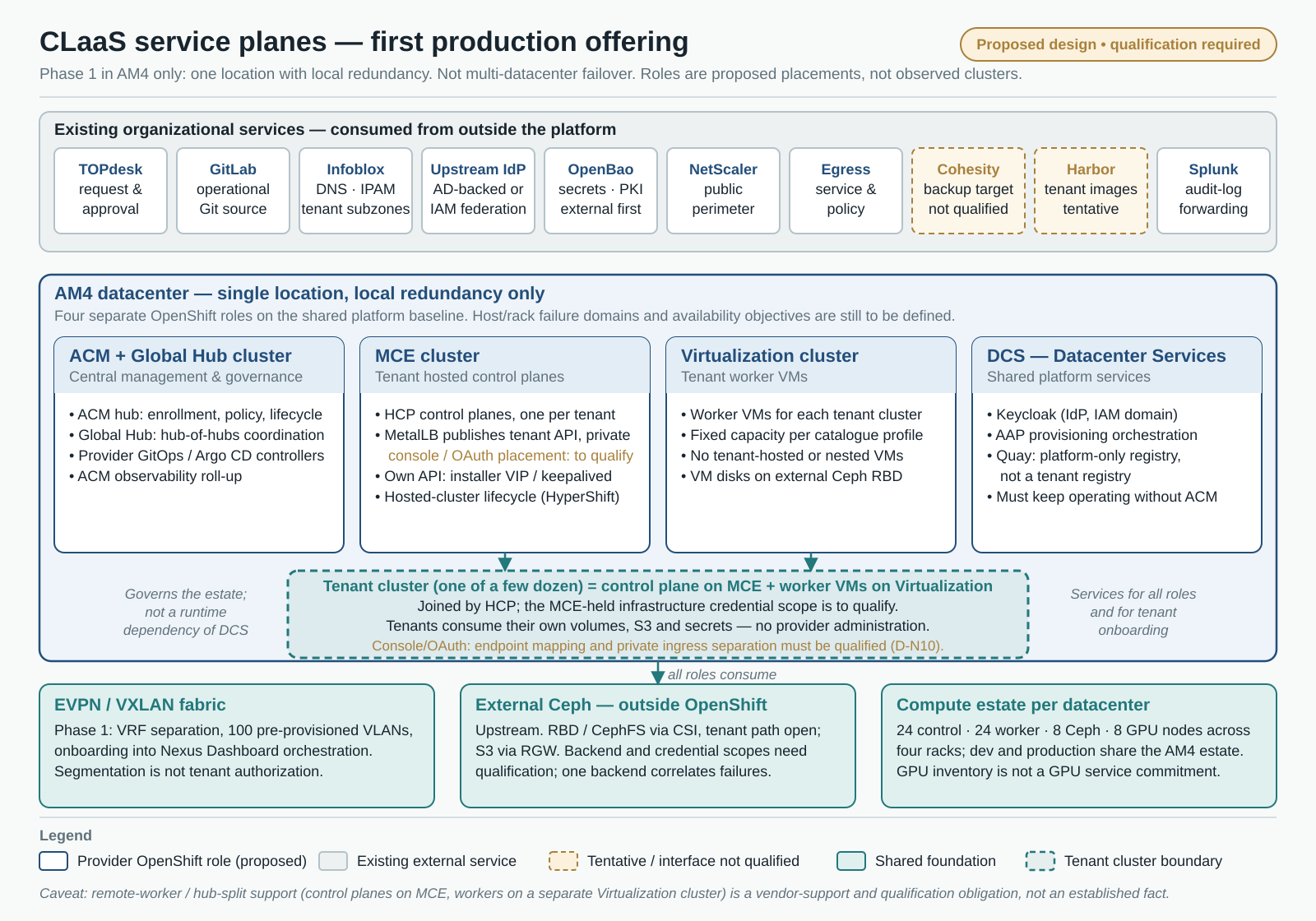 View full-size image (opens in a new tab)
How to read the figure. It is an overview of planes and placements; it does not show every feature, interface or endpoint, and where it is simpler than the text, the text governs:
- Top row: the organizational services consumed from outside the platform.
- Middle: AM4 holds four provider roles side by side. A tenant cluster is not a fifth box. It is a pairing of a control plane on MCE with worker VMs on the Virtualization cluster.
- Bottom: the fabric, external Ceph and the compute estate sit under every role. They are shared foundations and shared failure domains.
The figure's caveat states the main open support question: remote worker infrastructure. Its endpoint labels (for example console and OAuth placement) are indicative only; the authoritative placement is the network design's endpoint map, which is still open (D-N10).
In scope: the four provider roles, the joined tenant cluster, their trust and data relationships, failure behaviour, release ordering and deployment structure. Out of scope here: request and provisioning mechanics (see the lifecycle design); fabric, BGP and address detail (see the network design); storage-class and backup detail (see the storage and recovery design); federation, PKI and break-glass mechanisms (see the identity and trust design); the tenant permission model (see tenant isolation); SAK assessment (see SAK assurance, separate owner); and tenant applications.
| Neighbour | Interface used by the platform | Owner | If it is unavailable |
|---|---|---|---|
| TOPdesk | Approved request record (human handoff) | Organizational service management | New requests stop. Running clusters are unaffected. |
| External GitLab | Operational desired state, read by provider GitOps and AAP | GitLab service owner | No new desired state. Reconcilers keep their last applied state (inferred). |
| Infoblox DNS/IPAM | Allocations, provider zones, tenant subzones | DNS/IPAM owner | No new names or addresses. Existing resolution depends on Infoblox's own resilience. |
| Upstream identity (AD-backed or IAM federation) | Federated human identity behind Keycloak | IAM | New human logins fail. Break-glass is required. |
| External OpenBao | Platform secrets; intended internal PKI | Secrets service owner | Secret refresh and issuance stop. Already-delivered secrets keep working until they expire. |
| External Ceph | RBD, CephFS, RGW for every plane | Storage (datacenter domain) | Correlated failure across all planes (§6, R8). |
| EVPN/VXLAN fabric | VRF/VLAN transport and BGP peering | Networking (Quanza for Phase 1 fabric work) | A partial or total outage depending on the scope lost. |
| NetScaler, egress, Cohesity, Splunk, Harbor (tentative) | Public perimeter, outbound traffic, backup destination, audit sink, tenant images | Their organizational owners | Each affects a bounded tenant feature, not provider control. |
4. Solution Strategy
The estate is arranged as service planes. Each plane has its own authority, state and failure consequences:
| Plane | Realized by | Holds authority over | Does not hold authority over |
|---|---|---|---|
| Governance | ACM hub, Global Hub, provider GitOps on the central cluster | Enrollment, policy distribution, provider desired state, metrics roll-up | Hosted-cluster lifecycle execution, DCS runtime, tenant applications |
| Control-plane hosting | MCE cluster with HyperShift | HostedCluster/NodePool reconciliation, hosted etcd, hosted API publication |
Worker hosts, tenant workloads |
| Worker infrastructure | Virtualization cluster | Worker VM placement, VM disks, live migration/eviction | Tenant Kubernetes API, tenant authorization |
| Shared services | DCS: Keycloak, AAP, platform Quay, minimal local VMs | Human SSO, provisioning orchestration, platform content | Fleet governance, tenant data |
| Tenant | One hosted cluster per tenant | Tenant applications, tenant Argo CD, tenant group memberships | Anything in another plane |
| Foundations | Fabric, external Ceph, hardware, organizational services | Transport, persistence, physical capacity | Kubernetes authorization |
Five strategy rules follow from the goals.
- Authority follows the plane. A credential issued for one plane is scoped to that plane. The MCE-to-Virtualization credential is the main crossing and gets its own controls (§8.2).
- One desired-state writer per resource. Provider GitOps writes provider desired objects. HyperShift writes the objects it derives from them. Tenant Argo CD writes only tenant-authorized resources. Provider GitOps applies a tenant's desired state only at the commit AAP has activated for that tenant, not at the newest merge (the activation gate). The full table is in the lifecycle design.
- Runtime dependencies point downward. A running tenant workload must not need the governance plane. DCS must not need ACM. Bootstrap and recovery must not need DCS-hosted services.
- Decoupled control and data planes. The vendor describes control planes run "as any other workload" on a management cluster, separate from the data plane (P1 §2.1.1). The design uses that separation to keep tenant workloads running through some management faults (§6). It does not claim the separation is a security boundary on its own.
- Qualification before reliance. Where the vendor documents a procedure but not the combined support position, the design depends on it only after the qualification test in §10 passes.
The alternatives considered were: tenant control planes and workers on one cluster (the vendor default, P2 §4.4.4.2); standalone clusters per tenant; and co-locating management roles. They are compared in §9.
5. Building Block View
| Building block | Platform responsibility in this design | Writes | Credentials it holds | Must not |
|---|---|---|---|---|
| OpenShift baseline | Common install inputs, release pinning, fabric and Ceph access contracts, time/DNS/trust/image inputs | Nothing at runtime | None of its own | Be read as a working cluster |
| ACM + Global Hub | Enrollment and policy for provider clusters (and tenant clusters if agreed); Global Hub coordinates ACM hubs; hosts provider Argo CD and metrics roll-up | Policy-managed resources it is assigned; provider desired objects through Argo CD | Import credentials for managed clusters; Argo CD destination credentials | Reconcile HostedCluster lifecycle through its own bundled MCE; act as the runtime path for DCS |
| MCE cluster | Runs HyperShift; hosts one control-plane namespace per tenant (etcd, API server, Control Plane Operator, OLM, ingress and network operators, P1 §2.2.4); publishes hosted APIs through MetalLB | HostedControlPlane and derived resources; VMs on the infrastructure cluster through the infra credential |
Infrastructure kubeconfig per tenant infra namespace on the Virtualization cluster; each hosted cluster's admin kubeconfig (created by HyperShift) | Be reachable by tenants except through each tenant's published API |
| Virtualization cluster | Runs worker VMs in a per-tenant infra namespace; VM disks on Ceph RBD; eviction and live migration | VM and disk resources (on HyperShift's behalf) | Ceph client identity for VM disks | Host tenant control planes or nested VMs for tenants |
| HCP realization | The joined tenant: API on MCE, nodes on the Virtualization cluster, provider baseline inside | — (the contract under test) | — | Treat a cluster name as an isolation boundary |
| DCS | Keycloak, AAP, platform Quay, minimal local VM capability | Its own services' state | Service identities to external systems | Depend on ACM at runtime; host the ACM or MCE control path |
5.1 Resource ownership on the platform
The lifecycle design
has the complete writer table. The platform-level rule is this: provider GitOps
writes the spec of HostedCluster and NodePool objects on the MCE
cluster, and the provider-owned inputs around them (the per-tenant namespaces,
the infra namespace's quota and the infra credential's scope). The HyperShift
Operator, and the KubeVirt and KubeVirt CSI controllers it drives, own
everything they generate:
- status;
- the hosted control-plane namespace;
- machines;
- KubeVirt VMs, their disks and the backing PVCs in the infra namespace.
Provider GitOps does not prune or self-heal those generated objects.
The vendor documents that a hosted control plane update is a change to
.spec.release.image on those two resources, and that changes to the hosted
cluster's own ClusterVersion are ignored (P1 §2.2.5). Upgrades are therefore
provider desired-state changes. A tenant cannot start one.
ACM ships with an embedded MCE (P1 §2.3). Hosted clusters are automatically
imported into the local MCE. If they are later managed from a separate ACM
hub, the vendor states they must be updated through the local MCE, not through
the hub (P6 §17.1). Design rule: the central cluster's own MCE never owns
tenant HostedCluster objects. Tenant lifecycle stays on the MCE cluster.
Whether tenant clusters are also enrolled in the central hub for policy and
observability is open decision PD-5.
5.2 The infrastructure credential
The external-infrastructure procedure needs a namespace on the infrastructure cluster and a kubeconfig for it (P2 §4.4.4.2). The vendor does not document the minimum RBAC that kubeconfig needs. This design proposes:
- one infra namespace and one namespace-scoped credential per tenant;
- issued by the provider and stored only on the MCE side;
- never exposed to the hosted cluster, which the vendor states has no direct API access to the infrastructure cluster (P3 §5.3.3.6).
The alternative is one shared namespace and credential for all tenants. It is simpler, but one leaked credential would reach every tenant's VMs. Whether HyperShift works with a namespace-scoped credential has not been established (feasibility claim 1, tests b–c).
6. Runtime View
These scenarios are design expectations. Each one says where the expectation comes from (vendor-documented or inferred). None has been run. The tests that would confirm them are listed in §10.
R1 — Creating a tenant cluster (platform side)
- An approved, merged tenant record produces
HostedClusterandNodePooldesired objects in a per-tenant namespace on the MCE cluster. How that happens is in the lifecycle design. Do not share one namespace across tenants: the vendor warns that a shared namespace can cause unintended changes to other hosted clusters during backup and restore (P2 §4.4.4.2). - HyperShift creates the hosted control-plane namespace and its pods. Pods are
scheduled onto MCE nodes labelled for control-plane work, and spread over the
topology.kubernetes.io/zonefailure domains when theHighlyAvailablepolicy (the default) is used (P4 §3.5.2). - Using the tenant's infra credential, HyperShift creates worker VMs in the tenant's infra namespace on the Virtualization cluster.
- Workers join through the published hosted API. Konnectivity needs egress from the worker network to the API address on port 6443 (P2 §4.4.1.1). That makes the API reachable from the tenant's own worker network by design; the network design must still refuse other sources.
- The cluster reports available. It is then automatically imported into the local MCE (P6 §17.1). The provider baseline is applied inside the cluster (lifecycle design). Readback and handover follow.
If the flow fails partway, the platform keeps the partial objects. Retry and cleanup belong to the lifecycle flow. The platform requirement is that every derived resource carries the tenant identity, so readback can find it and retirement can remove it.
R2 — A worker VM fails
NodePool auto-repair runs through .spec.management.autoRepair (P1 §2.2.6).
HyperShift replaces the machine and its VM. Because capacity is fixed per
profile, repair restores the agreed node count; it never grows it. The proposer
reports that worker replacement has been tested only to a limited extent.
R3 — Maintenance or upgrade of a Virtualization host
| Condition | Vendor-documented behaviour | Consequence |
|---|---|---|
| VM root volumes and mapped KubeVirt CSI classes are RWX | VMs are live-migrated by default; the KubeVirtNodesLiveMigratable condition reports this (P2 §4.4.2) |
Host maintenance without restarting worker nodes |
| Any VM disk is not RWX | The controllers drain the hosted node, then stop the VM (P2 §4.4.2) | Planned disruption, contained by tenant PodDisruptionBudgets |
| VM cannot live-migrate (for example GPU passthrough) | VMs must be evicted together with the NodePool; set evictionStrategy: External (P3 §5.3.6) |
Needs an explicit hyperconverged configuration decision. GPU tenants are not in the offer. |
| Host fails unexpectedly | VMs on that host restart hard (P2 §4.4.2) | Workers come back after restart or repair; no live-migration guarantee |
Design choice: worker VM root disks use an RWX-capable block class on the Virtualization cluster, so live migration is possible. This depends on the storage choice in §8.3. No live-migration service guarantee is offered.
R4 — MCE cluster partly or fully fails
The vendor table (P5 §9.1.1) says:
- MCE worker-node, availability-zone or MCE control-plane failure: hosted API available, data plane available;
- MCE control plane and workers both fail: hosted API not available, data plane still available.
The vendor notes the table is not exhaustive. "Data plane available" is read here as: workloads already running keep running. Inferred consequence, not a vendor statement: nothing that needs the tenant API works while it is down. That includes new and restarted pods, scheduling, scaling, controller reconciliation, certificate and token renewal through the API, tenant Argo CD sync and login. Workloads that depend on those can degrade over time, so an API outage can grow into a workload outage (network F-N3). MCE is the most concentrated failure domain for tenant control: one cluster holds every tenant's etcd. Control-plane pod spread (R1 step 2) only tolerates loss within MCE if the zone labels map to real, independent racks. That mapping is open (§7).
R5 — Virtualization cluster becomes unavailable
No vendor table for this case was found in the fetched pages. Everything below is conditional inference, not a vendor promise, and must be confirmed by Q13. Two different failures are meant by "unavailable":
| Condition | Inferred effect on running workers | What stops |
|---|---|---|
| Infrastructure control plane unavailable: the Virtualization cluster's API, etcd or controllers are down, but its VM-hosting nodes and Ceph access are healthy | VMs that are already running are expected to keep running, because they are processes on healthy nodes. Tenant workloads on them continue, subject to the hosted API being up (R4) | Creating, repairing, rescheduling and live-migrating worker VMs; NodePool auto-repair (R2) and scale; KubeVirt CSI provisioning, attach and detach of tenant volumes; anything HyperShift must do through the infra credential. A worker VM that fails in this state is not replaced until the API returns |
| VM-hosting nodes or their storage unavailable: the hosts, their network, or Ceph access for VM disks are lost | Workers on the affected hosts stop. If all hosts or all VM-disk storage are lost, every tenant's workers stop | Everything above, plus the workloads themselves |
In both cases control planes on MCE stay up; in the second they report nodes
NotReady. The Virtualization cluster is the most concentrated failure domain
for tenant workloads. Spreading VMs across Virtualization nodes
(topologySpreadConstraint held in place by the descheduler, P3 §5.3.7)
protects against single-host loss only, not against losing the cluster's hosts
or storage.
R6 — ACM / Global Hub cluster is unavailable
Inferred, because the hub is not in the data or hosted-API path:
- tenant workloads and hosted APIs continue;
- HyperShift on MCE keeps reconciling the objects it already has;
- what stops: policy delivery and compliance reporting, metrics roll-up, and provider GitOps. Because provider GitOps runs on this cluster, provisioning, baseline changes and upgrades stop until it recovers. AAP on DCS keeps running, but its lifecycle runs wait at the activation gate, because the gate writes the provider Argo CD Applications on the hub.
DCS must show unchanged operation in this state (DCS qualification). When the hub reconnects, reconciliation must not overwrite emergency changes that were approved locally (§8.6). Hub restoration follows the separate ACM business-continuity procedure. It is not covered by this HLD.
R7 — DCS is unavailable
| Lost service | Immediate effect | What still works |
|---|---|---|
| Keycloak | New federated logins fail, for provider engineers and tenants | Existing tokens until they expire; native service accounts; break-glass accounts that do not depend on Keycloak (identity design) |
| AAP | No provisioning, upgrade or retirement runs; jobs in progress end in an unknown state and their locks stay held until the takeover procedure (lifecycle §8.8) | Running clusters; provider GitOps keeps reconciling each tenant at its last activated revision. Merges made during the outage are accepted intent only and are not applied |
| Platform Quay | New pulls of platform content fail (node scale-out, upgrades, new Operator installs) | Images already cached on nodes; tenant application images from the tenant image source (Harbor is tentative) |
DCS itself must restart without its own Quay, Keycloak or AAP. Its cold start uses the approved external registries and the independent bootstrap access (bootstrap).
R8 — External Ceph degrades or is lost
This is the widest correlated failure in the design. Every plane uses the same Ceph estate:
- MCE hosted etcd, if it is placed on Ceph;
- Virtualization VM disks;
- tenant PVCs;
- DCS persistence;
- RGW for tenants and possibly Quay.
The vendor recommends a fast dedicated device for hosted etcd and suggests LVM local storage for it (P2 §4.4.1). The etcd storage class can be chosen when the cluster is created (P3 §5.3.3.7). Placing hosted etcd on local LVM removes one Ceph dependency from tenant control: the hosted etcd data. The cost is that etcd members are tied to specific nodes and storage for MCE nodes must be planned. This is open decision PD-4, with that consequence.
It does not by itself make hosted APIs independent of Ceph. Before any claim that hosted APIs survive a Ceph outage, each of these remaining dependencies must be identified and tested (Q8):
- any other PV used by hosted control-plane components on MCE;
- the MCE cluster's own etcd, registry and platform PVs, if any of them are on Ceph;
- persistent storage of MCE-side MetalLB, ingress and monitoring that the hosted API path needs;
- Keycloak and its database on DCS, if on Ceph, for any login that federates through it; the hosted API then keeps serving existing tokens and service accounts only;
- image pulls for control-plane pod restarts, if the registry (platform Quay) stores blobs on Ceph RGW;
- OpenBao or other secret delivery, if its backend is on Ceph.
Tenant data is always on Ceph, whichever PD-4 choice is made: worker VM root disks are Ceph RBD and tenant PVCs are on Ceph. Losing Ceph therefore still stops every tenant data plane.
R9 — Upgrade sequence (provider-run)
The vendor order is (P7 §8.1):
- the management-side OpenShift cluster;
- MCE;
- the
HostedCluster; - its
NodePools.
For each step:
- Version range. MCE supports the latest released OpenShift plus two earlier
versions (P7 §8.4.1). A higher hosted version needs an MCE minor upgrade; a
patch upgrade of MCE does not deliver a newer HyperShift (P7 §8.4.2). The
versions HyperShift will install are listed in its
supported-versionsConfigMap (P1 §2.4.2). - Node pools. A node pool may be up to three minor versions behind its hosted cluster and never ahead of it, patch level included. Incompatible pools keep running "without stability or support" (P7 §8.2).
- Control plane only. A hosted cluster update changes only the control plane;
node pools are updated separately, by replace or in-place (P7 §8.5–8.6).
Pause
NodeHealthCheckremediation before critical operations (P7 §8.5). - Virtualization cluster. It is upgraded on its own schedule. That triggers R3 behaviour for every tenant's workers.
The tenant agrees the window for steps 3–4. Steps 1–2 and Virtualization upgrades are provider maintenance that affects all tenants. The notification policy and the security-patch deadline policy that would bound tenant choice are not agreed. No downgrade or rollback path is claimed: none was found in the fetched pages.
R10 — Cold start after an estate-wide outage in AM4
There is no single universal restart order. A strict sequence such as "Ceph first, then the key service" would be circular if Ceph's own keys, or the key service's storage, depend on each other. The recovery contract is therefore a partial order of preconditions: each stage starts only when the preconditions it names are verified, and stages without a dependency between them may proceed in parallel. This aligns with the storage and recovery design (R-S5):
| Stage | Starts when these are verified | Notes |
|---|---|---|
| A. Independent bootstrap base | Power and fabric; engineer-run bootstrap access, break-glass accounts that need no SSO, approved external registries; time and DNS reachable; IPAM records readable; recovery and unseal material in escrow reachable | Nothing in this stage may need Ceph, DCS, Keycloak or the hub |
| B. Required external services | Stage A; each external service (OpenBao, GitLab, Infoblox, upstream identity) confirmed reachable and able to serve its own recovery | OpenBao and GitLab are external in Phase 1. Being external does not prove they are recoverable independently of this estate: their own storage, network and key dependencies must be confirmed with their owners. Until confirmed, they are treated as a possible shared failure |
| C. Ceph healthy with retrievable keys | Stage A; the keys and client identities Ceph consumers need are retrievable (from OpenBao if stage B holds, otherwise from the sealed break-glass escrow, F-S7) | Pools, client authorization and RGW checked before any consumer restore |
| D. Provider roles and DCS | Stages B and C as each role needs them. DCS first from independent access and external registries (R7), then its platform Quay; the Virtualization and MCE clusters (MCE's API VIP needs no MetalLB) | Keycloak starts only after DCS and its storage are healthy. Nothing in stages A–C may depend on Keycloak |
| E. Hosted control planes and workers | Stage D for MCE and Virtualization; hosted etcd keys from stage B or C | Hosted APIs come back with MCE, worker VMs with the Virtualization cluster. Whether HyperShift reconnects cleanly when the two return in either order has not been established |
| F. ACM/Global Hub, provider GitOps and AAP operations | Stage D for the hub; the reconciliation gate: restored desired state and execution records compared with the actual state, and emergency changes recorded (§8.6) | Provider GitOps and AAP stay paused until that gate passes; nothing in stages A–E needs them. AAP resumes from execution records (lifecycle §8.8) |
Hub resources and hosted control planes have separate restore procedures (P5 §9.3–9.5). The recovery contract is in coordinated recovery and the storage and recovery design.
7. Deployment View
Everything in Phase 1 runs in AM4. Production is a separate build on the same reported 64-node estate as development (hardware). Host allocation per cluster, rack and U position, port maps and power-feed maps have not been supplied. This HLD therefore does not yet claim rack-level fault tolerance for any role.
| Failure domain | Members (proposed) | Protection designed | Protection established |
|---|---|---|---|
| Host | Any node of any role | Replicated control-plane pods, HA control-plane policy, VM spread and repair | None tested |
| Rack (four racks reported) | Unknown mapping | Zone labels map to racks so hosted control-plane pods and worker VMs spread across racks (P4 §3.5.2, P3 §5.3.7) | Not possible to verify until the rack and host map exists |
| Leaf pair / NIC | Each node's bonded attachment | Active-active bond across the leaf pair (network design); E810 workaround | Untested. The bandwidth target is not met by the workaround's own account. |
| Provider cluster | ACM/GH, MCE, Virtualization, DCS | Role separation (§4); downward runtime dependencies | R4–R7 untested |
| External Ceph | Every plane | PD-4 (etcd placement); backups that leave Ceph | Untested; shared by design |
| Organizational services | GitLab, OpenBao, Infoblox, upstream IdP, TOPdesk | Independent bootstrap and break-glass routes | Their actual placement and failure independence are unknown |
| Location (AM4) | Everything | None. There is no second site in Phase 1. | — |
Dev and production share hardware, fabric, Ceph and possibly BMC networks. The design needs dev and prod separated in at least these places:
- credentials;
- Ceph pools and client identities;
- VRF/VLAN allocation;
- Infoblox zones;
- ACM enrollment, where a dev cluster must never be managed as production.
Whether dev and prod can run on the hardware at the same time, and how capacity and maintenance windows move between them, is unconfirmed (open PD-7). The qualification environment is where destructive scenarios are allowed to run.
Placement rules this design proposes for each role:
- MCE: hosted control-plane pods run on dedicated, labelled and tainted nodes
(
hypershift.openshift.io/control-plane, P4 §3.5.2). They do not run alongside the MCE cluster's own infrastructure components. - Virtualization: each tenant's worker VMs are spread across hosts. RWX block storage enables live migration. The MTU on the VM-hosting cluster is decided before installation: the vendor recommends 9000 or more and states the MTU cannot be changed after install (P2 §4.4.1).
- ACM/GH: carries governance, provider Argo CD and metrics roll-up. Its capacity and storage are sized separately from tenant growth.
- DCS: bare metal with local VM capability, independent of ACM.
Restricted location detail stays out of this document.
8. Crosscutting Concepts
8.1 Plane-crossing interfaces
| Crossing | Mechanism | Direction | Control obligation |
|---|---|---|---|
| MCE → Virtualization | Infra kubeconfig per tenant namespace (P2 §4.4.4.2) | MCE initiates | Least privilege; storage and rotation of the credential; denial tests (feasibility claim 1) |
| Hosted cluster → its infra storage | KubeVirt CSI controller in the hosted control-plane namespace, RBAC limited to that namespace (P3 §5.3.3.6) | Only through the controller | Only applies if storage path A is used (§8.3) |
| Workers → hosted API | Konnectivity and API on port 6443 (P2 §4.4.1.1) | Workers initiate | Allowed source networks only |
| Central GitOps → MCE, Virtualization, hosted clusters | Argo CD destination credentials | Hub initiates | Scope per destination; no tenant-held credential |
| ACM → managed clusters | Import/agent credentials | Per enrollment | Inventory is not deletion authority (fleet) |
| DCS → all clusters | Keycloak OIDC; AAP job identities | Request-driven | Covered by the identity and lifecycle designs |
8.2 Credentials and secrets
Platform secrets are held in external OpenBao. Each crossing credential above
needs a recorded issuer, scope, storage location, rotation and revocation path.
The HyperShift-generated admin kubeconfig for each hosted cluster sits on the
MCE side. It is the most powerful credential for that tenant. The design treats
it as provider break-glass material: it must not be handed to tenants or used
day to day by automation. Lifecycle automation should use a scoped identity
instead (see the lifecycle design). The SAK asks that all privileged access pass
through a central PAM platform (L-IAM-09); no PAM integration is designed for
this break-glass material or for provider engineers, which is an open gap
(SAK assurance,
tenant isolation U3), not a satisfied control. Federation, break-glass custody and PKI are
in the identity and trust design. This
HLD records no secret values or endpoints.
8.3 Tenant persistent storage — an explicit unresolved alternative
The offer includes RBD, CephFS and S3. The vendor's KubeVirt storage table maps
any RWX block infrastructure class to kubevirt-csi in the hosted cluster, with
these capabilities (P3 §5.3.3, Table 5.1):
- RWO block and file;
- RWX block and snapshot;
- cloning.
KubeVirt CSI can only map RWX-capable infrastructure classes (P3 §5.3.3.1). There is no RWX filesystem mapping, so this path cannot carry CephFS-style shared filesystems. ODF is the vendor's richer option, and for RWX File it needs internal mode, which the vendor describes as larger and self-contained.
| A. KubeVirt CSI through the Virtualization cluster | B. Direct ceph-csi inside each tenant cluster | |
|---|---|---|
| Tenant holds Ceph credentials | No | Yes, scoped client capabilities |
| Network | No tenant reach to Ceph needed | Worker VMs need a path to Ceph's client network: an extra node-pool network through a Linux bridge or localnet UDN (P2 §4.4.8.1), plus filtering |
| RBD | Yes, as RWO block/file and RWX block | Yes |
| CephFS (RWX filesystem) | Not available. This conflicts with the offer. | Yes (upstream) |
| Privileged components inside the tenant cluster | None for storage | Node plugins with host privileges that the tenant-admin role must not be able to change |
| Vendor support position | Documented HCP path; the infrastructure class itself is upstream ceph-csi on the Virtualization cluster, which is not in Red Hat's supported CSI list (claim 3) | Upstream only; tested on Kubernetes, not OpenShift |
| Hosted-cluster backup | Vendor backup of a hosted cluster includes KubeVirt CSI PVCs only when workers are not on external infrastructure (P5 §9.5.1). That is not this topology. | Not covered by HCP backup either |
A hybrid (A for RBD, B for CephFS only) keeps Ceph credentials out of tenants that never use CephFS. It also runs two storage paths and two sets of tests.
The design does not select a default. The CephFS mismatch on path A is a first-release scope problem for the proposer. It must not be hidden by quietly offering only RBD. With external infrastructure, tenant PVC data in either path needs tenant-level protection (OADP in the tenant cluster), separate from hosted-cluster backup. The qualification tests are in §10; ownership is in the storage and recovery design.
8.4 Network attachment
Default hosted-cluster ingress becomes a subdomain of the VM-hosting cluster's
ingress domain, and needs wildcard routes allowed there (P2 §4.4.6). A
LoadBalancer service created inside the hosted cluster is mirrored onto the
hosting cluster and exposed with that cluster's load-balancer technology
(P2 §4.4.7.2). Both behaviours conflict with the proposer's choices:
- the dedicated per-tenant DNS subzone;
- in-tenant MetalLB.
How this is resolved is an open placement choice (claim 2), owned by the network design. The platform requirement is that the choice is made before the first production tenant, because ingress DNS names are visible to tenants and hard to change later.
8.5 Observability
Every provider and tenant cluster runs its own monitoring. ACM multicluster observability rolls metrics up to the central cluster. Logs go to OpenShift Logging/Loki and audit records to Splunk (observability). Platform-specific signals this design needs:
- hosted control-plane health on MCE, per tenant;
KubeVirtNodesLiveMigratableandSupportedVersionSkewconditions;- infra namespace quota pressure;
- loss of central collection, detected from outside the hub.
Central dashboards are not used as evidence that a tenant is healthy.
8.6 Change, drift and emergency action
Provider GitOps continuously reconciles its desired objects. For tenant resources it reconciles towards each tenant's activated commit, which AAP sets (lifecycle §8.7). An emergency change on a platform cluster:
- suspends reconciliation of the affected resource;
- carries a recorded scope, authority and expiry;
- is then either written into reviewed desired state or reverted.
This applies the intent-to-runtime rule. When a cluster reconnects after a hub outage (R6), this record decides what reconciliation may overwrite.
8.7 Release management
A release set lists all of the following together:
- management OpenShift and MCE;
- the HyperShift-supported hosted versions;
- the Virtualization Operator;
- ceph-csi and the Ceph release;
- MetalLB;
- GitOps and ACM/Global Hub.
The set is qualified in the qualification environment, pinned, and changed only through a reviewed desired-state change. The vendor's statement that HCP components "might require independent versioning and support levels" (P1 §2.4) is why this is a combined matrix rather than a set of separate component choices.
9. Architectural Decisions
These are proposals and recorded first-release choices. They are not approved ADRs. Local IDs (PD-n) are citation shorthand only.
| ID | Decision | Status | Rationale and trade-off |
|---|---|---|---|
| PD-1 | Control planes on MCE, workers on a separate Virtualization cluster | Recorded first-release choice (2026-10-09). Support unverified; release-note ambiguity open (U10). | Keeps the worker-hosting blast radius apart from control planes and makes provider maintenance separable. Costs a plane-crossing credential, two upgrade streams and an unconfirmed support position. The vendor default is co-location (P2 §4.4.4.2). If Red Hat declines support, co-location is the fallback. That would be a decision, not a silent change. |
| PD-2 | Per-tenant MCE namespace and per-tenant infra namespace with a scoped credential | Proposed | Limits what one credential can reach and avoids the shared-namespace restore hazard (P2 §4.4.4.2). More objects to manage; needs the least-privilege RBAC proven. |
| PD-3 | Central cluster's embedded MCE never owns tenant HostedCluster objects |
Proposed | Follows the vendor rule that updates go through the local MCE (P6 §17.1). Prevents two lifecycle controllers for one tenant. |
| PD-4 | Hosted etcd storage: local LVM versus Ceph RBD | Open | LVM follows the vendor recommendation for etcd and removes the hosted etcd data from the Ceph failure path. It does not remove the other Ceph dependencies of hosted control (R8), and tenant data stays on Ceph. RBD lets etcd move between nodes but couples every tenant's control state to Ceph. |
| PD-5 | Enroll tenant clusters in the central ACM hub for policy and observability | Open | Gives central governance and roll-up. The hub can see the hosted clusters but is not their lifecycle path (P6 §17.1). The policy-writer overlap with the provider baseline must be resolved. |
| PD-6 | Tenant storage path A, B or hybrid | Open (§8.3) | A: no tenant Ceph credentials, but no CephFS. B: CephFS available, but tenants hold credentials, need a network path to Ceph and run privileged node plugins. |
| PD-7 | Dev/prod separation on the shared AM4 hardware | Open | The plan for a separate production build is unchanged. Allocation and the ability to run both concurrently are unconfirmed. |
| PD-8 | ACM/Global Hub is not a runtime dependency of DCS or of running tenants | Recorded requirement for DCS; proposed for tenants | Keeps a hub outage from becoming an outage of running services. Provider GitOps on the hub means changes stop during a hub outage (R6). |
| PD-9 | No site failover in Phase 1 | Recorded scope | Honest consequence of a single location. Recovery means restore, not failover. |
These are decision inputs, not decision records. Their historical counterparts (for example ADR-010) are lessons only (§2).
10. Quality Requirements
None of these scenarios has been executed. Where no numeric target has been agreed, the measure says target unset; none is invented here.
| ID | Scenario | Stimulus and measure | Pass condition | Target status |
|---|---|---|---|---|
| Q1 | Support position | Written vendor statement for the exact OCP / MCE / Virtualization / HyperShift versions with external infrastructure, which also resolves the ambiguous release-note sentence (U10) | Statement obtained and recorded. A recorded risk exception, if the authority to be named accepts one, is recorded as such and is not a support statement | Required before production |
| Q2 | Infra credential scope | Create a hosted cluster with the namespace-scoped credential; then use that credential against another namespace | Creation succeeds; the cross-namespace attempt is refused | Required |
| Q3 | Tenant cannot reach the infrastructure plane | From a tenant worker and from a tenant-admin session, try the Virtualization API, the MCE API and the other tenant's hosted API | All refused | Required |
| Q4 | MCE node or rack loss | Remove one MCE node, then the nodes of one zone label | Hosted API stays available (P5 §9.1.1); measure API unavailability time | Interruption budget unset |
| Q5 | Virtualization host maintenance | Drain a host that carries workers from two tenants | VMs live-migrate (RWX), or drain, stop and return within the tenant's PDB; record any tenant-visible interruption | Budget unset |
| Q6 | Hub outage | Make ACM/GH unavailable in qualification | Tenant workloads and APIs unaffected; DCS unaffected; changes queue and then apply in order after recovery without overwriting recorded exceptions | Required |
| Q7 | DCS outage | Make DCS unavailable | Break-glass access works; running tenants continue; no provisioning job leaves an unrecorded partial state | Required |
| Q8 | Ceph degradation | Degrade, then interrupt, Ceph client access. First inventory every remaining Ceph dependency listed in R8 | Behaviour per plane matches R8 and is observable. A claim that hosted APIs stay available under PD-4=LVM is made only if this test shows it, with each R8 dependency either removed from Ceph or shown not to be needed during the outage | Thresholds unset |
| Q9 | Upgrade path | Run R9 against two tenants with different agreed windows | Order respected; skew condition never False; tenant workloads within budget |
Budget and policy unset |
| Q10 | Cold start | Run R10 in qualification from independent access, without warm image caches | Each stage starts only on its verified preconditions; no stage needs a service from a later stage; the estate reaches the recorded state without DCS-hosted services being needed before they exist | Recovery time objective unset |
| Q13 | Virtualization outage split | (a) Stop the Virtualization cluster's API and controllers while its hosts and Ceph stay healthy; (b) remove VM-hosting hosts or their VM-disk storage | (a) records whether running workers continue and which operations fail; (b) records which workers stop. R5 is corrected from the results | Interruption budget unset |
| Q11 | Storage alternative | For PD-6 A and B: provision, expand, snapshot, restore and node loss for RBD (both) and CephFS (B); in B, try another tenant's pool with the in-cluster Ceph credential | Results recorded per path; cross-tenant access refused | Required for selection |
| Q12 | Scale | Provision the agreed launch batch (size unset) and measure MCE and Virtualization headroom | Headroom stays within the agreed reserve | Batch size and reserve unset |
11. Risks and Technical Debt
| Risk | Effect | Response |
|---|---|---|
| Red Hat does not support remote worker infrastructure for the chosen versions, or the ambiguous release-note sentence (U10) applies to x86 | Unsupported production platform | Q1 first; fall back to co-location only as an explicit decision. A risk exception, if accepted, is recorded as an exception, not as support |
| A Virtualization API outage is mistaken for, or grows into, loss of workers | Workers that fail during the outage are not replaced; tenant volume operations stop | R5 split; Q13 |
| CephFS cannot be offered on the HCP-native storage path | Offer not met, or tenants hold Ceph credentials | PD-6 owned by the proposer and storage; do not hide the gap |
| MCE and the Virtualization cluster are single clusters serving all tenants | One fault reaches every tenant's control (MCE) or workloads (Virtualization) | Rack spread after host mapping; capacity reserve; R4/R5 drills |
| Ceph is shared by every plane | Correlated estate-wide outage (R8) | PD-4 for hosted etcd; inventory and test the remaining dependencies (Q8); backups that leave Ceph (storage design) |
| Rack and host mapping unknown | Failure-domain design cannot be verified | Obtain the DCIM record; until then make no rack-tolerance claim |
| Dev and prod share hardware | A dev incident or capacity use affects production | PD-7 separation controls and capacity rules |
| E810 permanent fix not yet scheduled | Bandwidth below target; later replacement means re-cabling and requalification | Tracked in the hardware note; requalify the network paths after the fix |
| The ingress and LoadBalancer behaviour differs from the chosen in-tenant MetalLB | Tenant DNS or endpoint redesign later | Decide in the network design before the first tenant |
| Hosted-cluster backup does not include PVCs on external infrastructure | False belief that tenant data is protected | Tenant-level OADP; restore evidence (Q11) |
| Provider GitOps lives on the hub | Hub outage blocks all change, including emergency baseline fixes | Documented emergency procedure (§8.6); break-glass |
| Single location | No continuity through loss of AM4 | Stated scope (PD-9); restore-based recovery only |
Technical debt that is accepted for now:
- MCE's API remains on the installer VIP/keepalived (research into an alternative is stretch scope);
- the E810 workaround;
- external OpenBao and GitLab before any DCS placement.
12. Glossary
| Term | Meaning here |
|---|---|
| Plane | A group of components with one authority boundary and one failure consequence (§4) |
| Management (hosting) cluster | The MCE cluster that runs HyperShift and the hosted control planes (P1 §2.5.1) |
| Infrastructure cluster | The Virtualization cluster that runs worker VMs, separate from management under the external-infrastructure feature (P2 §4.4.4.2) |
| Hosted cluster | A tenant OpenShift cluster: its control plane on MCE plus its node pools of worker VMs |
| Infra namespace / infra credential | The per-tenant namespace on the infrastructure cluster and the kubeconfig HyperShift uses to manage VMs there |
| Tailored tenant-admin | Tenant administrative role below cluster-admin; provider-reserved controls excluded |
| Release set | The jointly qualified and pinned combination of versions in §8.7 |
Sources consulted
Fetched 2026-10-21 from Red Hat documentation, OpenShift Container Platform 4.22, Hosted control planes. The sections are the ones cited in the text. These are documentation statements; they do not establish a support decision for this topology.
| Ref | Chapter and sections used |
|---|---|
| P1 | Ch. 2 Hosted control planes overview: §2.1.1, §2.2.4–2.2.6, §2.3, §2.4–2.4.2, §2.5 |
| P2 | Ch. 4 Deploying hosted control planes: §4.4.1, §4.4.1.1, §4.4.2, §4.4.4.2, §4.4.6, §4.4.7.2, §4.4.8.1 |
| P3 | Ch. 5 Managing hosted control planes: §5.3.3 (Table 5.1), §5.3.3.1, §5.3.3.6, §5.3.3.7, §5.3.6, §5.3.7 |
| P4 | Ch. 3 Preparing to deploy hosted control planes: §3.5.2 |
| P5 | Ch. 9 High availability for hosted control planes: §9.1.1, §9.3–9.5 |
| P6 | Ch. 17 Manually importing a hosted cluster: §17.1 |
| P7 | Ch. 8 Updating hosted control planes: §8.1, §8.2, §8.4.1–8.4.2, §8.5, §8.6 |
The MetalLB, ceph-csi, OLM/Argo CD and OADP evidence, and its limits, are taken from the feasibility register and not repeated here. The OCP 4.22 / MCE 2.17 baseline is the latest GA line observed on 2026-10-21. It is not a deployed version or a supported matrix. Historical workbench inputs are cited in §2 as lessons only.
Explore this note’s relationships 24 connected notes
Connections are authored references and declared relationships, not verified runtime dependencies or approval.
No notes match these filters. Reset filters to show the whole graph.
Drag to pan. Use arrow keys to pan, + / − to zoom, and 0 to fit. Select notes or relationships in the list below for a keyboard alternative.
Every note and relationship is available in the list below. The interactive map requires JavaScript.
Notes and relationships Accessible list
Notes (25)
- Intent, delivery and runtime evidenceNote · draft · Automation. Icon: Automation
- CLaaS tenant lifecycle design — request, provisioning, change and retirementHLD · draft · Automation. Icon: Automation
- CLaaS — Clusters-as-a-Service: first production offeringNote · draft · CLaaS. Icon: General note
- CLaaS platform design — service planes, hosting and failure boundariesHLD · draft · CLaaS. Icon: General note
- CLaaS technical feasibility evidence registerResearch · draft · CLaaS. Icon: General note
- Inventory and hardware-management control designHLD · draft · DCIM. Icon: Inventory
- ACM and Global Hub clusterSBB · draft · Fleet. Icon: Fleet
- Fleet governance and cluster lifecycleNote · draft · Fleet. Icon: Fleet
- MCE cluster — hosted control-plane managementSBB · draft · Fleet. Icon: Fleet
- Datacenter hardwareNote · draft · Hardware. Icon: General note
- Identity and trust design for CLaaSHLD · draft · Identity. Icon: Identity
- CLaaS tenant network designHLD · draft · Network. Icon: Network
- MetalLB — BGP application entry pointsSBB · draft · Network. Icon: Network
- CLaaS observability — local stacks and central visibilityNote · draft · Observability. Icon: General note
- DCS — Datacenter Services ClusterSBB · draft · Platform. Icon: Platform
- Hosted control planes — CLaaS cluster realizationSBB · draft · Platform. Icon: Platform
- OpenShift platform baselineSBB · draft · Platform. Icon: Platform
- OpenShift hosting and service boundariesNote · draft · Platform. Icon: Platform
- OpenShift Virtualization — tenant worker hostingSBB · draft · Platform. Icon: Platform
- Provider bootstrap — external engineer-run foundationNote · draft · Platform. Icon: Platform
- Representative non-production qualification environmentNote · draft · Platform. Icon: Platform
- Coordinated recovery and service restorationNote · draft · Recovery. Icon: Recovery
- SAK applicability and control allocation for CLaaSNote · draft · Security. Icon: General note
- Tenant isolation and provider-control protectionHLD · draft · Security. Icon: General note
- CLaaS storage and data-recovery designHLD · draft · Storage. Icon: Storage
Relationships (38)
- CLaaS tenant lifecycle design — request, provisioning, change and retirementReferences →CLaaS platform design — service planes, hosting and failure boundariesAutomation/tenant-lifecycle-design.md · Markdown link
- CLaaS — Clusters-as-a-Service: first production offeringReferences →CLaaS platform design — service planes, hosting and failure boundariesCLaaS/index.md · Markdown link
- CLaaS platform design — service planes, hosting and failure boundariesDepends on →Datacenter hardwareCLaaS/platform-design.md · depends_on
- CLaaS platform design — service planes, hosting and failure boundariesDepends on →CLaaS observability — local stacks and central visibilityCLaaS/platform-design.md · depends_on
- CLaaS platform design — service planes, hosting and failure boundariesDepends on →OpenShift hosting and service boundariesCLaaS/platform-design.md · depends_on
- CLaaS platform design — service planes, hosting and failure boundariesDescribes →ACM and Global Hub clusterCLaaS/platform-design.md · describes
- CLaaS platform design — service planes, hosting and failure boundariesDescribes →MCE cluster — hosted control-plane managementCLaaS/platform-design.md · describes
- CLaaS platform design — service planes, hosting and failure boundariesDescribes →DCS — Datacenter Services ClusterCLaaS/platform-design.md · describes
- CLaaS platform design — service planes, hosting and failure boundariesDescribes →Hosted control planes — CLaaS cluster realizationCLaaS/platform-design.md · describes
- CLaaS platform design — service planes, hosting and failure boundariesDescribes →OpenShift platform baselineCLaaS/platform-design.md · describes
- CLaaS platform design — service planes, hosting and failure boundariesDescribes →OpenShift Virtualization — tenant worker hostingCLaaS/platform-design.md · describes
- CLaaS platform design — service planes, hosting and failure boundariesReferences →Intent, delivery and runtime evidenceCLaaS/platform-design.md · Markdown link
- CLaaS platform design — service planes, hosting and failure boundariesReferences →CLaaS tenant lifecycle design — request, provisioning, change and retirementCLaaS/platform-design.md · Markdown link
- CLaaS platform design — service planes, hosting and failure boundariesReferences →CLaaS — Clusters-as-a-Service: first production offeringCLaaS/platform-design.md · Markdown link
- CLaaS platform design — service planes, hosting and failure boundariesReferences →CLaaS technical feasibility evidence registerCLaaS/platform-design.md · Markdown link
- CLaaS platform design — service planes, hosting and failure boundariesReferences →ACM and Global Hub clusterCLaaS/platform-design.md · Markdown link
- CLaaS platform design — service planes, hosting and failure boundariesReferences →Fleet governance and cluster lifecycleCLaaS/platform-design.md · Markdown link
- CLaaS platform design — service planes, hosting and failure boundariesReferences →MCE cluster — hosted control-plane managementCLaaS/platform-design.md · Markdown link
- CLaaS platform design — service planes, hosting and failure boundariesReferences →Datacenter hardwareCLaaS/platform-design.md · Markdown link
- CLaaS platform design — service planes, hosting and failure boundariesReferences →Identity and trust design for CLaaSCLaaS/platform-design.md · Markdown link
- CLaaS platform design — service planes, hosting and failure boundariesReferences →CLaaS tenant network designCLaaS/platform-design.md · Markdown link
- CLaaS platform design — service planes, hosting and failure boundariesReferences →MetalLB — BGP application entry pointsCLaaS/platform-design.md · Markdown link
- CLaaS platform design — service planes, hosting and failure boundariesReferences →CLaaS observability — local stacks and central visibilityCLaaS/platform-design.md · Markdown link
- CLaaS platform design — service planes, hosting and failure boundariesReferences →DCS — Datacenter Services ClusterCLaaS/platform-design.md · Markdown link
- CLaaS platform design — service planes, hosting and failure boundariesReferences →Hosted control planes — CLaaS cluster realizationCLaaS/platform-design.md · Markdown link
- CLaaS platform design — service planes, hosting and failure boundariesReferences →OpenShift platform baselineCLaaS/platform-design.md · Markdown link
- CLaaS platform design — service planes, hosting and failure boundariesReferences →OpenShift Virtualization — tenant worker hostingCLaaS/platform-design.md · Markdown link
- CLaaS platform design — service planes, hosting and failure boundariesReferences →Provider bootstrap — external engineer-run foundationCLaaS/platform-design.md · Markdown link
- CLaaS platform design — service planes, hosting and failure boundariesReferences →Representative non-production qualification environmentCLaaS/platform-design.md · Markdown link
- CLaaS platform design — service planes, hosting and failure boundariesReferences →Coordinated recovery and service restorationCLaaS/platform-design.md · Markdown link
- CLaaS platform design — service planes, hosting and failure boundariesReferences →SAK applicability and control allocation for CLaaSCLaaS/platform-design.md · Markdown link
- CLaaS platform design — service planes, hosting and failure boundariesReferences →Tenant isolation and provider-control protectionCLaaS/platform-design.md · Markdown link
- CLaaS platform design — service planes, hosting and failure boundariesReferences →CLaaS storage and data-recovery designCLaaS/platform-design.md · Markdown link
- CLaaS technical feasibility evidence registerReferences →CLaaS platform design — service planes, hosting and failure boundariesCLaaS/technical-feasibility.md · Markdown link
- Inventory and hardware-management control designReferences →CLaaS platform design — service planes, hosting and failure boundariesDCIM/inventory-control-design.md · Markdown link
- Identity and trust design for CLaaSReferences →CLaaS platform design — service planes, hosting and failure boundariesIdentity/identity-trust-design.md · Markdown link
- CLaaS tenant network designReferences →CLaaS platform design — service planes, hosting and failure boundariesNetwork/claas-network-design.md · Markdown link
- CLaaS storage and data-recovery designReferences →CLaaS platform design — service planes, hosting and failure boundariesStorage/storage-recovery-design.md · Markdown link