CLaaS storage and data-recovery design
1. Introduction and Goals
This HLD describes where data lives in the first CLaaS offering, how tenants consume storage, and how each kind of data is protected and restored. It covers four building blocks: the upstream Ceph backend, the ceph-csi volume integration, the tenant RGW/S3 service and the existing Cohesity destination. It applies the coordinated recovery and tenant workload protection outcomes to those blocks.
This is a draft design proposal. No storage, backup or restore has been configured, inspected or tested. Every scenario in this note is NOT TESTED. The design does not select a tenant-volume path or a backup adapter that vendor documentation does not support. It sets out the feasible alternatives, what each one costs in trust and support, and the decision and test that settle it.
The problem has three parts. First, the offer includes RBD, CephFS and S3 for tenants, on the same external Ceph estate that also holds provider and hosted-control-plane state. The design must keep these consumers apart in credentials, capacity and failure. Second, a platform-provided backup must move tenant data off the failing backend and be restorable. Third, the platform's own state must be recoverable in an order that works when the failed service is not available.
Stakeholders. Storage operations (datacenter domain, for Ceph), CLaaS platform operations, the Cohesity/backup service owner, security architecture, tenants (as application and data owners), and the future separate production operations team. Named owners and the recovery coordinator role are unassigned.
Quality goals, in priority order:
- Recoverable data. For each protected data unit, a copy exists outside the failing backend, together with the metadata, keys and catalogue needed to restore it. A restore has been demonstrated before anyone relies on it.
- Credential isolation. No tenant holds a credential that can read, change or delete another tenant's data, provider data or backups.
- Honest guarantees. Snapshots, replication and backups are described as what they are. Objectives come from the organizational policy, and no target is reported as met without evidence.
- Supportable composition. Each path's support position is known, or the gap is accepted by a decision.
- Safe deletion. Reclaiming, retiring or restoring cannot silently destroy data that should be kept.
2. Constraints
Recorded choices
- Upstream Ceph backend, consumed through upstream ceph-csi instead of ODF (backend). The five backend features and their budgets live in that note and are not changed here.
- Tenant offer: RBD, CephFS and S3 through Ceph RGW. Quotas are managed on the Ceph side. Increases follow the existing organizational storage request process.
- Tenant backup: OADP/Velero with the existing Cohesity service as destination. Retention, RPO and RTO follow the existing organizational backup policy. Its values have not been obtained.
- AM4 only, with local redundancy. No second site and no continuity through loss of the site are promised. RadosGW is prepared for multisite. It is not replicating.
- Reported progress (2026-10-12): some initial backup work, no restore tests, and no storage-interruption or identity-failure tests.
Vendor and upstream evidence
The technical feasibility register claims 3
and 5 are reused as they stand. They establish four points. ceph-csi v3.18.1 is
upstream GA, tested on Kubernetes 1.34–1.36, and not in OpenShift 4.22's
supported CSI table. KubeVirt CSI has no RWX filesystem mapping. OADP/Velero moves
CSI snapshot data to S3-compatible object storage. Upstream Velero's
CSI snapshot data movement
page, "Limitations" section (upstream main), states that the built-in data
mover uses a static common encryption key. The root assignment re-read that
section on 2026-10-21. It is upstream documentation. Whether it applies
unchanged to the OADP build pinned for 4.22 must be confirmed for that OADP
version. Cohesity as an OADP destination is not established.
Cohesity's own integration is a vendor-described alternative product path. It
deploys a Cohesity data mover (with Velero for metadata) and a cluster-admin-class
service account on the protected cluster. It is not documented as a drop-in
replacement for OADP, nor as able to coexist with it.
This HLD additionally read the following on 2026-10-21:
| Ref | Source and section | What it establishes |
|---|---|---|
| S-H1 | OCP 4.22 Hosted control planes, Managing HCP §5.3.3 Table 5.1 | Persistent storage for a hosted cluster on Virtualization comes in two documented forms. (a) An RWX Block infrastructure class plus kubevirt-csi gives RWO Block/File, RWX Block, snapshots and cloning. (b) An RWX Block infrastructure class plus ODF inside the hosted cluster gives the ODF feature set. For (b) the page states that "External mode … uses a standalone Red Hat Ceph Storage" and that internal mode suits "expanded capabilities such as RWX File". Without other configuration, the default class serves VM images, KubeVirt CSI and etcd. |
| S-H2 | same, §5.3.3.1, §5.3.3.4–5.3.3.7 | Only an RWX-capable infrastructure class can be mapped. Block mode is recommended. RWO infrastructure storage stops live migration. Separate storage classes can be set for the VM root volume and etcd. |
| S-H3 | same, §5.3.3.6 | KubeVirt CSI isolation: hosted-cluster storage is isolated from other hosted clusters. Workers have no direct API access to the infrastructure cluster. The controller runs in the hosted control-plane namespace, with RBAC limited to that namespace. |
| S-H4 | OCP 4.22 Hosted control planes, High availability §9.1.1 | When both the management cluster's control plane and its workers fail, the hosted API is unavailable but the hosted data plane stays available. |
| S-H5 | same, §9.5.1–9.5.2 | An OADP backup of a hosted cluster on Virtualization contains the hosted control-plane components and etcd. KubeVirt-CSI PVC data is included only when compute nodes are not on external infrastructure. Worker VMs are not backed up; they are recreated. Restore is possible only on the same management cluster. The fetched sections do not say whether a rebuilt management cluster counts as "the same". Shared namespaces risk changing other hosted clusters. |
| S-H6 | same, §9.7.2–9.7.3 and §9.7.5.2 | Bare-metal HCP disaster recovery with OADP uses an OADP-compatible object store, with MCG as the example. Data-plane application backup is separate. §9.7.5.2 describes restore into a new management cluster as Technology Preview for the Agent/bare-metal platform, including Agent/InfraEnv resources and DNS changes. It is not a documented KubeVirt external-infrastructure restore path and does not clear D-S7. The OADP version must match the management cluster. |
| S-H7 | OCP 4.22 Hosted control planes, Deploying HCP §4.4.1, §4.4.2 | The VM-hosting cluster needs an RWX storage class for live migration. Fast dedicated storage is recommended for hosted etcd (LVM Storage is suggested). Live migration needs RWX for the root volume and for mapped classes. |
| S-H8 | ODF 4.22, Deploying in external mode, ch. 1 | External mode consumes an external Red Hat Ceph Storage or IBM FlashSystem cluster. ODF disaster-recovery features need an ODF Advanced subscription plus ACM. The fetched pages do not establish ODF external mode against an upstream Ceph cluster. |
| S-H9 | OpenBao 2.7.x Integrated Storage and operator raft, snapshot, read 2026-10-21 | Integrated Storage provides backup/restore workflows. Its snapshot save/restore covers OpenBao data at a point in time, but is not supported when Raft is only ha_storage. This is an available mechanism, not a selection: the external service's actual backend, release, consistent-backup procedure and seal dependency must be established. |
The ODF check was limited to the support boundary. It does not evaluate ODF as a product, and it does not reopen the recorded upstream choice.
Limits of these sources. S-H1 to S-H8 were read on 2026-10-21 for the sections named. A later HA-chapter fetch returned HTTP 503, but a separate documentation review re-fetched §9.1.1, §9.5.1–9.5.2 and §9.7, including the Technology Preview procedure in §9.7.5.2. Its platform boundary matters: it does not establish KubeVirt restore onto a rebuilt or replacement management cluster. §9.9 (etcd snapshot method) and "Backing up applications" were not read in detail. S-H9 establishes only a conditional OpenBao backup mechanism, not the external service's implementation. Anything beyond these sections is a design assumption or an open item.
Constraints imposed by this design
- Do not distribute Ceph administrator keys outside storage operations.
- Do not count a snapshot held in the same Ceph cluster as a backup.
- Do not count RGW multisite preparation or Ceph replication as disaster recovery.
- Do not invent RPO, RTO or retention values, and do not mark anything compliant.
- Keep the hardware definition as the authority for nodes and adapters. This HLD neither restates allocations nor changes NIC facts.
- Assess security conformity through SAK assurance. Cross-tenant enforcement belongs to tenant isolation.
3. Context and Scope
The design covers data placement, the storage consumption paths, protection and restore for each data unit, the ordering of recovery dependencies, and deletion safeguards. It does not cover Ceph internals (OSD layout, CRUSH, tuning), Cohesity internals or application-level business consistency. Those stay with their owners. Placement of the provider roles is owned by the CLaaS platform design. Request, onboarding and retirement orchestration are owned by the tenant lifecycle design. Credentials and the identity of restore actors are owned by the identity and trust design. Network path E is in the network design.
 View full-size image (opens in a new tab)
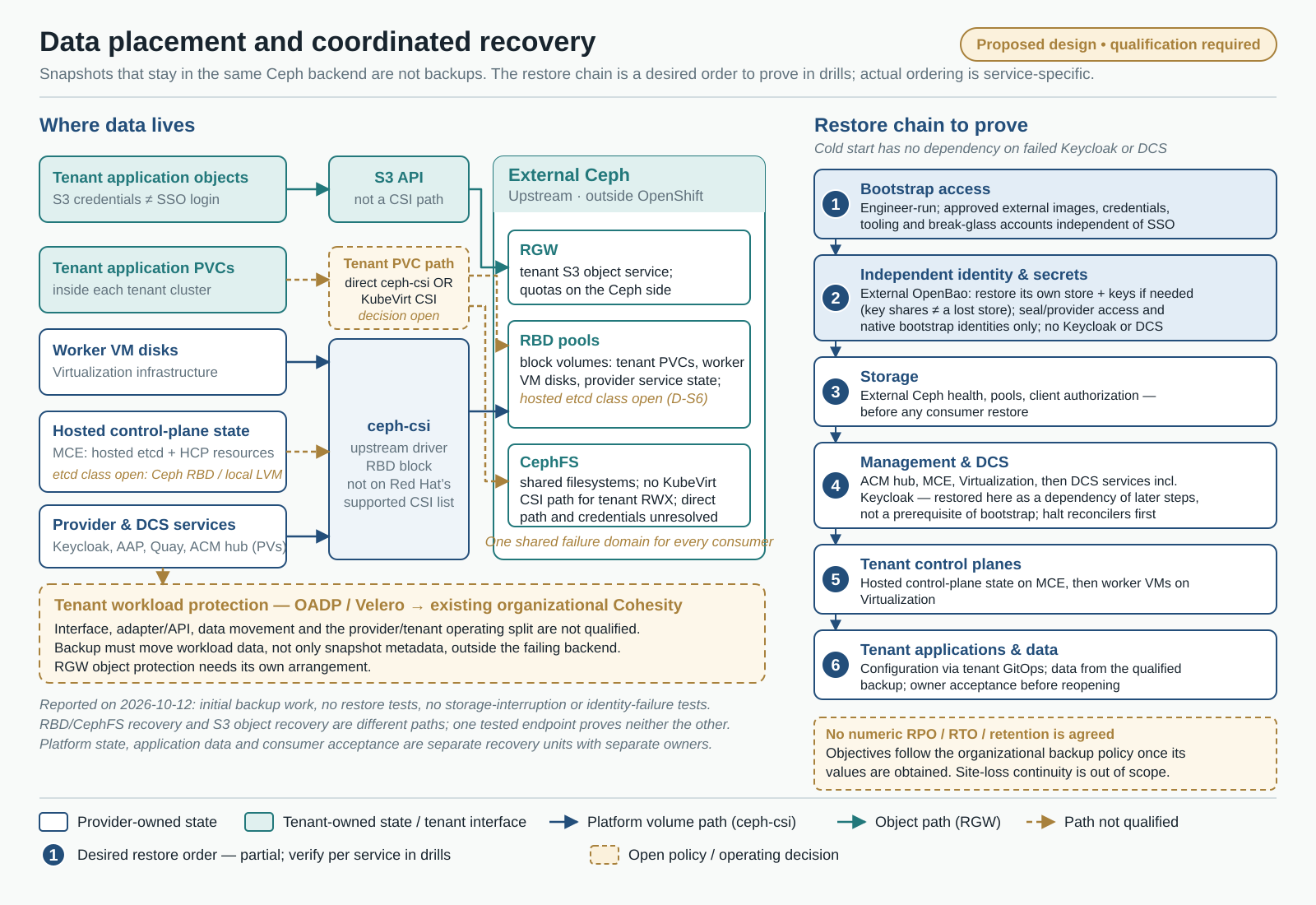
The figure is the shared canonical source ../CLaaS/assets/data-recovery.svg,
also used by the platform design. This HLD does
not own it. The figure shows the tenant-volume path as an open choice. §5
refines it into three options (V1 KubeVirt CSI, V2 direct ceph-csi, V3 ODF), none
of them selected yet. The figure's restore chain starts from bootstrap access and
from identity and secrets that do not depend on Keycloak or DCS. Keycloak is
restored later, as part of DCS. The chain is a desired order to prove in drills,
not a verified procedure. Where the figure and this text differ in detail, this
text applies to this HLD's scope.
Three distinct storage relationships
| Relationship | Consumer | Mechanism | Who holds Ceph credentials |
|---|---|---|---|
| Host infrastructure storage | Provider clusters (MCE, Virtualization, ACM, DCS) | ceph-csi on each provider cluster, against provider pools | Provider cluster operators, through approved secret delivery |
| Worker VM disks and KubeVirt-CSI tenant volumes | Tenant worker root disks, and tenant PVCs if option V1 is chosen | Virtualization cluster's ceph-csi RBD class. The tenant sees KubeVirt CSI. The infrastructure-side upstream ceph-csi support gap (feasibility claim 3) still applies underneath. | Virtualization cluster only. The tenant holds none (S-H3). |
| Direct tenant volumes | Tenant PVCs if option V2 is chosen | ceph-csi installed in the tenant cluster | The tenant cluster holds scoped Ceph client keys |
These relationships must not be merged in qualification. A passing test on one proves nothing about the others (ceph-csi note).
4. Solution Strategy
Map every data unit before choosing tools. Each unit (§5) gets a placement, a protection owner, a restore owner, a consistency model, an off-backend copy requirement, and the keys and catalogue it needs. A tool is accepted for a unit only when it covers that unit's bytes, metadata and restore path.
Keep the volume-path decision explicit. KubeVirt CSI (V1) gives tenants no Ceph credentials and no Ceph reachability, and it is vendor documented for this topology. The infrastructure class underneath it is still upstream ceph-csi, so V1 inherits that support gap (feasibility claim 3). It cannot provide RWX filesystem volumes. Direct tenant ceph-csi (V2) provides CephFS RWX, but gives the tenant cluster Ceph keys, network reach to the Ceph public network (path E), and a support position outside Red Hat's CSI list. ODF in the hosted cluster (V3) is vendor documented, but its external mode is documented against Red Hat Ceph Storage, which conflicts with the recorded upstream choice. The design recommends V1 for RBD-class tenant volumes, because that is the documented least-trust path. This is a recommendation pending decision D-S2, not a selection. It leaves the CephFS mechanism as decision D-S1, with V2 and V3 as the candidates and the CephFS promise kept in the offer. Dropping CephFS from Phase 1 would be a scope change for the proposer to agree. This HLD does not choose that outcome.
Off-backend or it is not a backup. CSI snapshots are local rollback points on the same Ceph cluster. They do not survive loss of that cluster, or loss of the pool or filesystem that holds them, and must not count as backups. A backup counts only when the snapshot data (not only the VolumeSnapshot object) has been moved to a destination outside the AM4 Ceph failure domain. The data mover and its catalogue must be restorable with that Ceph cluster gone.
Keep the backup destination conditional. The selected route is OADP/Velero with Cohesity as destination. It is valid only if Cohesity presents a Velero-compatible object store that both vendors support for the pinned versions (B1). The design describes two alternatives. B2 is Cohesity's own OpenShift integration. It is a vendor-described alternative product path, not a validated drop-in for OADP. Whether it can coexist with OADP on the same cluster, and which controllers and resources (for example Velero instances and CRDs) would conflict, must be qualified. It needs cluster-admin-class access there. B3 is OADP to another supported object store outside the Ceph failure domain. Neither alternative is chosen here (D-S3). No restore guarantee is given before qualification.
Restore in dependency order, from outside the failure. Bootstrap access, secrets and keys must be available without the failed platform. The order then follows the dependency chain: storage health, management clusters, hosted control planes, workers, tenant configuration, tenant data. Owner acceptance comes last. Conflicting reconcilers are paused first.
5. Building Block View
Data units, placement and protection ownership
| Data unit | Where it lives | Protection mechanism (design) | Off-backend copy | Backup owner | Restore initiator / acceptor | Notes |
|---|---|---|---|---|---|---|
| Provider cluster etcd (MCE, Virtualization, ACM, DCS) | Control-plane nodes of each provider cluster | OpenShift etcd backup, per coordinated recovery | Copy to a store outside AM4 Ceph and outside the cluster | Platform operations | Platform operations / recovery coordinator | Must be restorable without that cluster's own GitOps |
| Hosted control-plane state (hosted etcd and HCP namespace resources) | Hosted etcd PVs on MCE (storage class to decide, S-H7) | OADP backup of HCP namespaces on MCE (S-H5) and/or the etcd snapshot method (§9.9 of the HA chapter, not read in detail) | Required | Platform operations | Platform operations | Restore documented only on the same management cluster (S-H5). Whether a rebuilt MCE is an eligible target is not established (R-S4, D-S7). |
| Hosted etcd encryption key | HostedCluster secret on MCE | Exported with the HCP backup and held in OpenBao custody | Required, separate from data | Platform operations | Platform operations | Without it, restored etcd is unreadable |
| Worker VM disks | Virtualization cluster RBD class | Not backed up. Recreated from the NodePool (S-H5). | n/a | — | Platform operations | Tenant data must never sit on root disks |
| Tenant PVC — V1 (KubeVirt CSI) | Virtualization cluster RBD class, surfaced into the tenant | Tenant-cluster OADP with CSI snapshot data movement, or provider-side protection of the backing PVCs | Required | D-S4 | D-S4 | With external infrastructure, the HCP backup does not include KubeVirt-CSI PVC data (S-H5). It needs its own path. |
| Tenant PVC — V2 (direct ceph-csi) | Tenant-scoped RBD pool / CephFS subvolume group | Tenant-cluster OADP with CSI snapshot data movement | Required | D-S4 | D-S4 | Snapshot class and data mover must work with ceph-csi (BQ-2) |
| Tenant S3 objects | RGW buckets on the same Ceph cluster | Not automatically protected by Kubernetes resource or PVC backup. Raw RGW object data sits outside any namespace or PVC that OADP scopes. Protecting it needs a separate object-level path with its own scope: application backup to a separate destination, or an agreed service-side object copy (D-S5). This does not claim that no Velero or OADP plugin could ever copy objects. Any such tool is assessed as that separate path. | Required if promised | Tenant (default) or storage operations (if D-S5 decides so) | Tenant | Object versioning and lock are not off-backend |
| Tenant Kubernetes resources | Tenant etcd (hosted) | Primarily tenant GitOps from the tenant's repository. OADP resource backup for state that is not in Git. | Git is external | Tenant (Git), provider (OADP schedule, D-S4) | Tenant | Git is the source for configuration, not for data |
| DCS service stores (Keycloak DB, AAP DB, Quay DB + blobs, OpenBao if moved to DCS later) | DCS PVs and RGW buckets | Per-service backups with aligned database/blob points (Quay: coordinated recovery) | Required | Each service owner | Each service owner | These units carry the bootstrap and identity dependencies of everything else |
| External OpenBao storage (secret engines, PKI state, policies, auth configuration and retained keys) | The external service's storage backend, not assumed to be AM4 Ceph or Integrated Storage | Backend-appropriate consistent backup and qualified restore; Integrated Storage snapshots only if that is the actual data backend (S-H9) | Required, independent of that backend and available without OpenBao, Keycloak or DCS | External OpenBao service owner in Phase 1 | External OpenBao service owner / recovery coordinator | Restore before retrieving escrowed consumer keys. Shamir shares or auto-unseal recovery shares do not replace the data backup; the external seal provider/key is a separate prerequisite. |
| Ceph cluster configuration (monitor map, auth database, pool and filesystem definitions, RGW realm/zone configuration) | Ceph cluster | Storage operations' own backup | Required | Storage operations | Storage operations | Needed to rebuild client authorization consistently |
| Backup catalogue and keys (Velero BSL configuration, repository password / Kopia key, Cohesity catalogue) | Each protected cluster plus the destination | Escrowed in OpenBao, plus a sealed break-glass copy | Required outside the platform | Backup service owner + platform | Recovery coordinator | Without them, the bytes on the destination cannot be used |
Tenant volume path (decision D-S1)
| Option | RBD-class volumes | CephFS RWX | Tenant trust and reach | Vendor position | Backup implication |
|---|---|---|---|---|---|
| V1 — KubeVirt CSI | RWO Block/File, RWX Block (S-H1) | Not available | No Ceph credentials and no Ceph network reach. Isolation is documented (S-H3). | Documented for HCP on Virtualization. The infrastructure-side ceph-csi is itself outside Red Hat's CSI list (feasibility claim 3), so V1 inherits that support gap. | Excluded from the HCP backup under external infrastructure (S-H5). Needs a tenant-side or infrastructure-side data path. |
| V2 — direct ceph-csi in tenant | Yes | Yes | The tenant cluster holds Ceph client keys and needs path-E reach to monitors, OSDs and MDS. A tenant-admin bypass would expose those keys. | Upstream GA. Not in Red Hat's list. Third-party support policy applies. | Tenant-side OADP with ceph-csi snapshots |
| V3 — ODF in tenant cluster | Yes (ODF feature set) | Documented for internal mode. External mode needs Red Hat Ceph Storage (S-H1, S-H8). | External mode still places Ceph credentials and reach in the tenant cluster | Documented with RHCS. With upstream Ceph: not established. | ODF/OADP path. ODF DR features need extra subscriptions (S-H8). |
Design position.
- RBD-class tenant volumes: V1 is recommended, pending D-S2. It is the documented path that keeps Ceph credentials and reach out of tenant clusters. It follows the security preference of keeping infrastructure credentials on the management side. It does not remove the upstream ceph-csi support gap underneath.
- CephFS for tenants (D-S1): unresolved. V2 meets the recorded upstream intent, with a support gap, at the cost of tenant-held keys and reach. V3 is vendor documented but conflicts with the upstream-Ceph choice and with ODF licence avoidance. Reaching a decision requires BQ-1 (support positions), SQ-3 (credential refusal) and the tenant-isolation result. If V2 is chosen, the per-tenant Ceph identity must be limited to that tenant's CephFS subvolume group and/or RBD pool or RADOS namespace. Network reach must be limited to the Ceph public endpoints. Capacity limits must use the quota mechanisms the backend actually offers for the chosen scope. Ceph pool quotas apply per pool. CephFS limits apply per directory or subvolume. This design has not established a per-RADOS-namespace quota. If tenants share a pool through RADOS namespaces, how their capacity is limited must be decided (SQ-2). Recorded progress mentions RBD automation for the provider. It is not evidence for tenant-side V2.
Object service
RGW provides tenant S3. Its tenant boundary is the RGW account or user, the bucket ownership, the S3 access keys and the RGW quota. It is not the Kubernetes namespace. Human SSO does not grant S3 access. S3 keys are separate credentials, issued per tenant through the approved secret path. Quotas are set by storage operations and changed through the storage request process. Object data protection is a separate contract (D-S5). It is never implied by volume backup. The tenant's own buckets must not be used as backup destinations for that tenant's volumes, because both would sit in the same failure domain.
Backup destination (decision D-S3)
| Option | How it works | Tenant-cluster privilege | Status |
|---|---|---|---|
| B1 — selected intent | OADP/Velero with the built-in data mover (Kopia) writes snapshot data to a Velero backup storage location presented by Cohesity (for example an S3 view) | OADP operator and node-agent in each protected cluster, installed by the provider | Not established. No fetched vendor document supports it. Upstream Velero's "Limitations" section states that the built-in mover uses a static common encryption key, so anyone with destination access can read the data (feasibility claim 5). Applicability to the pinned OADP build is to be confirmed. |
| B2 — Cohesity native | Cohesity registers each cluster as a source and deploys its own data mover (with Velero for metadata) | Cluster-admin-class service account on each protected cluster, held by the backup service | A vendor-described alternative path (Red Hat/Cohesity/HPE, feasibility claim 5), documented only for the versions those sources name. It is not validated for this OCP, Virtualization and Ceph combination, and not a documented drop-in for OADP. Whether it can coexist with an OADP/Velero install on the same cluster is not established. Qualification must set out the exact supported composition, any controller or CRD conflicts, and the privilege it needs. User application namespaces only. Recovery granularity is limited. |
| B3 — other supported object store | OADP to a supported S3 store outside the AM4 Ceph failure domain | Same as B1 | Not selected. Bringing in another destination is a scope decision. |
The cluster-admin implication of B2 matters for tenant clusters. The backup service would then hold full control of every tenant cluster, which has to be weighed in the tenant isolation and identity designs. B1 also gives the provider-owned OADP namespace strong rights in the tenant cluster. Either way, the tenant must not hold credentials for the backup destination.
6. Runtime View
All scenarios are NOT TESTED.
R-S1 Tenant storage onboarding
- An approved request reaches provisioning, under the tenant lifecycle design.
- Storage operations create the tenant's backend scope: a pool or RADOS namespace (V2), a CephFS subvolume group (V2 or V3), and an RGW account or user. Each scope gets the quota mechanism the backend actually supports for it: pool quota, CephFS directory or subvolume quota, or RGW user, account or bucket quota. A RADOS namespace inside a shared pool is not assumed to have its own quota. They issue scoped client identities. Under V1, the tenant needs no Ceph identity of its own. How its capacity on the shared Virtualization backing class is limited is still to be decided and covered by SQ-2.
- Credentials are delivered through OpenBao to the consuming cluster only.
- Storage classes are mapped (V1 via
--infra-storage-class-mapping, S-H2) or installed (V2). The provider configures the backup schedule per D-S4. - Acceptance: SQ-1 to SQ-4 pass for this tenant.
R-S2 Tenant backup (B1 shape)
- The schedule fires. Pre-backup hooks quiesce the application, if the tenant has defined them (§8).
- CSI snapshots are taken. The data mover reads them and writes the data to the destination. Velero writes the resource metadata. After the backup the local snapshot is removed (Velero behaviour, feasibility claim 5).
- The backup is recorded with its identifier, scope, consistency type (crash or application), start and end times, and destination.
- Verification: BQ-3 confirms the data bytes are at the destination, not just the VolumeSnapshot objects.
R-S3 Tenant restore
The tenant (or the provider, per D-S4) requests a restore of a named backup into a namespace the tenant owns. Restore into a namespace it does not own must be refused. Restored PVs are filled by the data mover. The application is started, and the tenant checks integrity and accepts. Restoring into a fresh cluster needs the destination catalogue and keys from escrow.
R-S4 Hosted cluster recovery
Two cases must be kept apart.
(a) Original management cluster still in place. This is the documented case. The MCE cluster that took the backup is still running, and a hosted cluster's control-plane state is lost or damaged. Under S-H5 the state is restored on that same MCE cluster. With external infrastructure, the HCP backup contains no tenant PVC data. Tenant volumes are therefore restored separately (R-S3) after the hosted cluster is healthy. Worker VMs are recreated from the NodePool.
(b) MCE cluster lost and rebuilt, or replaced. Here the fetched sections establish nothing. They do not say whether a rebuilt or replacement management cluster is an eligible restore target. They give no vendor procedure for it. And they do not show that restoring the old cluster's etcd, name, or other identity attributes onto a rebuilt cluster makes it "the same management cluster" for S-H5. Preserving identity by itself is not evidence of compatibility. Until D-S7 is settled, case (b) is a recovery gate. No restore of hosted control-plane state onto a rebuilt or new MCE cluster is attempted or promised unless one of these exists:
- a vendor-documented procedure, or a written support position, for that target; or
- a qualification result (BQ-5 case b) for the exact procedure, together with an explicit, authorized risk acceptance.
Without either, the fallback is to recreate the hosted cluster and restore tenant configuration and data (R-S3). That is a different recovery with different outcomes, and it is recorded as such.
R-S5 Coordinated platform recovery (desired order)
This follows the diagram's restore chain. Each step runs only after the previous step's acceptance check.
- Bootstrap access. An engineer-run environment, approved external images, tooling and break-glass accounts that do not depend on SSO, Quay on DCS or the failed cluster.
- Independent identity and secrets. The external OpenBao owner first establishes service availability and, if its data was lost, restores its own backend from a qualified off-backend copy (the data-unit row above). Unseal uses the selected seal mechanism: Shamir shares, or the available external seal provider and key for auto-unseal; recovery shares do not substitute for that provider. Engineers then authenticate with native bootstrap identities independent of Keycloak and DCS and retrieve the consumer keys. If OpenBao cannot be restored, only separately custodied, verified copies of each required consumer key and catalogue can support a limited recovery path. Missing state or keys stop the affected restore; possessing recovery shares alone does not clear this step. Reconcile restored grants and revocations against current authorized intent before reopening the service.
- Storage. Ceph health, pools and client authorization are verified before any consumer restore. RGW is checked if DCS or tenant objects depend on it.
- Management and DCS. Provider-cluster etcd and DCS services, including Keycloak, are restored with aligned database/blob points. Keycloak is a dependency of later steps, not of steps 1–3. Provider GitOps and AAP are held paused until the restored state is confirmed.
- Tenant control planes. HCP restore on MCE, only where R-S4 allows it: case (a), or case (b) once its gate is cleared. Otherwise hosted clusters are recreated. Workers are recreated on the Virtualization cluster.
- Tenant applications and data. Tenant GitOps reconciles configuration. Data is restored from the qualified backup. The owner accepts before the service reopens.
Failure scenarios
| ID | Failure | Design behaviour | What survives / what does not |
|---|---|---|---|
| F-S1 | One Ceph OSD host lost | Ceph redundancy (as configured by storage operations) keeps data available. Recovery traffic contends with clients. | Survives only if the replication or erasure-coding layout matches the failure domain. The layout is not yet supplied. |
| F-S2a | Whole Ceph cluster lost or corrupted | Correlated, global failure. All consumers fail together: provider PVs, hosted etcd (if on Ceph), worker disks, tenant PVCs, RGW. | All in-cluster snapshots are lost. Only off-backend backups survive. Hosted etcd on local LVM storage (S-H7) would decouple control-plane state. |
| F-S2b | One pool (or one CephFS filesystem) lost or corrupted | Only the consumers whose data is in that pool fail. Snapshots stored in it are lost too. Other pools are not automatically lost, but must be checked for shared causes (for example the same faulty OSDs or CRUSH rule). | Consumers and snapshots in other pools survive, unless the cause also affects them. For CephFS, losing either the metadata pool or a data pool can make the whole filesystem, or the files whose data is in that pool, unavailable. The assessment therefore covers the metadata pool and all data pools that back each filesystem and subvolume group. The pool-to-consumer mapping is a storage-operations input that has not yet been supplied. |
| F-S3 | Tenant deletes its own data | Restore from backup (R-S3) | Up to the last backup. Local snapshots may help if they still exist. |
| F-S4 | Ransomware or credential misuse in a tenant | Tenant-held keys (V2, S3) can delete that tenant's backend data | Backups survive only if the destination is unreachable and undeletable with tenant or cluster credentials (SQ-5) |
| F-S5 | MCE cluster lost | Hosted APIs are down. S-H4 states that the hosted data plane stays available. API-dependent workloads, restarts and new scheduling are not covered by that statement. | Restoring HCP state onto a rebuilt MCE is gated (R-S4 case b, D-S7). Without a cleared gate, hosted clusters are recreated. |
| F-S6 | Cohesity unavailable | Backups fail and alert. Existing data is unaffected. | No new recovery points. The gap is reported against policy. |
| F-S7a | OpenBao unreachable or sealed, data intact | Consumer keys cannot yet be retrieved | Repair availability and use the selected seal path; auto-unseal still needs its external seal provider/key. Shares alone do not repair a network or service outage. |
| F-S7b | OpenBao storage lost or corrupted | Its secrets, PKI and auth state are lost | Restore the service owner's consistent off-backend backup plus the required seal material/provider. Reconcile stale grants and revocations before serving. |
| F-S7c | No usable OpenBao data backup or seal path | Full secret-service recovery is not demonstrated | Only independently custodied copies of each required consumer key/catalogue can permit a scoped restore. Anything missing blocks that consumer; these copies do not recreate the complete OpenBao service. |
| F-S8 | AM4 site lost | Out of scope for Phase 1. No continuity promised. | Only data whose backups are outside AM4 survives. Whether Cohesity storage is outside AM4 is not established. |
Reclaim and deletion safeguards
-
Reclaim policy (decision D-S9). No reclaim policy has been agreed for any tenant or provider storage class. Kubernetes uses
Deletefor dynamically provisioned volumes when a class sets nothing. That is a platform default, not a chosen service behaviour, and this design does not adopt it. The policy is set explicitly per class, asDeleteorRetain, by decision D-S9. Whatever is chosen, these gates apply before any destructive step. A PVC that holds stateful tenant data is deleted only after a backup of it has been verified restorable (BQ-3 evidence, or a per-volume verification), or after the data owner explicitly accepts its loss. UnderDelete, removing the PVC removes the backend volume. Only an off-backend backup restores it. UnderRetain, the released PV and its backend volume remain until cleaned up, and they need an owner and a disposal step. -
Retention and legal hold. Backup retention, data retention and any legal hold that may apply to a tenant's data are unknown. They have not been obtained from the policy owner, and no values or exemptions are invented here (D-S8). Until they are known, no backup, retained PV or backend data is disposed of on the assumption that no retention or hold applies.
-
Ordering at retirement (tenant retirement).
- Stop tenant reconciliation and backup schedules that could recreate or change resources.
- Confirm the final backup, verify that it is restorable, and complete any export that the retention and disposition decision (D-S8) requires.
- Remove tenant interactive access. Revoke the tenant's own S3 keys and the tenant-administrator access to the cluster and to any Ceph identity it could use. That stops further tenant reads, writes and deletes.
- Keep a provider cleanup identity. The provider-held CSI driver identity, or a separate provider cleanup identity, is scoped to the retiring tenant's backend scope and held only by the provider. It stays valid so that the CSI driver can delete PVs and snapshots and storage operations can remove the scope. Revoking it first would leave orphaned backend volumes and snapshots behind. Under V2/V3 the in-cluster Ceph key may have been readable by tenant administrators. In that case the key is replaced by a fresh provider-only cleanup identity with the same scope before it is revoked, or the cleanup runs from the storage-operations side.
- Delete, or dispose of as D-S8 decides, the tenant workloads, PVCs, VolumeSnapshots and retained PVs. Data that D-S8 requires to be kept is moved to, or left in, its authorized retention location first. The tenant's data is not deleted wholesale.
- Read back from the backend that no images, snapshots, subvolumes, buckets or objects of the tenant's scope remain, except those retained under D-S8. Only after that readback does storage operations delete the tenant backend scope (pool or namespace, subvolume group, RGW account).
- Then revoke the provider cleanup identity and the remaining tenant-scoped Ceph identities, and verify the revocation.
- Keep backups for the retention period under a separately authorized access boundary, then dispose of them as the policy says.
If cleanup fails or the readback is incomplete, the tenant stays in a recorded pending-cleanup state. Its backend scope, names and allocations are not reused for another tenant until cleanup has been completed and verified.
-
Restore safety. A restore must not overwrite live data unless explicitly confirmed. Restoring into a shared HCP namespace can change other hosted clusters (S-H5): use one namespace per hosted cluster.
-
Shared-backend safety. Storage-side deletion of a pool, namespace or subvolume group requires a check that it is owned by the retiring tenant and has no other consumers.
7. Deployment View
| Location | Storage components |
|---|---|
| External upstream Ceph (AM4, Ceph role nodes) | MON/MGR/OSD, MDS for CephFS, RGW. Provider, Virtualization and tenant scopes kept separate by pool, namespace or subvolume group and Ceph identity. |
| Each provider cluster | ceph-csi (RBD, and CephFS where a provider consumer needs it). OADP if that cluster is protected through OADP. |
| MCE cluster | Hosted etcd PVs (storage class to decide: Ceph RBD or local LVM, D-S6). OADP for HCP namespaces. |
| Virtualization cluster | RWX Block RBD class for VM root disks and KubeVirt-CSI mapping (S-H2). Snapshot class mapping for KubeVirt CSI. |
| Each tenant cluster | KubeVirt CSI classes if D-S2 selects V1 (recommended, not yet selected). ceph-csi or ODF only if D-S1/D-S2 select V2 or V3. Backup agent per D-S3/D-S4 (OADP data mover for B1/B3, Cohesity components for B2). |
| Organizational Cohesity | Backup destination. Location relative to AM4 is unknown. |
| OpenBao (external) | Escrow for backup keys, hosted etcd keys, Ceph client keys and S3 keys |
The hardware note records the Ceph node role and its adapters. Cluster count, daemon placement and capacity are not recorded and are not invented here. Storage traffic uses path E in the network design. Under V2, path E must reach tenant workers. Under V1 it does not.
8. Crosscutting Concepts
Consistency and recovery points
- Crash-consistent is the default for a CSI snapshot. Many databases recover from it, but that must be checked for each application.
- Application-consistent needs quiescence: pre/post backup hooks that flush or freeze writes, or an application-native dump. The tenant owns the hook definitions for its applications. The provider owns the hook mechanism. The representative stateful workload in workload protection must demonstrate one such contract.
- Multi-volume and multi-service consistency. Snapshots of separate PVCs are not atomic across volumes unless volume-group snapshots are used and supported. Those were not assessed. DCS services that combine a database and object blobs (Quay) need aligned points, as coordinated recovery describes.
- S3 objects have no snapshot point in this design. Their consistency with related PVC data is an application concern.
Objectives and policy
RPO, RTO and retention come from the organizational backup policy, whose reference, version and values have not been obtained. Until they are, the design records unknown, not a placeholder number. Backup schedules and retention settings must be derived from the policy values once they are known. A backup job succeeding does not show that a policy objective is met. Only a measured restore does.
Snapshots, replication and backups
| Mechanism | What it protects against | What it does not protect against |
|---|---|---|
| CSI snapshot (same Ceph) | Logical mistakes, fast rollback | Ceph cluster loss, loss of the pool or filesystem holding the snapshot, credential misuse that deletes snapshots |
| Ceph replication or erasure coding | Disk or host failure inside the cluster | Logical deletion, corruption that replicates, cluster loss |
| RGW multisite (prepared, not active) | Nothing in Phase 1 | — |
| Off-backend backup (qualified) | Cluster loss, deletion, corruption, ransomware (if the destination is protected) | Loss of keys or catalogue, unqualified restore |
Credentials and keys
| Secret | Holder | Must not be held by |
|---|---|---|
| Ceph admin key | Storage operations | Any cluster, any tenant |
| Provider ceph-csi identities | Each provider cluster, scoped to its pools | Tenants |
| Tenant Ceph identity (V2/V3 only) | That tenant cluster, scoped to its own pool, namespace or subvolume group | Other tenants |
| Provider cleanup identity for a retiring tenant | Provider only (CSI driver or storage operations), scoped to that tenant's backend scope | Tenants. Revoked only after the cleanup readback (§6 retirement ordering). |
| Tenant S3 keys | That tenant | Other tenants. Not reused as backup credentials. |
| Backup destination credential | Provider OADP (B1/B3) or the Cohesity service (B2) | Tenant administrators |
| Backup repository encryption key | Escrow (OpenBao and break-glass) | Tenants. Note that the Velero built-in data mover uses a static common key (feasibility claim 5), so destination access control is the compensating control. |
| Hosted etcd encryption key | MCE plus escrow | Tenants |
Rotation and revocation at retirement are required for every tenant-scoped secret. At retirement, tenant interactive access is revoked first. Provider cleanup identities are revoked last, after the backend readback.
9. Architectural Decisions
| ID | Decision | Status | Options and consequence | Decider (proposed) |
|---|---|---|---|---|
| D-S0 | Upstream Ceph with ceph-csi instead of ODF; RBD, CephFS and S3 offered; OADP to Cohesity; policy-driven objectives | Recorded | — | Proposer |
| D-S1 | Tenant CephFS mechanism | Open | V2 (upstream, tenant keys and reach, support gap) or V3 (ODF, RHCS needed for external mode). Removing CephFS from Phase 1 would be a scope change. | Proposer, with storage and security |
| D-S2 | Tenant RBD-class volume path | Open; V1 recommended, not selected | V1 documented least-trust, but inherits the infrastructure-side upstream ceph-csi support gap. V2 only if D-S1 selects it for all volumes. | Platform + security |
| D-S3 | Backup destination path | Recorded intent B1, conditional | B1 stays if BQ-1 and BQ-3 pass. Otherwise choose B2 (vendor-described alternative path; cluster-admin-class access; composition with or without OADP to qualify) or B3 (new destination). | Proposer, with backup service owner |
| D-S4 | Backup and restore operating split | Open | Who defines schedules and hooks, who starts restores, who accepts | Proposer + operations |
| D-S5 | S3 object protection | Open | Tenant-owned application backup, or a service-side copy outside the Ceph failure domain | Proposer + storage |
| D-S6 | Hosted etcd storage class on MCE | Open | Ceph RBD (shared failure domain) or local LVM (vendor-suggested for latency, S-H7) | Platform |
| D-S7 | Recovery of a hosted cluster when MCE is rebuilt or replaced | Open; recovery gate | Restoring HCP state onto a rebuilt or new MCE is allowed only with a vendor procedure or support position, or with a BQ-5 case (b) qualification plus authorized risk acceptance. Preserving the old MCE identity alone is not evidence. Otherwise hosted clusters are recreated and tenant data is restored (R-S3). | Platform; risk acceptance by an authority not yet recorded |
| D-S8 | Retention, legal hold and disposition at retirement | Open; follows policy; values unknown | — | Policy owner |
| D-S9 | Reclaim policy per storage class | Open | Delete or Retain, set explicitly per class. The Kubernetes default is not adopted implicitly. The §6 destructive gates apply either way. |
Platform + storage + data owners |
10. Quality Requirements
All tests are NOT TESTED. Each pass needs retained evidence: environment, versions, configuration revision, data identifiers and results.
| ID | Quality | Scenario and pass criterion |
|---|---|---|
| BQ-1 | Supportability | Written positions from Red Hat and Cohesity on: OADP to a Cohesity S3 view (B1); Cohesity native on HCP tenant clusters, including whether it can coexist with OADP and what privilege it needs (B2); ceph-csi in tenant clusters (V2) and on the Virtualization cluster underneath V1; ODF external mode against upstream Ceph (V3). Record the outcome per item: supported (vendor statement) or gap accepted (a risk exception by an authorized party, which is not support). Also confirm whether the static-key limitation applies to the pinned OADP build. |
| BQ-2 | Data movement | On a non-production tenant, back up a PVC-bearing app for each volume path in use (V1 and, if chosen, V2 RBD and CephFS). Pass: the data bytes are present at the destination, independent of the source Ceph. |
| BQ-3 | Off-backend restore | Delete the namespace and its in-cluster snapshots. Restore into a fresh tenant cluster using only escrowed keys and the catalogue. Pass: the application starts and a checksum matches. |
| BQ-4 | Application consistency | Representative database with pre/post hooks. Pass: the restore is consistent without crash recovery, or the documented recovery succeeds. |
| BQ-5 | HCP recovery | Case (a), original MCE in place: back up a hosted cluster, destroy its control-plane state, and restore it on the same, never-rebuilt MCE cluster (S-H5). Pass: control plane healthy, workers recreated, tenant volumes restored separately (R-S3), tenant accepts. Case (b), rebuilt or new MCE: run only once a vendor procedure or support position exists, or as an explicit qualification for a risk-acceptance decision. Rebuild or replace the MCE cluster by the documented procedure under test, then restore the backup from case (a) onto it. Pass: the same criteria as case (a), the vendor procedure (if any) followed exactly, and no other hosted cluster affected. A case-(a) pass says nothing about case (b). |
| BQ-6 | Measured objectives | Once policy values exist, measure the restore time and the data loss window against them. Pass only by measurement. |
| BQ-7 | External OpenBao recovery | In an authorized isolated environment, restore the actual backend from its off-backend backup with the qualified seal path. Recover representative secret/PKI/auth state and consumer escrow keys, then reconcile revoked identities against current intent before enabling access. Separately prove the limited per-key break-glass path with OpenBao unavailable. No live destructive test is authorized by this scenario. |
| SQ-1 | Volume isolation (V1) | From a tenant, attempt to bind or access a PV belonging to another tenant's infrastructure namespace. Pass: refused. |
| SQ-2 | Quota | Exceed the capacity limit for RBD, CephFS and RGW in turn, using the mechanism actually configured for each tenant scope (pool, CephFS subvolume or directory, RGW user/account/bucket, or the V1 limit). Pass: each limit refuses at its own boundary, and one tenant's usage cannot exhaust another tenant's scope. If a scope has no backend quota mechanism (for example a RADOS namespace in a shared pool), the test records that, and how capacity is bounded is a decision instead. |
| SQ-3 | Credential refusal (V2/V3) | With the in-cluster Ceph identity, read or list another tenant's pool, namespace or subvolume group, and the provider pools. Pass: Ceph capabilities refuse. |
| SQ-4 | S3 isolation | With tenant S3 keys, list or read another tenant's bucket. Pass: refused. SSO tokens grant no S3 access. |
| SQ-5 | Backup tamper resistance | With tenant-admin and with tenant S3 or Ceph credentials, read, delete or overwrite backups at the destination. Pass: refused. Restore into a namespace the tenant does not own is refused. |
| SQ-6 | Retirement | Retire a test tenant in the §6 order. Pass: tenant access is refused from step 3. The provider cleanup identity removes PVs and snapshots. The backend readback shows no residual images, snapshots, subvolumes or objects, apart from data retained by decision. The scopes are removed, and only then are the remaining identities revoked. Backups are kept under policy, and no other tenant's or provider's data is touched. An injected cleanup failure leaves the tenant in pending-cleanup, with no reuse of its scope. |
| SQ-7 | Failure | Take one Ceph host down while volumes are mounted. Drain a Virtualization node with V1 volumes (live migration). Pass: behaviour matches the agreed service promise. |
11. Risks and Technical Debt
| Risk | Effect | Treatment |
|---|---|---|
| B1 unsupported or not working | No off-backend tenant backup | BQ-1 early. Alternatives B2/B3. Decision D-S3. |
| KubeVirt-CSI PVC data excluded from HCP backup under external infrastructure (S-H5) | A silent gap if the HCP backup is assumed to cover tenant data | Separate tenant-volume protection path. BQ-2. |
| CephFS for tenants requires tenant Ceph keys (V2) or an RHCS-dependent product (V3) | Security or support conflict with recorded choices | D-S1 with SQ-3 and BQ-1 evidence |
| One Ceph failure domain for all consumers | Correlated loss of provider, control-plane and tenant data | Off-backend backups. D-S6 for hosted etcd. Escrowed keys. |
| Static Velero data-mover key (upstream "Limitations"; OADP build to confirm) | Anyone with destination access can read backups | Destination access control. SQ-5. BQ-1 confirms applicability. |
| Cohesity location relative to AM4 unknown | A site loss might also destroy the backups | Confirm with the backup service owner |
| HCP restore documented only for the same management cluster | After an MCE rebuild, restoring hosted control-plane state may be unavailable. Hosted clusters may then have to be recreated. | D-S7 gate. BQ-5 case (b). |
| Reclaim policy and retirement cleanup | Implicit Delete or premature credential revocation could destroy data that should be kept, or leave orphaned backend data |
D-S9, §6 retirement ordering, SQ-6 |
| Retention and legal-hold requirements unknown | Disposal could breach an unknown obligation | D-S8. No disposal on assumption. |
| No restore tests to date | Recovery capability unproven | BQ-3 before reliance |
| Policy values unknown | Schedules and retention cannot be set or assessed | Obtain the policy |
| Snapshots misreported as backups | False assurance | §8 table. BQ-3 deletes snapshots before restore. |
12. Glossary
| Term | Meaning here |
|---|---|
| Data unit | A set of state with one protection and restore contract (§5) |
| Off-backend copy | Backup data held outside the AM4 Ceph failure domain, restorable without it |
| V1/V2/V3 | Tenant volume path options: KubeVirt CSI, direct ceph-csi, ODF in tenant |
| B1/B2/B3 | Backup destination options: OADP→Cohesity, Cohesity native, OADP→other store |
| Data mover | The component that reads snapshot data and writes it to the destination (Velero built-in Kopia mover or Cohesity's mover) |
| Crash-consistent | The state equivalent to a sudden power loss |
| Application-consistent | The state captured after the application has quiesced or flushed |
| External infrastructure | HCP mode where worker VMs run on a cluster separate from the control plane (S-H5) |
| Escrow | Controlled storage of recovery keys outside the system they unlock |
Decision and qualification matrix
| Item | Selected intent | Evidence status (2026-10-21) | Required decision | Qualification test | Blocking for |
|---|---|---|---|---|---|
| Backend | Upstream Ceph | Upstream. Backend features proposed, readiness unknown. | — | Backend acceptance in Ceph clusters | All storage |
| Provider volumes | ceph-csi | Upstream GA. Not in Red Hat's CSI list. | Support acceptance | BQ-1, provider RBD tests | Provider roles |
| Tenant RBD-class volumes | ceph-csi (recorded); V1 recommended, not selected | V1 documented (S-H1, S-H3). It inherits the upstream ceph-csi support gap underneath. | D-S2 | SQ-1, BQ-2, BQ-1 | Tenant storage acceptance |
| Tenant CephFS | ceph-csi CephFS | V1 lacks RWX FS. V2 support gap. V3 needs RHCS for external mode (S-H8). | D-S1 | BQ-1, SQ-3, BQ-2 | CephFS offer |
| Tenant S3 | RGW | Deployment and usable tenant access not established; isolation unverified. | D-S5 | SQ-4, SQ-2 | S3 offer |
| Tenant backup | OADP → Cohesity | Not established (feasibility claim 5) | D-S3, D-S4 | BQ-1, BQ-2, BQ-3, SQ-5 | Workload protection acceptance |
| HCP state recovery | Not recorded | Documented on the same management cluster only (S-H5). A rebuilt or new MCE target is not established. | D-S6, D-S7 (gate) | BQ-5 cases (a) and (b) | Coordinated recovery |
| Provider and DCS recovery | Per service | Not tested | Owners per unit | Recovery drill | Coordinated recovery |
| Objectives | Organizational policy | Values unknown | Obtain policy | BQ-6 | Any objective claim |
| Retirement | Approved complete | Procedure undefined. Retention and legal-hold values unknown. | D-S8, D-S9 | SQ-6 | Tenant retirement |
Explore this note’s relationships 16 connected notes
Connections are authored references and declared relationships, not verified runtime dependencies or approval.
No notes match these filters. Reset filters to show the whole graph.
Drag to pan. Use arrow keys to pan, + / − to zoom, and 0 to fit. Select notes or relationships in the list below for a keyboard alternative.
Every note and relationship is available in the list below. The interactive map requires JavaScript.
Notes and relationships Accessible list
Notes (17)
- CLaaS tenant lifecycle design — request, provisioning, change and retirementHLD · draft · Automation. Icon: Automation
- CLaaS — Clusters-as-a-Service: first production offeringNote · draft · CLaaS. Icon: General note
- CLaaS platform design — service planes, hosting and failure boundariesHLD · draft · CLaaS. Icon: General note
- CLaaS technical feasibility evidence registerResearch · draft · CLaaS. Icon: General note
- Approved complete tenant retirementNote · draft · CLaaS. Icon: General note
- Datacenter hardwareNote · draft · Hardware. Icon: General note
- Identity and trust design for CLaaSHLD · draft · Identity. Icon: Identity
- CLaaS tenant network designHLD · draft · Network. Icon: Network
- Cohesity DataProtect — organizational backup destinationSBB · draft · Recovery. Icon: Recovery
- Coordinated recovery and service restorationNote · draft · Recovery. Icon: Recovery
- Tenant workload protection — platform-provided backupNote · draft · Recovery. Icon: Recovery
- SAK applicability and control allocation for CLaaSNote · draft · Security. Icon: General note
- Tenant isolation and provider-control protectionHLD · draft · Security. Icon: General note
- Ceph clustersSBB · draft · Storage. Icon: Storage
- External Ceph through ceph-csiSBB · draft · Storage. Icon: Storage
- CLaaS storage and data-recovery designHLD · draft · Storage. Icon: Storage
- Ceph RGW — tenant S3 object serviceSBB · draft · Storage. Icon: Storage
Relationships (31)
- CLaaS tenant lifecycle design — request, provisioning, change and retirementReferences →CLaaS storage and data-recovery designAutomation/tenant-lifecycle-design.md · Markdown link
- CLaaS — Clusters-as-a-Service: first production offeringReferences →CLaaS storage and data-recovery designCLaaS/index.md · Markdown link
- CLaaS platform design — service planes, hosting and failure boundariesReferences →CLaaS storage and data-recovery designCLaaS/platform-design.md · Markdown link
- CLaaS technical feasibility evidence registerReferences →CLaaS storage and data-recovery designCLaaS/technical-feasibility.md · Markdown link
- Identity and trust design for CLaaSReferences →CLaaS storage and data-recovery designIdentity/identity-trust-design.md · Markdown link
- CLaaS tenant network designReferences →CLaaS storage and data-recovery designNetwork/claas-network-design.md · Markdown link
- SAK applicability and control allocation for CLaaSReferences →CLaaS storage and data-recovery designSecurity/sak-assurance.md · Markdown link
- Ceph clustersReferences →CLaaS storage and data-recovery designStorage/ceph-clusters.md · Markdown link
- External Ceph through ceph-csiReferences →CLaaS storage and data-recovery designStorage/external-ceph-csi.md · Markdown link
- CLaaS storage and data-recovery designDepends on →Coordinated recovery and service restorationStorage/storage-recovery-design.md · depends_on
- CLaaS storage and data-recovery designDepends on →Tenant workload protection — platform-provided backupStorage/storage-recovery-design.md · depends_on
- CLaaS storage and data-recovery designDescribes →Cohesity DataProtect — organizational backup destinationStorage/storage-recovery-design.md · describes
- CLaaS storage and data-recovery designDescribes →Ceph clustersStorage/storage-recovery-design.md · describes
- CLaaS storage and data-recovery designDescribes →External Ceph through ceph-csiStorage/storage-recovery-design.md · describes
- CLaaS storage and data-recovery designDescribes →Ceph RGW — tenant S3 object serviceStorage/storage-recovery-design.md · describes
- CLaaS storage and data-recovery designReferences →CLaaS tenant lifecycle design — request, provisioning, change and retirementStorage/storage-recovery-design.md · Markdown link
- CLaaS storage and data-recovery designReferences →CLaaS — Clusters-as-a-Service: first production offeringStorage/storage-recovery-design.md · Markdown link
- CLaaS storage and data-recovery designReferences →CLaaS platform design — service planes, hosting and failure boundariesStorage/storage-recovery-design.md · Markdown link
- CLaaS storage and data-recovery designReferences →CLaaS technical feasibility evidence registerStorage/storage-recovery-design.md · Markdown link
- CLaaS storage and data-recovery designReferences →Approved complete tenant retirementStorage/storage-recovery-design.md · Markdown link
- CLaaS storage and data-recovery designReferences →Datacenter hardwareStorage/storage-recovery-design.md · Markdown link
- CLaaS storage and data-recovery designReferences →Identity and trust design for CLaaSStorage/storage-recovery-design.md · Markdown link
- CLaaS storage and data-recovery designReferences →CLaaS tenant network designStorage/storage-recovery-design.md · Markdown link
- CLaaS storage and data-recovery designReferences →Cohesity DataProtect — organizational backup destinationStorage/storage-recovery-design.md · Markdown link
- CLaaS storage and data-recovery designReferences →Coordinated recovery and service restorationStorage/storage-recovery-design.md · Markdown link
- CLaaS storage and data-recovery designReferences →Tenant workload protection — platform-provided backupStorage/storage-recovery-design.md · Markdown link
- CLaaS storage and data-recovery designReferences →SAK applicability and control allocation for CLaaSStorage/storage-recovery-design.md · Markdown link
- CLaaS storage and data-recovery designReferences →Tenant isolation and provider-control protectionStorage/storage-recovery-design.md · Markdown link
- CLaaS storage and data-recovery designReferences →Ceph clustersStorage/storage-recovery-design.md · Markdown link
- CLaaS storage and data-recovery designReferences →External Ceph through ceph-csiStorage/storage-recovery-design.md · Markdown link
- CLaaS storage and data-recovery designReferences →Ceph RGW — tenant S3 object serviceStorage/storage-recovery-design.md · Markdown link